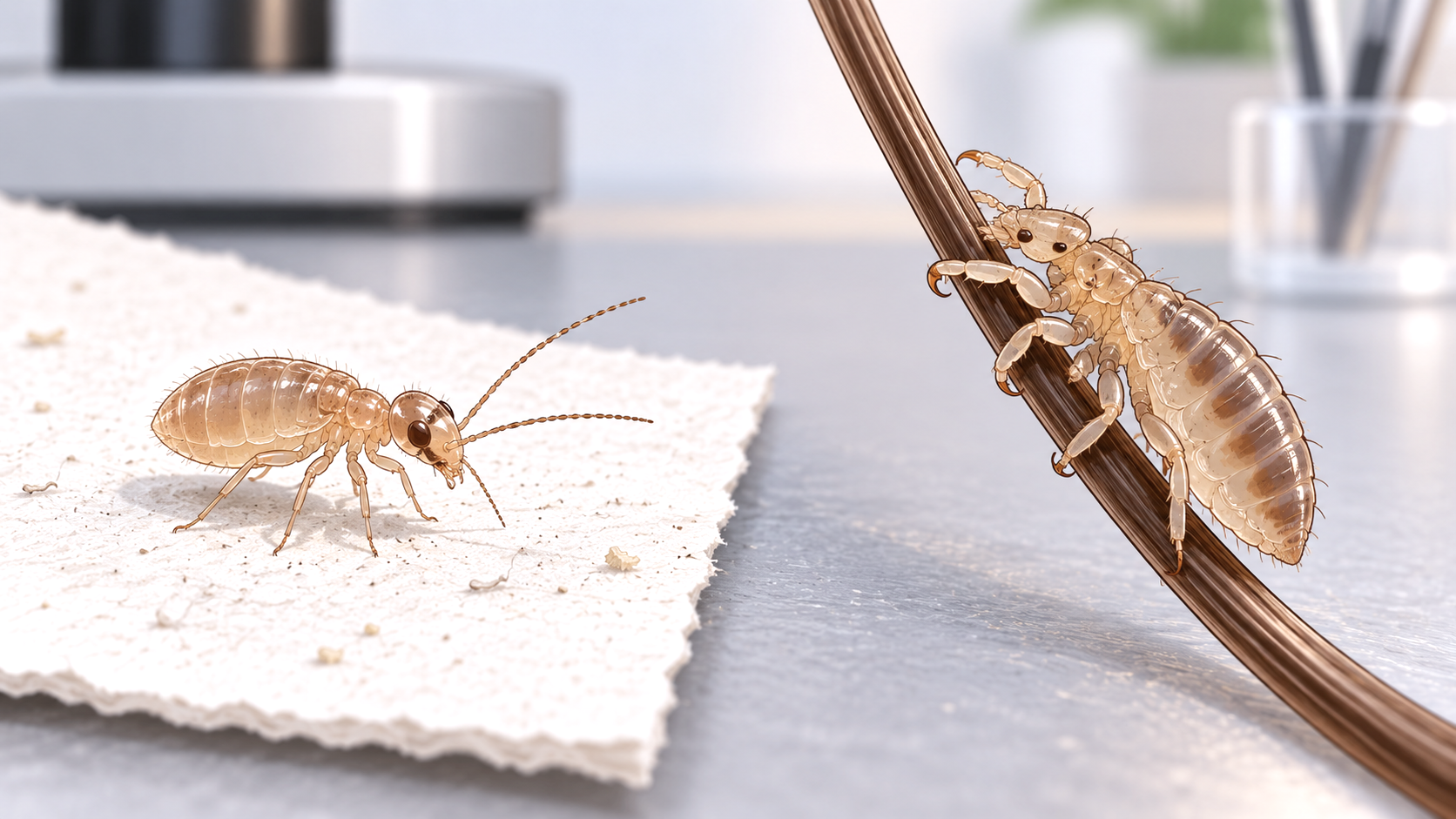
The word “lice” makes booklice sound much more concerning than they are. A booklouse found near your bed, clothes, or bathroom is not a human louse looking for a host. Booklice and human lice have fundamentally different feeding habits and habitats, and the distinction becomes especially clear when head lice are involved.
Booklice are tiny, free-living insects that feed mainly on mold and fungi in humid environments. Head lice are parasites that live on the human scalp and feed on blood. Booklice do not bite, infest people, or attach eggs to hair. Head lice live among scalp hair, have legs adapted for gripping hair, and cement their eggs, called nits, to hair shafts. Where the insect is consistently living is therefore one of the strongest clues. Booklice belong in the environment. Head lice belong on a human host.
Booklice vs. Head Lice at a Glance
FeatureBookliceHead LiceTypical adult sizeCommonly 1–2 mmAbout 2–3 mmLifestyleFree-livingHuman parasiteMain foodMold, fungi and other suitable organic materialHuman bloodLives on scalpNoYesBites peopleNoYesEggs attached to hairNoYesAntennaeLong and slenderShorter relative to bodyBodySoft, relatively large headFlattened, adapted for living among hairLegsOrdinary walking legsEquipped with claws for gripping hairCommon locationDamp books, cardboard, cupboards, stored materialsScalp hair, particularly near the scalpMain control issueMoistureTreating an infested person
This comparison becomes even clearer once you stop treating “lice” as one type of insect. Several very different insects carry that word in their common names.
Booklice Are Not True Human Lice
Booklice are psocids. Common indoor booklice belong to the family Liposcelididae, within the order Psocodea. Many of the booklice found inside buildings are species of Liposcelis.
Human lice are parasitic insects specialized for living on people. The three forms affecting humans are head lice, body lice, and pubic lice. Head lice are Pediculus humanus capitis, while pubic lice belong to a different genus and species, Pthirus pubis.
Interestingly, modern classification places booklice and parasitic lice within the broader order Psocodea. That evolutionary relationship does not make booklice parasites. Their lifestyles are radically different.
The everyday distinction is simpler than the taxonomy. Booklice are harmless environmental insects, while human lice survive by feeding on human blood. Knowing the scientific classification of booklice helps explain why the shared word “lice” should not be interpreted as shared behavior.
Head Lice Live on People, but Booklice Do Not
Habitat is one of the quickest ways to separate them.
Head lice usually live on the scalp among human hair. They are highly specialized for that environment and spread primarily through direct hair-to-hair contact with an infested person. The CDC identifies the scalp as the normal habitat of head lice.
Booklice have no reason to remain on a human head. They live in the environment, particularly in warm, damp, relatively undisturbed places where mold and fungi grow. They may occur around books, paper, cardboard, cupboards, stored foods, plumbing, wall voids, and other humid locations.
A booklouse could accidentally crawl onto a person just as another tiny household insect could, but it cannot establish a head-lice infestation. Persistent insects moving among scalp hairs deserve an identification based on head lice and other organisms associated with hair rather than an assumption that damp-room booklice have moved onto the body.
This is why finding booklice in hair has a very different meaning from finding actual head lice.
Head Lice Are Larger Than Most Booklice
Size helps, although the ranges are close enough that it should not be your only test.
Common indoor booklice are generally around 1 to 2 millimeters long. Head lice are somewhat larger as adults, measuring roughly 2 to 3 millimeters, about the size of a sesame seed. The CDC’s head lice identification information gives this 2-to-3-millimeter adult range.
Young head lice are smaller. A newly hatched head louse is called a nymph and can be around the size of a pinhead. This creates more potential for confusion with an adult booklouse than a comparison involving mature head lice.
Size is therefore useful but not decisive. If you are examining a tiny specimen, its body shape, legs, location, and the presence or absence of nits provide stronger evidence. The actual size of booklice is still worth establishing before comparing magnified photographs.
Booklice Have Long, Slender Antennae
A close look at the front of the insect reveals an important difference.
Booklice have conspicuous, long, threadlike antennae. Their heads are also broad relative to the thorax, with a prominent clypeus that contributes to the characteristic large-headed appearance. These features are useful when identifying what a booklouse looks like.
Head lice have a different silhouette. Their antennae are much shorter relative to their bodies, and their legs are conspicuous because they are specialized for gripping hair.
A blurry photograph may hide these differences. If possible, capture the insect and examine it with a hand lens or take a sharp macro photograph. The contrast between the long antennae of a booklouse and the gripping legs of a head louse becomes much easier to see with adequate magnification.
Head Lice Have Claws Built for Holding Hair
Head lice are adapted to spend their lives moving through human scalp hair. Each adult has six legs equipped with claws that help it grasp hair shafts.
That gripping anatomy makes sense for a parasite that would otherwise be easily dislodged from its host. The CDC describes adult head lice as six-legged insects with claws and notes that their legs are adapted for clinging to hair.
Booklice have six legs too, but they are not specialized to live attached to human hair. Their legs carry them across paper, wood, walls, stored materials, and other surfaces in their environment.
This difference is more informative than simply asking whether the insect has six legs. Both do. What those legs are adapted to do is different.
Booklice Do Not Bite People
This is the most important biological difference if you are worried about something living on your body.
Booklice do not feed on blood. They do not bite people and are not disease vectors. Indoors, they feed primarily on mold and fungi, although some species also consume grains, insect fragments, and other suitable starchy material.
Head lice must feed on human blood to survive. Bites can cause itching because some people develop an allergic reaction to louse saliva. The CDC identifies itching as the most common symptom of head lice, although someone with a first infestation may not develop itching immediately.
Therefore, finding booklice somewhere in the house does not explain an itchy scalp. If the question is specifically whether booklice bite, the answer is no.
Head Lice Eggs Are Glued to Hair
Egg location is one of the clearest distinctions between booklice and head lice.
Head louse eggs are called nits. Female head lice cement them firmly to individual hair shafts near the scalp. The eggs are tiny, approximately 0.8 by 0.3 millimeters, and viable nits are generally found close to the scalp. They can be mistaken for dandruff, but unlike loose flakes, they are firmly attached to the hair.
The CDC recommends looking for nits within about one-quarter inch of the scalp when examining someone for head lice, particularly behind the ears and near the back of the neck.
Booklice do not attach nits to human hair. Their eggs are laid in their environmental habitat rather than cemented to a host. Booklice eggs therefore should not be confused with the nits used to diagnose human lice.
If numerous tiny oval objects are firmly attached to hair shafts near the scalp, booklice are not a good explanation.
Dandruff Is Not the Same as Head Lice Eggs
Because the booklice comparison often begins with something tiny found around hair, it is worth separating insects from ordinary scalp debris as well.
Dandruff and other particles can resemble nits visually, but nits are cemented to hair shafts. The CDC notes that head louse eggs are frequently mistaken for dandruff, dirt, or hair-product droplets.
Finding a live crawling nymph or adult louse provides the strongest evidence of an active head lice infestation. The CDC specifically identifies finding a live louse as the best diagnostic method.
This matters because unnecessary lice treatment can follow a mistaken identification. A white speck in hair is not automatically a nit, just as a tiny insect found elsewhere in the home is not automatically a louse.
Booklice Prefer Humidity and Mold
Instead of looking for a host, booklice are looking for an environment that provides moisture and food.
They thrive in humid areas where microscopic fungi grow. Damp cardboard, books, paper, cupboards, stored foods, condensation, leaking pipes, and poorly ventilated spaces can all provide suitable conditions. Persistent booklice can therefore act as a clue that excess moisture is present.
Booklice generally cannot survive when relative humidity remains below roughly 45 to 50 percent, and reducing moisture is the primary management method recommended for indoor infestations. The University of Minnesota recommends moisture reduction rather than routine insecticide use.
That environmental dependence explains why mold can attract booklice and why finding them should prompt a moisture inspection rather than treatment for human parasites.
Head Lice Do Not Mean Someone Is Dirty
Booklice and head lice can both attract assumptions about cleanliness, but those assumptions are misleading.
Head lice spread mainly through direct hair-to-hair contact. The CDC explicitly notes that getting head lice is not related to cleanliness. Children are particularly likely to encounter them because close head-to-head contact occurs during ordinary play and other activities.
Booklice also should not be interpreted as evidence of poor housekeeping. Their presence is much more strongly connected to humidity, damp materials, and fungal growth. An exceptionally clean home can still develop booklice if moisture conditions are favorable.
The useful question is therefore not whether a person or home is clean enough. For head lice, investigate exposure and the scalp. For booklice, investigate the environment and moisture.
Head Lice Cannot Jump or Fly Either
Movement alone does not separate these two pests as neatly as it separates booklice from springtails.
Head lice crawl. They cannot hop or fly, and transmission occurs primarily through close contact with the hair of an infested person. Booklice also crawl and common indoor species are wingless.
That means a crawling insect is compatible with either group. However, a tiny animal that repeatedly jumps is a poor match for both. If the organism launches itself from a damp surface when disturbed, springtails vs. booklice becomes a more relevant comparison.
For booklice and head lice, habitat and anatomy are more informative than movement.
Body Lice Are Different From Head Lice Too
“Lice” can also refer to body lice, which should not be lumped together with either booklice or head lice.
Body lice feed on human blood but primarily live and lay their eggs in clothing and bedding, moving onto the body to feed. Adults measure about 2.3 to 3.6 millimeters long. Unlike head lice, body lice can transmit diseases, including epidemic typhus, trench fever, and louse-borne relapsing fever. The CDC outlines these important differences for body lice.
This makes accurate terminology important. Booklice do not transmit these diseases. Head lice do not transmit disease either. The disease-vector concern applies specifically to body lice among the human lice discussed here.
An insect found in a humid cardboard box should therefore not inherit the health risks of body lice simply because both names contain “lice.”
Pubic Lice Look Different Again
Pubic lice, commonly called crab lice, are another human parasite and have a noticeably different body shape from head and body lice.
They are short and broad, with enlarged second and third pairs of legs that contribute to their crab-like appearance. They are usually associated with coarse hair in the pubic region, although they can occur on other coarse body hair.
The CDC describes pubic lice as broader and flatter than head and body lice. Like other human lice, they are parasites rather than environmental mold feeders.
Booklice should not be confused with any of these human lice based on their name alone.
How to Tell What You Have
Start with where the organism is repeatedly found. Tiny insects living among scalp hairs point toward head lice or another scalp-associated problem. Tiny insects scattered across a damp wall, cardboard box, bookshelf, cupboard, or mold-prone surface fit booklice much better.
Then examine the specimen. Booklice commonly measure around 1 to 2 millimeters and have long slender antennae and a relatively large head. Adult head lice are roughly 2 to 3 millimeters, have shorter antennae relative to their bodies, and possess strong claws adapted for gripping hair.
Finally, look for eggs. Nits firmly cemented to hair shafts near the scalp support head lice. Environmental eggs around an established population of tiny moisture-associated insects do not.
When a specimen does not clearly match either pest, compare it with other bugs that look like booklice rather than forcing it into one of these two categories.
Other Questions About Booklice and Head Lice
Can booklice crawl on your skin?
A booklouse can accidentally crawl onto a person, but it cannot establish a parasitic infestation on human skin. Its normal habitat and food are in the surrounding environment.
Can booklice lay eggs in your hair?
No. Booklice do not use human hair as a reproductive habitat. Eggs firmly attached to hair shafts near the scalp are much more consistent with head lice nits.
Can head lice live in books?
Head lice depend on human blood and are adapted to living on the scalp. An ongoing population of tiny insects reproducing among damp books is not explained by head lice.
Can pets spread head lice or booklice?
Dogs, cats, and other pets do not spread human head lice. Booklice may occur in a home with pets, but they are environmental insects rather than parasites that use pets to spread between people.
3 thoughts on “Booklice vs. Lice: Including Head Lice”