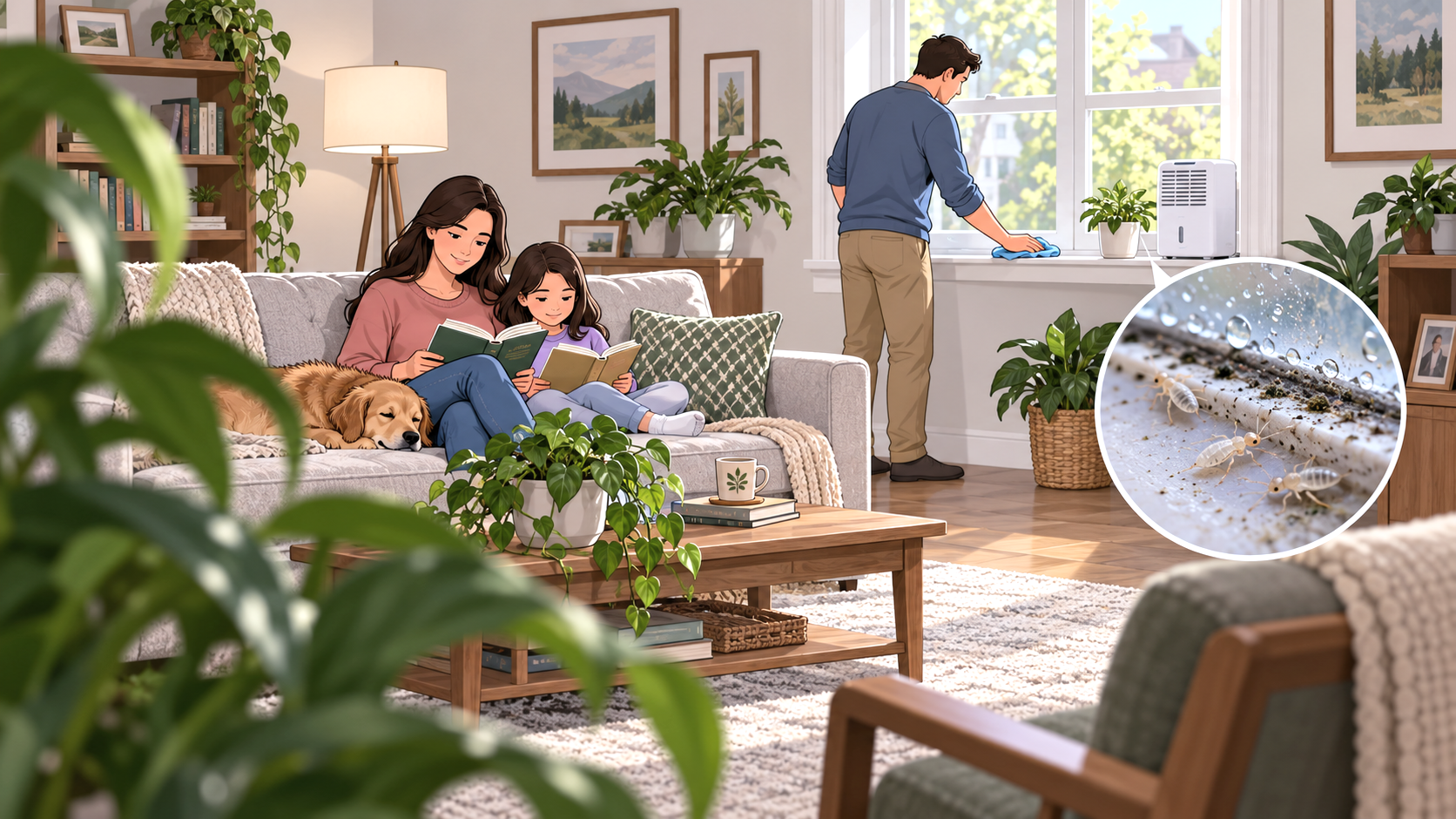
Seeing dozens of tiny insects moving across a wall, bookshelf, pantry shelf, or windowsill can make booklice look more threatening than they actually are. For most people, finding booklice indoors is primarily a pest and moisture problem rather than a direct health threat.
Booklice are generally harmless to humans. They do not bite, feed on blood, live on people, or transmit disease. However, booklice can contaminate stored foods, and research has identified certain booklice as potential indoor allergens. Their presence can also point to excessive moisture or mold that deserves attention. So, while a few booklice crawling around your home are not dangerous in the way bed bugs, mosquitoes, or disease-carrying pests can be, a persistent population should not simply be ignored.
Booklice Are Generally Harmless to People
Common household booklice are tiny psocids that spend their lives in the environment rather than on humans. They are widely regarded as harmless to people and pets, and most indoor encounters amount to little more than a nuisance.
They are not interested in human blood. Instead, booklice feed primarily on microscopic fungi and mold, along with grains, insect fragments, and certain other starchy or organic materials. This explains why infestations are strongly associated with damp cupboards, cardboard, books, humid rooms, stored foods, and other places where suitable food and moisture occur.
Their intimidating common name is misleading. Although booklice and parasitic lice belong within the broader order Psocodea, booklice do not behave like the head, body, or pubic lice that parasitize humans. Understanding the differences between booklice and human lice can prevent an unnecessary lice treatment when the insects are actually environmental psocids.
Booklice Do Not Bite Humans
One of the easiest health concerns to eliminate is biting. Booklice do not bite people and are not disease vectors.
This means a booklice infestation does not produce a characteristic pattern of red bumps, welts, or bite marks. Even when large numbers are present, they are not waiting for a person to fall asleep so they can feed.
A booklouse can accidentally crawl across your hand or another part of your body, particularly if you have been handling infested books, cardboard, food packages, or other materials. Crawling on skin does not mean the insect is feeding on you.
If you have unexplained skin marks while booklice are present in the room, the two observations should not automatically be connected. The separate question of whether booklice bite is straightforward, so persistent bite-like marks require another explanation.
Booklice Do Not Spread Disease
Booklice are not known vectors of human disease.
This is an important distinction because the health significance of some insects comes largely from what they can transmit while feeding. Mosquitoes, ticks, and certain parasitic lice can transmit pathogens under appropriate circumstances. Booklice do not have this relationship with humans.
They do not require human blood to complete their booklice life cycle, nor do they establish feeding populations on the human body. Adults and nymphs remain associated with their environmental food and moisture sources.
For the average household infestation, disease transmission is therefore not a reason to fear booklice.
Can Booklice Cause Allergies?
This is where the answer becomes more nuanced.
Although booklice are generally described as harmless household insects, scientific research has found evidence that some people can become sensitized to booklouse allergens. One study of people with respiratory allergies found IgE-mediated sensitization to psocids, while another study involving Liposcelis bostrychophila identified booklouse-specific IgE in some adults with allergic asthma.
Researchers have also identified an allergenic protein from Liposcelis bostrychophila, providing biological evidence that booklice can act as allergens rather than the association being based solely on people reporting symptoms around insects.
That does not mean finding a few booklice in your bathroom is likely to make you sick. The available evidence concerns sensitization and allergic responses in particular populations, and it should not be turned into the much broader claim that ordinary household booklice routinely cause allergies in everyone exposed to them.
For people with unexplained respiratory or allergic symptoms, however, it would also be inaccurate to say booklice have absolutely no potential health relevance. We examine that narrower issue separately in whether booklice can cause allergies.
Booklice Can Contaminate Stored Food
Booklice become more concerning when they are inside food rather than simply walking across a wall.
Some species are recognized stored-product pests and can infest grains and other dry foods. Infested products can become contaminated by the insects and their fecal material. Food containing booklice should be discarded rather than eaten, particularly when an infestation is obvious.
There is also a rare but important allergy consideration. Published medical case reports have documented anaphylaxis after contaminated food containing Liposcelis bostrychophila was eaten. Another reported case involved oatmeal contaminated with L. bostrychophila.
These reports demonstrate that severe allergic reactions are biologically possible, but they should be kept in perspective. They are individual medical cases, not evidence that eating food from a house containing booklice routinely causes anaphylaxis.
The practical response is much simpler. If booklice are visibly infesting a food product, discard it. Then inspect nearby packages and address the moisture conditions that allowed the infestation to develop.
The Moisture Behind Booklice May Matter More Than the Insects
A persistent booklice infestation can tell you something useful about the building.
Indoor booklice thrive in damp environments where microscopic fungi and mold can grow. They are commonly found in warm, humid, relatively undisturbed locations, which is why a sudden increase in booklice should prompt a search for moisture rather than an assumption that the house is dirty.
That moisture might come from condensation, a plumbing leak, damp cardboard, inadequate ventilation, recently installed building materials, or another localized source. This relationship is particularly noticeable when booklice appear in newly built homes, where retained construction moisture can create suitable conditions even in an otherwise spotless building.
Booklice can therefore function as a warning sign. The insects themselves may be relatively harmless, while the damp conditions supporting them deserve investigation.
Does Finding Booklice Mean You Have Dangerous Mold?
No. Finding booklice does not prove that a dangerous mold problem exists.
Booklice feed on microscopic fungi and molds, and these food sources may develop on damp materials without producing the dramatic patches of visible mold people normally imagine. Their presence tells you that conditions have been suitable for booklice, not what mold species is present or whether indoor air poses a health hazard.
This is why it is more useful to investigate moisture than to diagnose a mold problem from the insect alone. Check for condensation, leaks, damp materials, and persistently humid spaces.
The relationship between mold and booklice explains why the two frequently occur together, but a booklouse is not a mold test.
Are Booklice Harmful if They Get in Your Hair?
An accidental booklouse in your hair is not a human infestation.
Booklice are not adapted to live on the scalp, feed on blood, or attach their eggs to human hair. One may occasionally crawl onto a person from the surrounding environment, but the human body does not become its normal habitat.
Repeatedly finding insects attached to hair or seeing eggs firmly attached close to the scalp deserves closer identification because that pattern is much more consistent with a parasite such as head lice than with booklice.
If the insect has genuinely been identified as a booklouse, the useful question is where it came from. A damp wall, humid bedroom, bookshelf, cardboard storage area, or another nearby source is more likely to explain its presence. Normal washing is sufficient for an accidental insect, while the environmental source of booklice found around your hair should be investigated if encounters keep happening.
Should You Be Worried About a Large Booklice Infestation?
A large infestation deserves attention, but panic is unnecessary.
The number of insects does not transform booklice into biting or disease-spreading pests. Instead, a substantial population usually indicates that the environment has remained favorable enough for repeated reproduction. That makes moisture, mold growth, or an infested stored product the more useful things to investigate.
Reducing moisture is usually the central control measure. Household psocids do not survive when relative humidity remains below roughly 45 to 50 percent, although simply reaching a particular reading briefly should not be treated as an instant kill switch. Humidity needs to remain unfavorable, and localized damp materials or concealed moisture still need to be corrected.
Once you have confirmed the insects using the typical signs of a booklice infestation, concentrate on why they are thriving. Removing that underlying condition is generally more useful than repeatedly killing the insects you can see.
When Booklice Deserve More Attention
For most households, booklice are a nuisance rather than a medical threat. They do not warrant treating your skin, pets, bedding, or hair with insecticides simply because they have been found nearby.
The situation deserves closer attention when booklice are repeatedly appearing in stored food, when numbers remain high despite drying the area, or when their presence points to an unresolved leak or damp building material. Someone experiencing persistent respiratory, skin, or other allergic symptoms should also discuss those symptoms with an appropriate healthcare professional rather than trying to determine the allergen from the presence of an insect alone.
For the infestation itself, getting rid of booklice starts with finding the moisture source and making the environment unsuitable for continued reproduction.
Questions About Booklice and Human Health
Can booklice make you sick?
Booklice are not disease vectors and generally do not harm people. However, certain booklice have been documented as allergens, and visibly infested food should not be eaten. These issues are different from the insects transmitting an infectious disease.
Are booklice dangerous around children?
Booklice do not bite, feed on children, or transmit disease. Their presence should still prompt an inspection for excess moisture and contaminated stored foods, particularly if large numbers are appearing.
Is it safe to sleep in a room with booklice?
Booklice do not seek sleeping people for blood meals, so their presence does not create the biting risk associated with bed bugs. A persistent bedroom infestation is still worth addressing because it can indicate excessive humidity or a localized moisture source.
Can touching booklice hurt you?
Ordinary contact with a booklouse does not result in a bite or sting. If one crawls onto your skin, it can simply be brushed or washed away. People with unexplained allergic symptoms should not assume the insect is responsible without appropriate medical evaluation.
Should I call pest control for booklice?
Not necessarily. Small household populations can often be resolved by identifying and correcting the moisture problem, and insecticides are normally unnecessary. Persistent large populations, concealed moisture, or an infestation whose source cannot be identified may justify professional help.