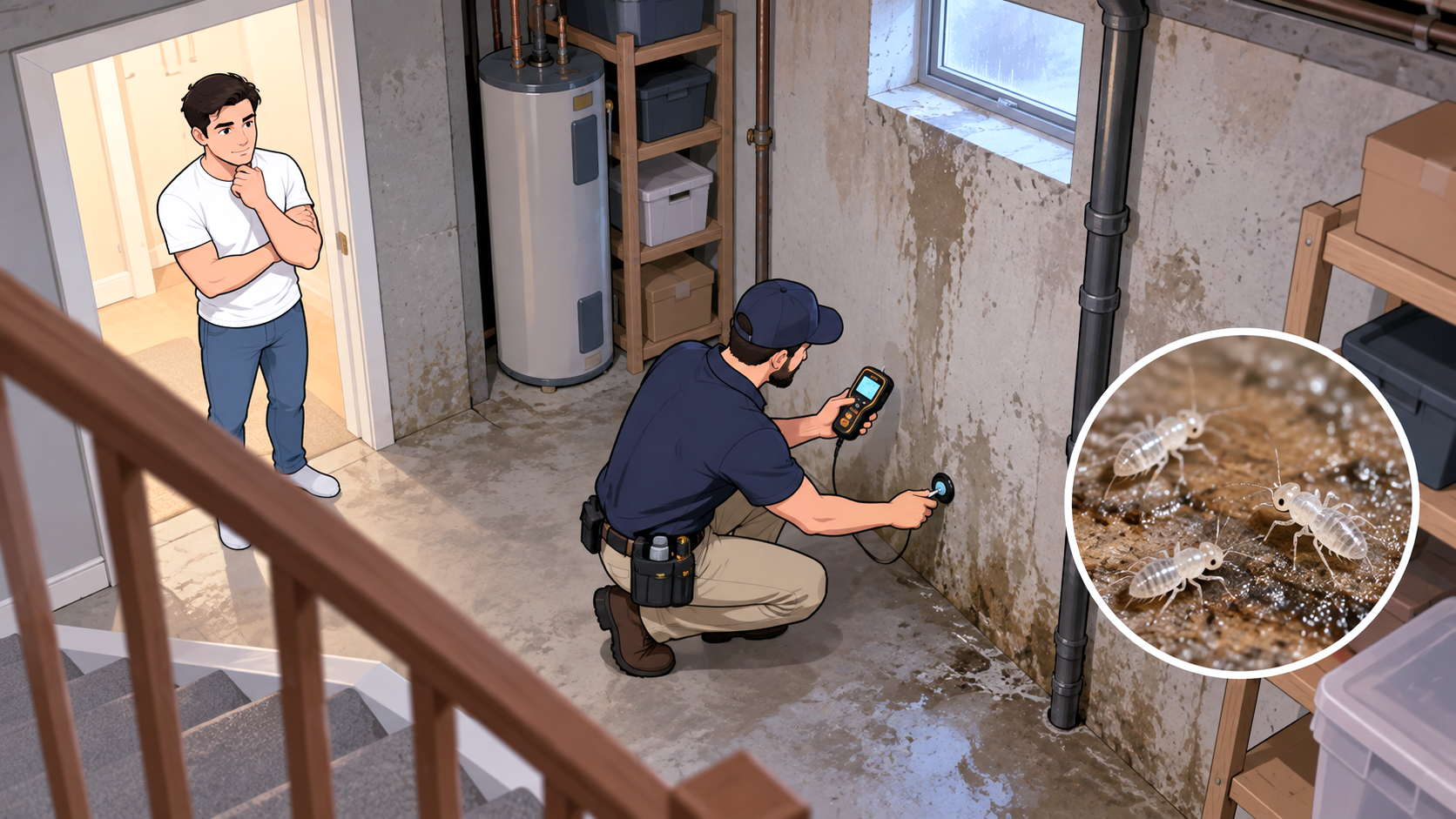
Finding dozens of tiny insects around a window, bookshelf, or bathroom can make professional treatment feel like the obvious next step. With booklice, it usually is not. Call pest control for booklice when large numbers persist after moisture has been corrected, you cannot confidently identify the insects, they keep returning from an unknown location, or the infestation involves difficult areas you cannot safely inspect. Most household booklice problems can otherwise be managed by lowering humidity and correcting damp conditions.
A Few Booklice Usually Do Not Justify Pest Control
Small numbers of correctly identified booklice are generally a moisture-management problem rather than a reason for immediate pesticide treatment.
Booklice commonly occupy damp, warm, undisturbed locations where molds and fungi are available. They are mostly nuisance pests in homes, and small numbers can simply be ignored or physically removed. Vacuuming accessible insects is often enough while you work on the environment.
The more important question is why they are surviving there.
Check the relative humidity with a hygrometer. Look for condensation, plumbing leaks, damp cardboard, wet building materials, mold, or another moisture source. Keeping relative humidity below about 50% prevents the conditions that normally allow indoor populations to persist, and pesticides are not normally necessary for household booklice.
If you find several booklice around a damp windowsill and discover heavy condensation there every morning, you already have a useful lead. Correcting that moisture problem is more valuable than paying someone to kill the insects currently walking across the sill.
Call Someone When You Are Not Sure They Are Booklice
Identification is one situation where professional help can save considerable wasted effort.
At only about 1 to 2 millimeters long, common indoor booklice are easy to misidentify. Springtails, mold mites, early bed bug nymphs, thrips, and several other tiny arthropods can cause confusion.
Treatment changes depending on what you actually have.
A springtail problem can also indicate moisture, but springtails have different biology and characteristically jump. Bed bugs require an entirely different response. Mold mites are arachnids rather than insects. Assuming every tiny pale crawler is a booklouse can therefore send you down the wrong treatment path.
Compare the specimen with the identifying features of booklice first. If uncertainty remains, capture a specimen rather than crushing it. A pest-management professional, extension diagnostic service, or qualified entomology service may be able to identify it.
You do not need to purchase a treatment simply because you requested identification.
Persistent Numbers After Drying Deserve More Investigation
A population that continues despite meaningful moisture correction is more interesting than one that disappears as the room dries.
Booklice depend heavily on humidity. University of Minnesota guidance states that psocids do not survive when humidity falls below roughly 45% to 50%, while Clemson recommends keeping buildings below 50% RH for control.
That does not mean every booklouse dies the moment a hygrometer reads 49%. Drying has to reach the places where the insects are actually living, and environmental conditions can vary considerably within a building.
A bedroom may measure 45% RH while a concealed space behind damp drywall remains much wetter.
If you have maintained dry conditions in the occupied space but continue seeing substantial numbers, the next job is to find the hidden source. At that point, professional inspection can become worthwhile.
A pest professional may help determine where activity is concentrated. However, a plumber, roofer, building contractor, HVAC technician, or moisture specialist may ultimately be the person needed if the underlying problem is water rather than insects.
Booklice Coming From a Wall Can Point to Hidden Moisture
Repeated activity from one wall, baseboard, ceiling junction, or other structural gap deserves attention.
Penn State notes that when moisture is trapped inside a wall void, the drywall may sometimes need to be opened so the cavity can dry. That is very different from spraying the insects emerging from the wall.
Booklice are particularly associated with newly constructed buildings because construction materials can retain enough moisture to support mold and psocids while the building dries.
Do not start cutting into walls merely because you saw booklice. First look for supporting evidence such as persistent moisture readings, water staining, a known leak, recurring mold, or concentrated insect activity.
When the suspected source is inaccessible, professional investigation becomes more reasonable. The pest company can assess the insect activity, while an appropriate building professional can investigate suspected structural moisture.
Recurring Booklice Are Different From a One-Time Outbreak
An infestation that disappears and then repeatedly returns deserves a fresh look at its cause.
Repeated spraying can disguise the pattern. You kill the exposed insects, activity falls, and several weeks later they appear again because the habitat never changed.
Instead, map where you see them.
If most sightings occur beside one bathroom wall, underneath a particular window, inside one kitchen cabinet, or around a basement storage area, that distribution may help narrow the search. The broader process for preventing booklice from coming back should focus on moisture, mold, storage conditions, and the original hotspots.
Professional help becomes useful when that investigation stops producing answers. Someone inspecting the property in person can see conditions that photographs and internet identification cannot reveal.
That is a better reason to call than simply reaching a particular number of insects.
A Large Infestation Can Make Professional Help Worthwhile
There is no scientifically useful household threshold such as 20, 100, or 1,000 booklice that automatically means you need pest control.
Context matters more than a count.
Seeing a few individuals on a damp windowsill is different from finding large numbers across several rooms, cabinets, stored belongings, and walls. University of Minnesota describes booklice as capable of becoming a nuisance in large numbers, although moisture reduction remains the most effective management method.
Widespread activity also makes locating the source harder. There may be several damp locations, contaminated stored material, or a building-wide humidity issue.
At that scale, an inspection may save time even if pesticide treatment is ultimately unnecessary. A good outcome from professional pest control does not always involve spraying something. Correct identification and finding the source can be more valuable.
Pantry Infestations Need the Contaminated Food Removed
Finding booklice in food changes what needs to happen, but it still does not automatically require an exterminator.
Psocids can infest stored grain products and other dry foods. Infested food should be discarded because it can be contaminated with mold and booklouse feces. Unaffected foods should be kept dry in tightly closing glass or plastic containers.
Empty the affected storage area and clean it thoroughly. Inspect nearby dry foods rather than assuming only the first package is involved.
A recurring pantry infestation after contaminated products have been removed and storage conditions corrected may justify professional inspection. This is especially true when you cannot determine which product or structural area is sustaining the insects.
Commercial food environments are a different matter. Food manufacturing, warehousing, grain storage, restaurants, and other regulated facilities can have sanitation, monitoring, documentation, and pest-management requirements beyond ordinary household advice. Professional commercial pest management may therefore be appropriate much earlier.
Valuable Collections Can Change the Decision
A $5 paperback and a valuable archival collection should not be treated as though the consequences of a mistake are identical.
Booklice can occur among books, papers, specimens, photographs, archives, and other stored materials. Their presence can also indicate dampness, which may threaten the collection independently of the insects.
If valuable or irreplaceable material is involved, avoid experimenting with household sprays, alcohol, bleach, essential oils, powders, or heat treatments.
The Canadian Conservation Institute describes psocids as a warning of dampness in collections. In a museum, archive, library, or valuable private collection, a conservator or integrated pest-management specialist may be more appropriate than routine household extermination.
For ordinary books, the approach is less complicated. Correct the moisture problem and use methods appropriate for removing booklice from books without unnecessarily treating the collection with chemicals.
Do Not Call Pest Control Because You Think Booklice Are Biting You
Booklice do not bite people.
They are not blood feeders or human parasites, and booklice do not affect human or animal health through biting or disease transmission. If unexplained skin marks are the reason you believe you need booklice treatment, confirming the pest should come before treating the home.
That matters because another pest may require a completely different inspection.
Do not repeatedly apply insecticides to beds, clothing, furniture, or skin in an attempt to stop supposed booklouse bites. Instead, establish whether the insects you found are actually connected to the skin problem.
Our separate explanation of whether booklice bite covers that misconception in more detail.
Pest Control Cannot Repair the Reason Booklice Are There
This is the limitation worth understanding before paying for treatment.
A pest-management professional can identify insects, inspect for activity, recommend control measures, and use appropriately labeled treatments when they are justified. They cannot make a pesticide substitute for repairing a leaking pipe, drying a wall cavity, improving inadequate ventilation, or correcting persistent condensation.
Insecticides are also ineffective as a long-term answer while moisture remains a problem. Clemson notes that booklice are easily killed with insecticides but often occupy places that are difficult to treat, while humidity control alone can be highly effective.
That should shape what you expect from a service call.
If a company proposes pesticide treatment without showing any interest in humidity, water intrusion, mold, or where the insects are concentrated, ask how the treatment will prevent the same conditions from supporting another population.
What to Do Before Booking an Exterminator
Spend a little time gathering information first. You may solve the problem yourself, and if you still need professional help, the information makes the inspection more useful.
Measure relative humidity in the affected rooms for several days. Note exactly where insects appear and whether sightings increase at particular times or under particular conditions. Check for leaks, condensation, mold, damp cardboard, wet stored materials, and affected pantry products.
Save a few intact specimens for identification if possible.
Then begin basic booklice control by drying the environment and physically removing accessible insects. A dehumidifier or improved ventilation may be enough when general indoor humidity is responsible.
If activity declines as the area dries, you have strong practical evidence that environmental control is working.
If it does not, you now have useful humidity readings, specimens, locations, and observations to show the professional.
When We Would Make the Call
We would not call pest control because two booklice appeared beside a humid window.
We would consider professional help when the identification remains uncertain, substantial numbers continue after sustained moisture correction, insects repeatedly emerge from inaccessible areas, activity spreads widely through the home, or the source cannot be located.
We would also seek specialized help sooner when valuable collections or commercial food environments are involved.
The goal is not necessarily to obtain a stronger insecticide. It is to find out what has prevented the problem from resolving through the usual moisture-first approach.
Safety note: If pesticide treatment is recommended, use only a product whose current label permits the pest, site, and application involved. Follow the complete label. Do not improvise treatments inside wall cavities, electrical equipment, food-storage areas, or other sensitive locations.
Questions to Ask About Professional Booklice Control
Will an exterminator definitely need to spray for booklice?
No. Inspection, identification, and locating conducive conditions can be useful even when no insecticide is applied. Household booklice often respond to moisture correction alone.
Should I call a plumber or pest-control company first?
If you already have clear evidence of a plumbing leak, call the appropriate plumbing professional. If the insects have not been identified or you cannot determine where activity originates, pest inspection may help establish what you are dealing with.
Can pest control get rid of booklice permanently?
No treatment can guarantee that booklice will never enter a home again. Long-term control depends heavily on keeping the environment unfavorable for them, particularly by preventing persistent dampness and fungal growth.
What should I tell the pest-control company before they arrive?
Explain where you are finding the insects, how long the problem has lasted, what moisture problems you have found, what steps you have already taken, and whether the insects occur around food, books, walls, or another specific location. Mention any pesticides or household treatments already applied.
One thought on “When Should You Call Pest Control for Booklice?”