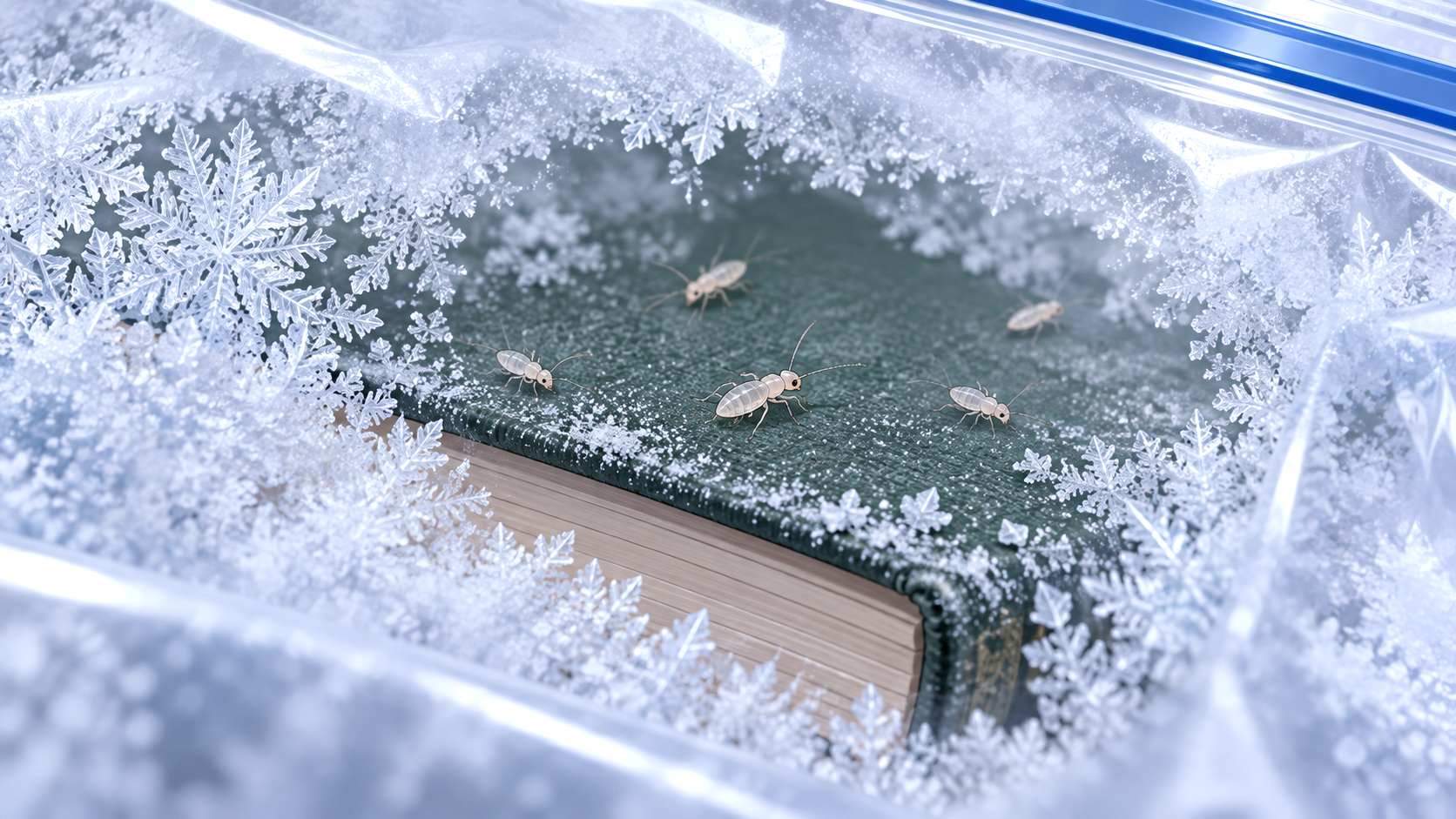
Freezing does kill booklice, but cold treatment only works when the temperature is low enough and the exposure lasts long enough. Putting an infested object somewhere chilly, refrigerating it, or exposing it to a brief outdoor freeze should not be treated as equivalent to controlled freezing. At 0°F (-18°C), nymphs and adults of several Liposcelis species are killed relatively quickly, but eggs are much more cold tolerant. Research found young Liposcelis bostrychophila eggs surviving as long as 120 hours at -18°C, so several days of continuous freezing are needed when the goal is to kill every life stage.
How Cold Does It Need to Be to Kill Booklice?
For practical household freezing, 0°F (-18°C) is a useful target. This is the standard temperature of a properly operating household freezer, and it has also been directly studied against stored-product psocids. USDA Agricultural Research Service experiments exposed four Liposcelis species to -18°C and found that nymphs and adults were far less cold tolerant than eggs.
No nymphs or adults in that experiment ultimately survived two hours at -18°C. Eggs required longer exposures, and the amount of time varied considerably among species. That makes “freezing temperature” too vague for treatment advice. Water freezes at 32°F (0°C), but a temperature being below the freezing point of water does not mean it will quickly kill booklice.
Booklouse Eggs Are the Hardest Stage to Kill
The eggs determine how conservative a freezing treatment needs to be.
Researchers tested young and old eggs, nymphs, and adults of L. bostrychophila, L. paeta, L. decolor, and L. entomophila at -18°C. Eggs were the most cold-tolerant life stage for every species tested. The differences were substantial. Complete egg mortality required about 24 hours for L. paeta, 12 hours for L. decolor, and two hours for L. entomophila. Young L. bostrychophila eggs were much tougher, with some surviving as long as 120 hours at -18°C.
USDA researchers concluded that L. bostrychophila eggs require at least 128 hours at -18°C for complete mortality under the studied conditions. That is more than five days.
The result is important because booklice eggs are tiny and easily concealed. You cannot judge a freezing treatment simply by checking whether adult insects are still crawling around afterward.
How Long Should You Freeze Booklice?
For movable household items that can safely tolerate freezing, seven continuous days at 0°F (-18°C) or colder is a sensible conservative treatment.
The seven-day recommendation gives more time than the 128-hour minimum indicated by the USDA experiments for the particularly cold-tolerant young eggs of L. bostrychophila. It also provides some practical margin for an object that does not reach freezer temperature immediately after being placed inside.
Some extension recommendations use shorter treatments. Colorado State recommends placing freeze-resistant articles in plastic bags and freezing them at 0°F for four days, while Virginia Tech gives the same four-day, 0°F treatment for infested stored products.
Those recommendations are useful, but laboratory research showing survival of L. bostrychophila eggs beyond four days supports being more conservative when the species is unknown and complete elimination is the goal.
Seven days is therefore not a magical biological cutoff. It is a practical household treatment period built around the more cold-tolerant booklouse eggs.
Why 24 Hours in the Freezer Is Not Enough
A day at 0°F may kill many booklice, but it should not be relied upon to eliminate every life stage.
Adults and nymphs are highly susceptible to -18°C. Eggs are not. USDA research found that while 24 hours at -18°C was sufficient for all life stages of several tested species, young L. bostrychophila eggs survived much longer.
This matters because L. bostrychophila is a widespread indoor and stored-product booklouse. Its life cycle includes eggs followed by nymphal stages and adults, so leaving viable eggs behind can allow the population to continue after treatment.
A motionless adult after 24 hours is therefore not evidence that the eggs are dead. If you have already decided to freeze a suitable object, extending the treatment is simpler than trying to determine which Liposcelis species you have.
Does Refrigeration Kill Booklice?
Do not rely on ordinary refrigeration to eliminate booklice.
A refrigerator normally operates above freezing, while effective cold-treatment research uses substantially lower temperatures. Even booklice exposed to temperatures below 32°F can survive surprisingly long when the temperature is not sufficiently low.
In one study of L. bostrychophila, adults were still alive after seven days at 14°F (-10°C). Complete adult mortality occurred after one day at 5°F (-15°C), while eggs remained alive even after three days at that temperature.
That demonstrates why “cold” and “lethal cold” are different things. Refrigeration may slow insect development and activity, but slowing booklice is not the same as reliably killing every life stage.
Use an actual freezer if cold is being used as a disinfestation treatment.
Does a Brief Outdoor Freeze Kill Booklice?
Cold winter weather should not be treated as a dependable substitute for a freezer.
Outdoor temperatures fluctuate considerably between day and night. Sunlight, wind, insulation, walls, packaging, and the thermal mass of an object can also make its internal temperature very different from the reported outdoor air temperature.
Even sustained temperatures around 14°F (-10°C) may be inadequate. L. bostrychophila adults have survived seven-day laboratory exposures at that temperature. Eggs can be still more tolerant.
Leaving an infested box outside overnight when the temperature drops below freezing may therefore kill some insects without eliminating the population. You would also be exposing the object to condensation, precipitation, and uncontrolled temperature changes.
A freezer maintaining a known temperature provides a much more predictable treatment environment.
Can Booklice Survive Being Frozen?
Yes, if the freezing exposure is not cold enough or long enough.
The survival of L. bostrychophila at subzero temperatures makes this especially clear. Research comparing temperatures from 32°F down to 5°F (0°C to -15°C) found that mortality increased as exposure became colder and longer, but booklice could survive surprisingly substantial cold exposure.
Another USDA study at 0°F (-18°C) found extreme differences between life stages. Adults and nymphs died rapidly, while young L. bostrychophila eggs survived for days.
So the answer is not that booklice somehow withstand indefinite deep freezing. They do not. Rather, some life stages can survive exposures that people might reasonably assume would have killed them.
That is why treatment instructions need both a temperature and a duration.
What Can You Freeze to Kill Booklice?
Freezing makes the most sense for small, movable objects that tolerate low temperatures.
Some books, paper goods, textiles, furnishings, and stored products may be candidates depending on their materials and condition. Colorado State specifically recommends freezing suitable movable articles in plastic bags at -18°C when the objects are resistant to freezing.
Material compatibility comes first. Electronics, liquids, fragile objects, antiques, photographs, adhesives, coated materials, and mixed-material objects may respond unpredictably to freezing or subsequent condensation.
Do not assume an object is freezer-safe simply because booklice are on it. Killing the insect is useful only if the treatment does not damage the item you were trying to save.
Does Freezing Kill Booklice in Books?
Yes, controlled freezing can kill booklice in books that are suitable for the treatment.
Books are particularly relevant because booklice can occur among damp or undisturbed paper materials, where microscopic fungi and some starchy binding materials can provide food. Freezing gives you a way to treat a contained infestation without applying liquid insecticides to paper.
For an ordinary dry book that can safely tolerate freezing, sealing it appropriately and keeping it at 0°F (-18°C) for seven days provides a conservative household treatment. The book should then return to room temperature while still sealed before the packaging is opened.
The exact handling matters because a thick book does not instantly become -18°C when you put it into a freezer. The center takes time to cool, and condensation during warming can introduce unwanted moisture.
For that reason, freezing books for booklice requires more than simply choosing a number of days.
Should You Bag an Item Before Freezing It?
For appropriate household objects, bagging can make the process easier to control and can help contain insects during treatment.
Make sure the object is dry before sealing it. Booklice are strongly associated with moisture, and sealing an already damp object creates a different preservation problem.
The package should not be so large or densely packed that the center takes an excessive amount of time to cool. A single book or small group of objects is easier to treat predictably than a huge box packed tightly with room-temperature material.
After freezing, leave the object sealed until it has returned completely to room temperature. This reduces the chance of warm, humid room air immediately condensing on a very cold object.
Rare, antique, fragile, or unusually constructed materials deserve conservation-specific advice rather than a generic freezer treatment.
Can You Freeze Infested Food?
Some stored products can be treated with freezing, although throwing away inexpensive infested food is often simpler.
Virginia Tech recommends that psocid-infested pantry products can either be discarded or stored in a deep freezer for four days at 0°F. Treated products should then be kept in tightly sealed containers.
However, booklice in food can also indicate excessive moisture and fungal problems. Freezing kills insects but does not reverse deterioration or make moldy food suitable to eat.
For ordinary household flour, cereal, grains, or similar inexpensive foods with an obvious infestation, disposal is generally the straightforward option. Then inspect adjacent products, vacuum the cupboard, keep replacement food dry, and correct the conditions supporting booklice in the kitchen.
Is Freezing Better Than Heat?
Both sufficiently low and sufficiently high temperatures can kill booklice.
Freezing has a practical advantage for small objects because a household freezer can maintain a known temperature for several days. Heat can act much faster at sufficiently high temperatures, but achieving a lethal temperature throughout an object without damaging it can be more difficult.
The same biological complication appears with both methods. Eggs tend to be harder to kill than mobile stages. When using heat to kill booklice, treatment therefore needs to account for both temperature and exposure time rather than stopping when exposed adults die.
Neither treatment is automatically better for every object. Material compatibility, infestation size, equipment, temperature control, and the reason booklice are present should determine which approach makes sense.
Freezing Does Not Prevent Booklice From Coming Back
Freezing treats the insects in the object. It does not treat the room.
This distinction matters because booklice flourish under humid conditions. They feed heavily on microscopic fungi and can multiply in damp books, cardboard, food products, walls, cupboards, and other protected areas.
If you freeze an infested book and return it to the same humid shelf, another population can eventually become established. The environmental problem remains untouched.
Research also shows how powerful humidity control can be. USDA experiments found that all life stages of four tested Liposcelis species reached complete mortality after 8 to 12 days at 43% relative humidity and 10 to 16 days at 50%, depending on species.
That helps explain why maintaining low humidity for booklice control is more useful for a room-wide infestation than trying to freeze everything you own.
When Freezing Makes Sense
Freezing is most useful when you can identify a small number of infested objects, know that those objects can tolerate the treatment, and have a freezer capable of maintaining about 0°F (-18°C).
It becomes much less practical when booklice occur throughout an entire bathroom, kitchen, basement, wall system, or large collection. At that scale, the insects are telling you that the environment itself needs attention.
Look for condensation, plumbing leaks, damp building materials, mold, poorly ventilated storage, and consistently high relative humidity. Vacuum visible insects and remove contaminated materials where appropriate.
For a widespread household infestation, getting rid of booklice naturally through drying, moisture correction, cleaning, and physical removal addresses the habitat rather than treating belongings one at a time.
Questions About Freezing Booklice
Will four days in the freezer kill booklice?
Four days at 0°F (-18°C) is recommended by several extension sources for suitable infested items and stored products. However, laboratory research found young L. bostrychophila eggs surviving beyond four days at -18°C. When complete control of an unknown booklouse species is the goal, seven days provides a more conservative margin.
Will booklice die at 32°F (0°C)?
Do not use 32°F as a reliable booklice treatment. Cold mortality depends on temperature and exposure time, and L. bostrychophila can tolerate prolonged exposure at temperatures considerably below the freezing point of water. A deep-freezer temperature around 0°F (-18°C) is much more useful for disinfestation.
Will a refrigerator kill booklice?
Refrigeration should not be relied upon for complete control. A refrigerator is much warmer than the -18°C temperature used in effective freezing treatments. It may slow activity without killing every life stage.
Does freezing kill booklice eggs?
Yes, but eggs are generally the most cold-tolerant life stage. USDA research found young L. bostrychophila eggs surviving as long as 120 hours at -18°C, which is why a freezing treatment needs to continue much longer than the time required to kill adults and nymphs.
Do booklice come back to life after freezing?
Booklice killed by a sufficient freezing treatment do not revive after warming. However, insects that merely became inactive or survived an inadequate exposure can resume activity as temperatures rise. That is why seeing motionless insects inside a freezer is not proof of mortality.
2 thoughts on “Does Freezing Kill Booklice?”