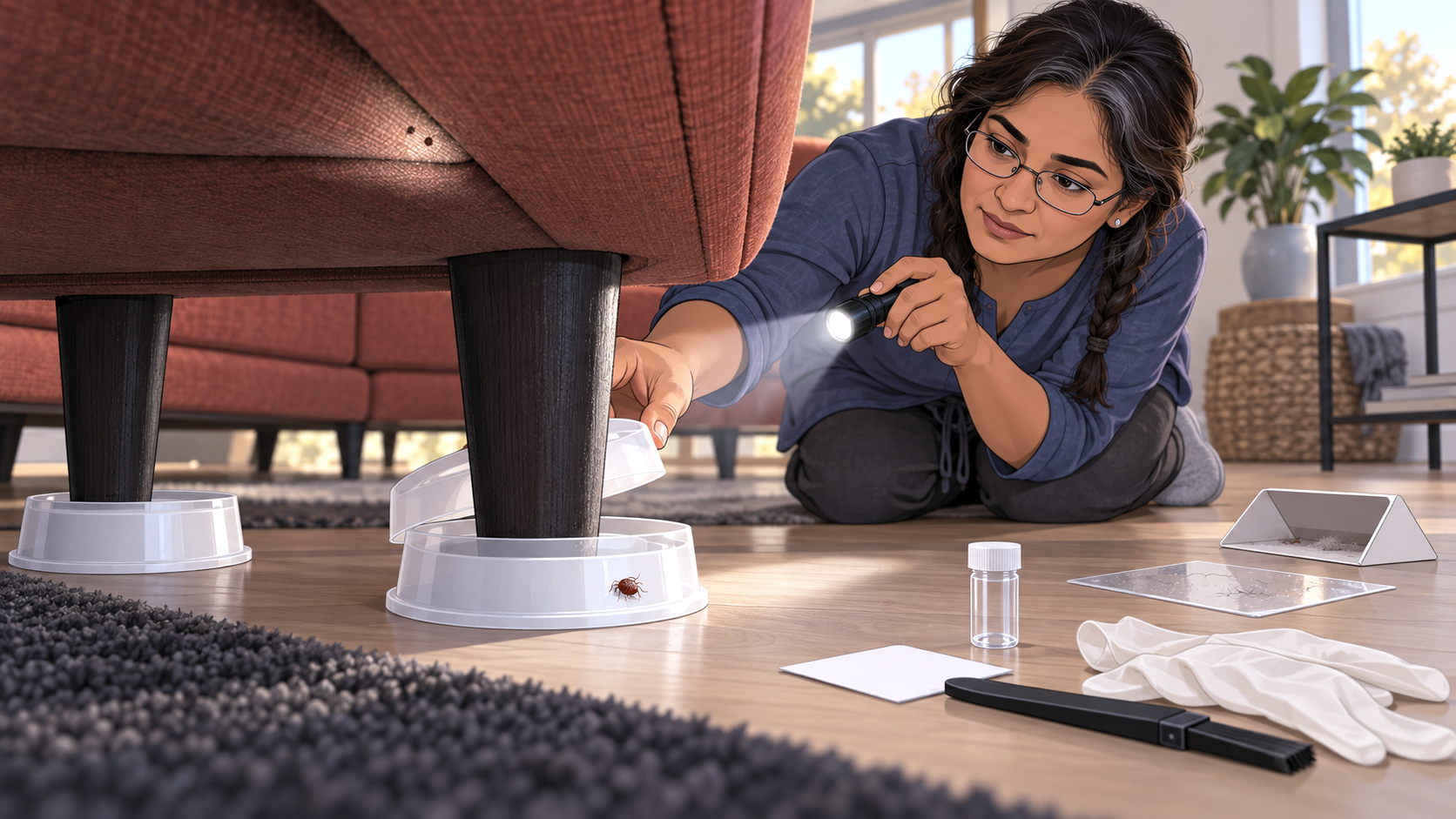
At-home bed bug test kits can work, but the answer depends heavily on what the “kit” actually contains. A passive interceptor placed under furniture legs, a small chemical lure, and an active monitor releasing carbon dioxide aren’t equivalent detection methods, even though all may be marketed to homeowners as ways to find bed bugs.
Some at-home bed bug monitors are supported by good research, particularly interceptor traps and active monitors that use carbon dioxide. CO₂ is a strong bed bug attractant, while certain chemical lures can improve trap catches further. A negative result from any single monitor, however, doesn’t prove your home is bed-bug-free.
Carbon Dioxide Is One of the Strongest Cues Used by Active Monitors
Bed bugs locate hosts using several cues, including carbon dioxide, heat, and chemicals associated with a host. Of these, carbon dioxide has performed particularly well in monitoring research.
Rutgers NJAES describes CO₂ as the primary attractant used in active bed bug monitoring and notes that adding a CO₂ source to a trap can make it highly effective for detecting bed bugs. Its guidance describes both dry ice and sugar-yeast fermentation as reliable ways of generating CO₂ for monitoring.
Earlier experimental work demonstrates just how much CO₂ can matter. In one study of an active trap using heat, chemical lures, and CO₂, researchers captured 5,898 bed bugs during trap-days with CO₂ compared with 656 without it. The study involved specific experimental conditions, so those numbers shouldn’t be treated as a universal performance ratio for every monitor. They do show that adding CO₂ can dramatically change trap performance.
A later field study also found a positive relationship between CO₂ release rate and the number of bed bugs captured in occupied apartments.
For an active monitor designed to attract host-seeking bed bugs, CO₂ therefore has substantial research behind it.
Chemical Lures Can Improve a Monitor Without Replacing CO₂
Chemical lures aren’t useless on their own, and the research doesn’t support dismissing every lure-only product. What it does show is that the exact lure formulation and the rest of the monitor design matter.
A 2013 Rutgers field study placed paired interceptor traps in occupied apartments and added an experimental chemical lure to one trap in each pair. The lure contained nonanal, 1-octen-3-ol, spearmint oil, and coriander Egyptian oil. The baited interceptors caught about 2.2 times as many bed bugs initially and 2.3 times as many during the later monitoring period as the unbaited interceptors.
That experiment is important because CO₂ wasn’t being supplied to those paired interceptors. The human occupants remained present, however, so natural host cues existed in the apartments.
Researchers later tested a different experimental lure containing nonanal, L-lactic acid, 1-octen-3-ol, and spearmint oil alongside a sugar-yeast CO₂ source. With CO₂ present, adding the chemical lure increased trap catch 7.2-fold.
The sensible conclusion is that a validated chemical lure can improve monitoring and can work particularly well alongside CO₂. It doesn’t follow that every commercial lure uses the same compounds, release rates, formulation, or trap design tested in those experiments.
Passive Interceptors Work Without Any Lure at All
A monitor doesn’t need CO₂ to be useful.
Interceptor traps take a different approach. Instead of actively attracting bed bugs across a room, they’re commonly placed beneath the legs of beds and upholstered furniture so bugs moving between the furniture and surrounding room fall into the device and have difficulty escaping.
Field research found that interceptors were more effective than visual inspection for detecting small numbers of bed bugs. In lightly infested occupied apartments, interceptors deployed for seven days caught similar numbers of bed bugs to a dry-ice active monitor operated for one day.
That distinction matters when evaluating an at-home kit. A passive interceptor isn’t an inferior active monitor that’s “missing” an attractant. It is a different monitoring design that takes advantage of normal bed bug movement around an occupied sleeping area.
Its limitation becomes more apparent in an unoccupied room. Without a person sleeping there, the host cues that normally encourage bed bugs to move toward the bed are absent. Rutgers consequently notes that active CO₂ monitors can be especially useful in vacant rooms.
Sugar and Yeast Can Produce an Effective CO₂ Monitor
One of the more useful findings from Rutgers research is that an active CO₂ monitor doesn’t necessarily require compressed gas or dry ice.
In a 2015 study, researchers created CO₂ through sugar-yeast fermentation. During the first eight hours, the mixture released an average of 405.1 milliliters of CO₂ per minute compared with 397.0 milliliters per minute from the dry ice setup.
When both systems were paired with the same experimental chemical lure in naturally infested apartments, the sugar-yeast monitor performed similarly to the dry-ice monitor.
The researchers also compared one sugar-yeast monitor operated for one day with 6 to 18 Climbup interceptors placed under furniture legs for 11 days. The one-day sugar-yeast monitor was equally effective at trapping bed bugs under those study conditions.
That doesn’t mean one night with a homemade trap is universally equivalent to 11 days of interceptors. It was a specific field comparison involving naturally infested apartments and a particular monitor design. What it demonstrates is that sugar-yeast fermentation can be a legitimate CO₂ source rather than merely an internet home remedy.
Rutgers provides instructions for making sugar-yeast and dry-ice monitors, including important safety precautions for dry ice.
A Negative Test Doesn’t Prove You Don’t Have Bed Bugs
No monitor catches every bed bug in a room, and detection becomes particularly difficult when only a few insects are present.
Trap placement, monitoring duration, infestation level, room occupancy, competing host cues, trap design, and attractants can all affect what gets caught. A trap sitting empty after one night therefore isn’t equivalent to a laboratory test returning a definitive negative result.
Rutgers recommends placing monitors near sleeping and resting areas and checking them regularly. Monitoring over time gives the device more opportunities to intercept or attract insects than a single short deployment.
If suspicion remains despite an empty monitor, inspect the sleeping area for live bugs, eggs, shed skins, and fecal spotting rather than relying exclusively on the trap. It’s entirely possible to have bed bugs without immediately seeing them, particularly when an infestation is small.
Our guide to telling whether you have bed bugs covers the physical evidence that can be used alongside monitoring.
Don’t Assume Every Commercial Test Kit Has Been Validated
The words “bed bug detector” or “test kit” don’t tell you how well a particular product works.
Research has demonstrated meaningful differences between trap designs, attractants, CO₂ release rates, and monitoring periods. In the 2013 Rutgers experiments, even changing the physical pitfall design produced a substantial difference in trap catch before attractants were considered.
Before buying a kit, check what the product actually does. Determine whether it is a passive interceptor, an active CO₂ monitor, a chemical-lure trap, or another type of detector. Then look for independent field research on that specific design or technology rather than assuming that results from one experimental monitor apply to every product using the words “lure” or “bed bug attractant.”
The current options are also broader than a single style of trap. Our comparison of bed bug detectors looks at the main approaches separately.
At-Home Monitors Detect Bed Bugs, They Don’t Clear an Infestation
A monitor can answer an important question: are bed bugs active here?
It doesn’t follow that catching them will eliminate an established infestation. Even an effective trap captures only insects that encounter or respond to it, while other bugs and eggs may remain concealed elsewhere.
The EPA includes interceptor-style devices as part of monitoring and preparation for bed bug management rather than presenting them as a standalone extermination method. Monitoring can help detect a low-level infestation, identify where activity is occurring, and track whether activity continues after treatment.
A positive result is therefore valuable evidence that deserves further inspection and appropriate control. It isn’t a measurement of exactly how many bed bugs are hidden throughout the property.
Questions About At-Home Bed Bug Test Kits
Are CO₂ monitors better than passive interceptors?
They serve somewhat different purposes. Active CO₂ monitors can detect bed bugs quickly and are particularly useful where no human host is present. Passive interceptors have also performed well in occupied apartments and can remain in place for extended monitoring without requiring a CO₂ source.
Can a bed bug monitor tell you how severe an infestation is?
Trap counts can help monitor changes in activity, but the number caught shouldn’t automatically be treated as a complete count of the infestation. Trap design, placement, duration, host presence, and bed bug distribution all influence the catch.
Do bed bug monitors work in vacant rooms?
Active monitors can. Rutgers specifically notes that sugar-yeast and dry-ice CO₂ traps can detect low numbers of bed bugs in occupied or vacant rooms and that active monitors are especially useful where a human host isn’t present.
Does an empty bed bug test mean you don’t have bed bugs?
No. An empty monitor means it didn’t capture a bed bug during that monitoring period. When there is continuing reason to suspect an infestation, extend monitoring and combine it with a careful inspection rather than treating one negative trap as definitive proof.
Can you make an effective bed bug monitor yourself?
Research supports a specific sugar-yeast CO₂ monitoring approach, and Rutgers publishes instructions for making one. That evidence shouldn’t be generalized to every homemade trap design found online, particularly when the construction, CO₂ production, or capture mechanism differs from the tested method.