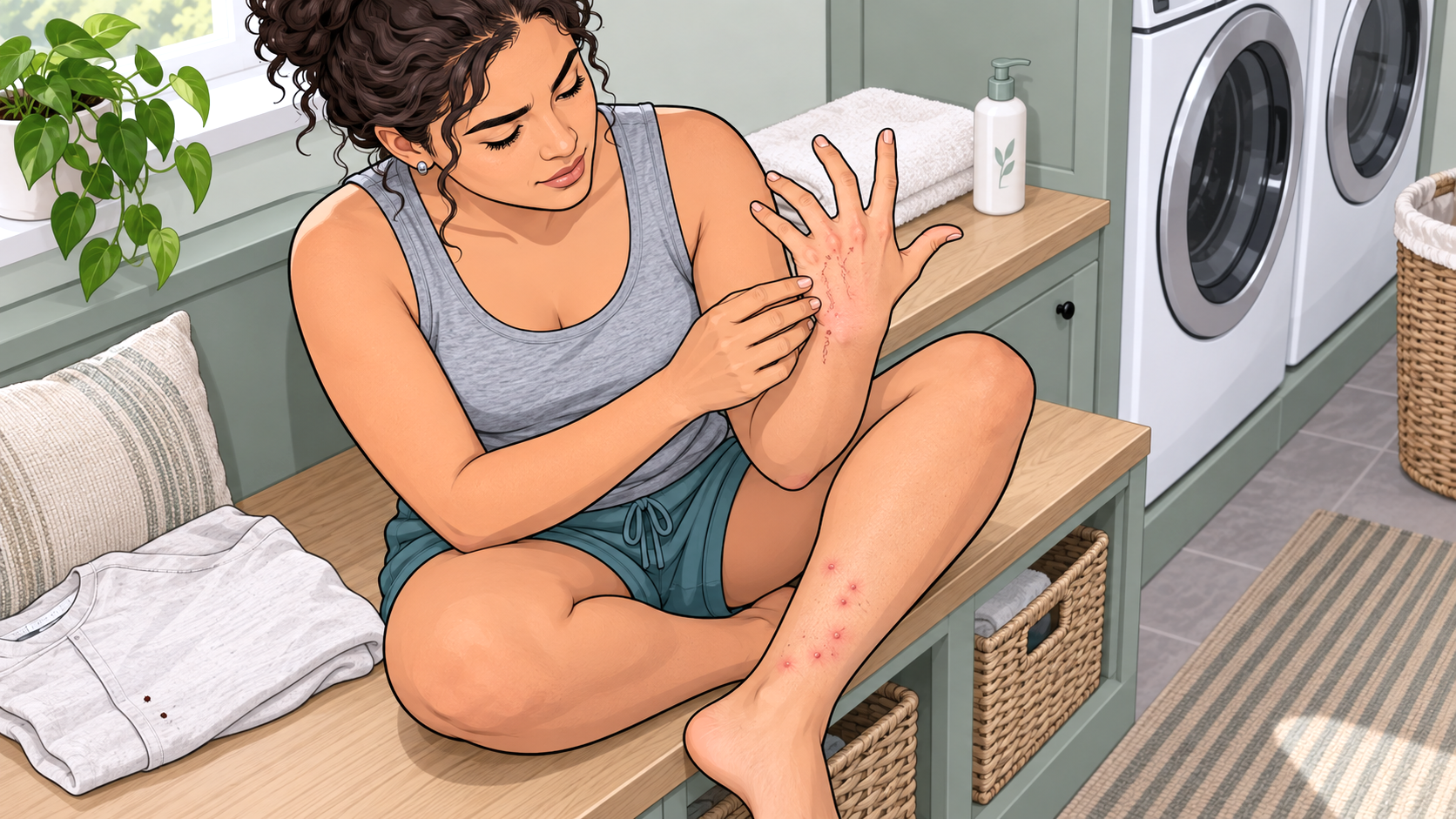
Bed bug bites and scabies can both cause intense itching, but they come from completely different problems. Bed bugs stay outside the body and feed briefly on blood. Scabies is caused by microscopic mites that burrow into the upper layer of skin and remain there.
Scabies also spreads primarily through prolonged skin-to-skin contact and requires treatment with a scabicide. Bed bugs require treatment of the infested environment instead.
Scabies Mites Actually Burrow Into Your Skin
Scabies is caused by the human itch mite, Sarcoptes scabiei var. hominis. According to the CDC, female mites burrow into the upper layer of skin and lay eggs there.
Bed bugs never burrow into the body. They pierce exposed skin, take a blood meal, and leave. The resulting marks are reactions to feeding rather than evidence of an insect living beneath the skin.
With scabies, much of the itching and rash results from the body’s allergic reaction to the mites, their eggs, and their feces.
Where the Rash Appears Can Provide Clues
Scabies commonly affects the skin between the fingers and around the wrists, elbows, armpits, waist, buttocks, nipples, penis, and shoulder blades. Infants and very young children can have involvement of the head, face, neck, palms, and soles as well.
Bed bug bites don’t follow those same characteristic locations. They can appear on skin accessible while a person sleeps, although clothing doesn’t provide an absolute barrier.
Location can therefore provide a clue, but it can’t diagnose either condition by itself. Skin reactions vary too much between people for that.
Scabies Can Produce Visible Burrows
A thin, slightly raised, crooked or wavy line in the skin is one of the more distinctive signs of scabies. These burrows are created as female mites tunnel beneath the skin surface.
Bed bug bites don’t produce burrows because bed bugs never enter the skin.
Even so, burrows can be difficult to find, and not everyone with scabies will recognize them. Intense itching combined with a compatible rash and possible exposure deserves medical evaluation rather than self-diagnosis from photographs.
Scabies Spreads Differently From Bed Bugs
Scabies usually spreads through prolonged direct skin-to-skin contact with an infested person. Less commonly, it can spread through shared clothing, towels, or bedding, particularly with crusted scabies.
Bed bugs aren’t contagious in this sense. They normally spread by crawling through a building or hitchhiking on luggage, furniture, clothing, bags, and other belongings. A bed bug could therefore be transported on something a person is carrying, but ordinary skin-to-skin contact isn’t how a bed bug infestation passes between people.
That distinction matters because catching bed bugs from another person is fundamentally different from contracting scabies through close physical contact.
Scabies Symptoms Can Take Weeks to Appear
Someone getting scabies for the first time may have no symptoms for several weeks even though the mites are already present and can spread to other people. The CDC says symptoms can take three to six weeks to develop after a first infestation.
Previous scabies changes that timeline. In someone who has had it before, symptoms generally appear much sooner, often within one to four days.
Bed bug reactions have their own variable timing and can’t reliably be distinguished from scabies simply by counting how many days passed before itching began.
Scabies Requires Specific Treatment
Scabies should be treated with medications designed to kill scabies mites. The CDC states that no over-the-counter products are approved to treat human scabies. Prescription treatment may include topical permethrin or oral ivermectin, depending on the patient and circumstances.
Close household members and other people with prolonged skin contact may need treatment at the same time to prevent reinfestation. Clothing, towels, and bedding used during the days before treatment also need to be handled according to medical guidance.
Itching can continue for several weeks after successful treatment, so persistent itching by itself doesn’t necessarily mean live mites remain.
Bed bug treatment is entirely different because the insects live in the environment. If physical evidence is present around the bed or furniture, bed bug bites versus scabies ultimately comes down to confirming which organism is actually responsible.
Questions About Scabies and Bed Bugs
Can bed bug bites cause scabies?
No. Scabies is caused by Sarcoptes scabiei mites. Bed bug bites can’t turn into scabies or create a scabies infestation.
Does scabies live in mattresses?
Scabies mites primarily live on human skin rather than establishing colonies inside mattresses like bed bugs. Bedding and clothing can still play a role in transmission, which is why recently used items may need to be washed or otherwise handled as directed during treatment.
When can someone with scabies return to work or school?
CDC guidance generally allows adults and children to return to work, school, or childcare the day after treatment, while avoiding direct skin-to-skin contact for at least 24 hours after effective treatment.
What if the rash doesn’t look like either one?
Many skin conditions and other arthropods can cause itching or marks that resemble bites. Hives are one possibility, and bed bug bites and hives can sometimes be difficult to distinguish visually. A persistent or unexplained rash is better evaluated by a healthcare professional than diagnosed from appearance alone.