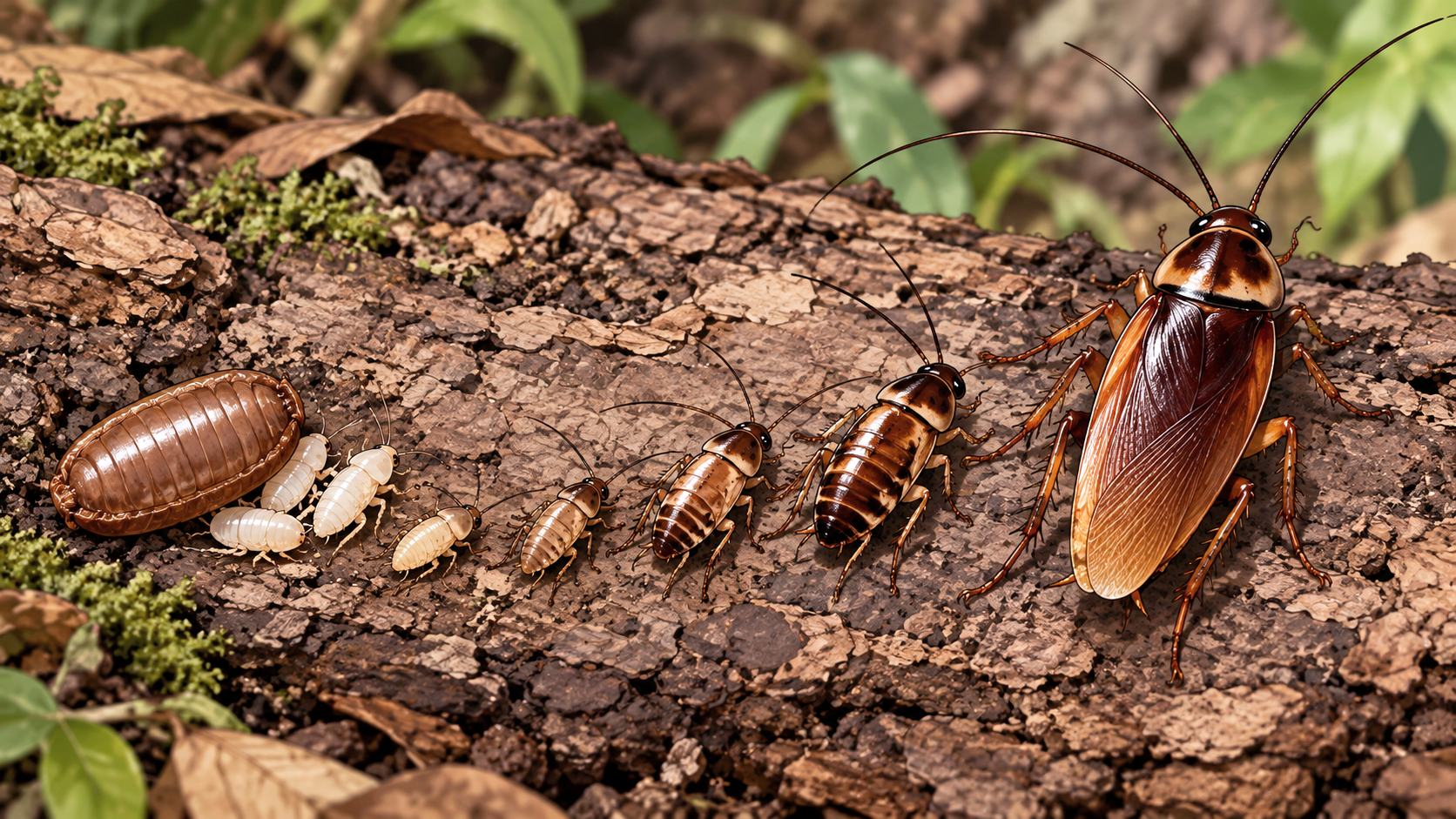
A cockroach does not pass through a worm-like larval stage or become a pupa before adulthood. Its development is much more gradual. A newly hatched cockroach already has the basic form of the insect it will become, then grows through repeated molts until the final molt produces an adult.
The cockroach life cycle has three stages: egg, nymph, and adult. Eggs develop inside an egg capsule called an ootheca. Nymphs hatch from the capsule and pass through several progressively larger stages called instars. After the final nymphal molt, the cockroach becomes a reproductive adult. There is no pupal stage. This pattern is known as incomplete metamorphosis.
The Cycle Starts Inside an Ootheca
Cockroach embryos generally develop within an ootheca, a protective capsule containing multiple eggs. How the female handles that capsule varies considerably by species. German cockroaches retain the ootheca at the end of the abdomen through most of embryonic development, while species such as American, Oriental, and brown-banded cockroaches deposit their capsules before hatching. The precise appearance of a cockroach egg case also varies by species, so an ootheca should not be expected to have one universal size or color.
Embryonic development can last weeks or considerably longer depending on the species and environmental conditions. Laboratory observations of German cockroaches at 26°C found that embryos developed for roughly 35 days before hatching, while American cockroach eggs have also hatched after about 35 days under controlled conditions. The reproductive processes that produce these capsules, including mating and ootheca formation, belong to cockroach reproduction rather than the developmental sequence itself.
Hatching Produces Nymphs, Not Larvae
When development inside the ootheca is complete, first-instar nymphs emerge. There is no caterpillar, maggot, grub, or other larval form between the egg and recognizable cockroach. Newly hatched individuals already share the general body plan of adults, although baby cockroaches are smaller and lack developed adult wings.
This form of development differs fundamentally from complete metamorphosis in insects such as beetles and flies. Cockroaches are hemimetabolous, meaning their development proceeds directly from egg through nymphal stages to adulthood. A tiny roach-like insect can therefore be an early developmental stage rather than a separate larval form.
Each Molt Moves the Nymph Into Another Instar
A cockroach cannot simply expand its existing exoskeleton as it grows. During the nymphal period, it periodically sheds the old cuticle and replaces it with a larger one. The interval between two molts is an instar, so first instar, second instar, and later instars describe successive developmental stages rather than different kinds of cockroach.
Immediately after a cockroach molts, its new cuticle is soft and pale. It subsequently hardens and darkens. Nymphs repeat this process several times before adulthood, but there is no single molt count that applies to every cockroach. German cockroaches commonly pass through about five or six nymphal instars under laboratory conditions, while American cockroach development can involve substantially more. One controlled study recorded 6 to 14 molts before American cockroaches reached adulthood.
Growth conditions can alter how quickly these stages pass. Temperature has a particularly strong effect on developmental rate, and food, humidity, sex, species, and other environmental conditions can also influence maturation. A cockroach’s age therefore cannot be calculated reliably from its size alone.
The Final Molt Produces the Adult
The transition to adulthood happens during the last nymphal molt. After emerging from its old exoskeleton and completing the normal hardening process, the cockroach has reached its adult form. Where the species develops functional adult wings, those structures become fully expressed at this stage rather than appearing as complete wings on earlier nymphs.
Adulthood also marks the reproductive phase of the life cycle. Nymphs cannot reproduce, whereas sexually mature adults can begin another generation. German cockroaches illustrate how quickly the cycle can turn under favorable laboratory conditions: research at 26°C recorded a complete egg-to-adult cycle of roughly 95 days. Other species develop much more slowly. Oriental cockroach nymphal development has been measured at approximately 185 days for males and 216 days for females under laboratory conditions.
There Is No Universal Cockroach Life-Cycle Length
Statements that a cockroach takes a particular number of weeks or months to become an adult are incomplete unless the species and conditions are specified. German cockroaches can mature relatively quickly, while larger or outdoor species may spend many months in the nymphal stage. Wood cockroach nymphs can even overwinter before reaching adulthood the following spring, and some may remain nymphs for considerably longer.
The same variation applies after maturity. Reaching adulthood is not the end of the animal’s lifespan, and adult longevity differs among cockroach species. Developmental speed and adult lifespan are therefore separate measurements. A species that reaches maturity quickly does not necessarily have the same total lifespan as another species that develops slowly.
The contrast between common pest species is substantial. A practical identification chart places German cockroach sexual maturity at roughly two months under favorable conditions, compared with about 15 months for American cockroaches and around 12 months for Oriental cockroaches. These figures are useful approximations rather than countdowns for an individual insect because temperature and other conditions alter cockroach development.
Questions About Cockroach Development
Can cockroaches reproduce before they become adults?
No. Nymphs are immature stages. Reproduction begins after the final molt has produced a sexually mature adult.
Does a cockroach become a pupa inside the egg case?
No. The ootheca contains developing eggs and embryos. Once they hatch, the young enter the nymphal stage directly. Cockroaches never have a pupal stage.
Can different stages be present in one infestation at the same time?
Yes. An established population can contain oothecae, nymphs of several instars, and adults simultaneously. Finding noticeably different sizes therefore does not necessarily mean several types of cockroaches are present.
Does every nymph become larger after each molt?
Growth occurs across successive molts because the old exoskeleton is replaced as the insect develops. The amount of change between individual instars varies, so size alone is not a precise way to assign an unknown nymph to a particular instar.