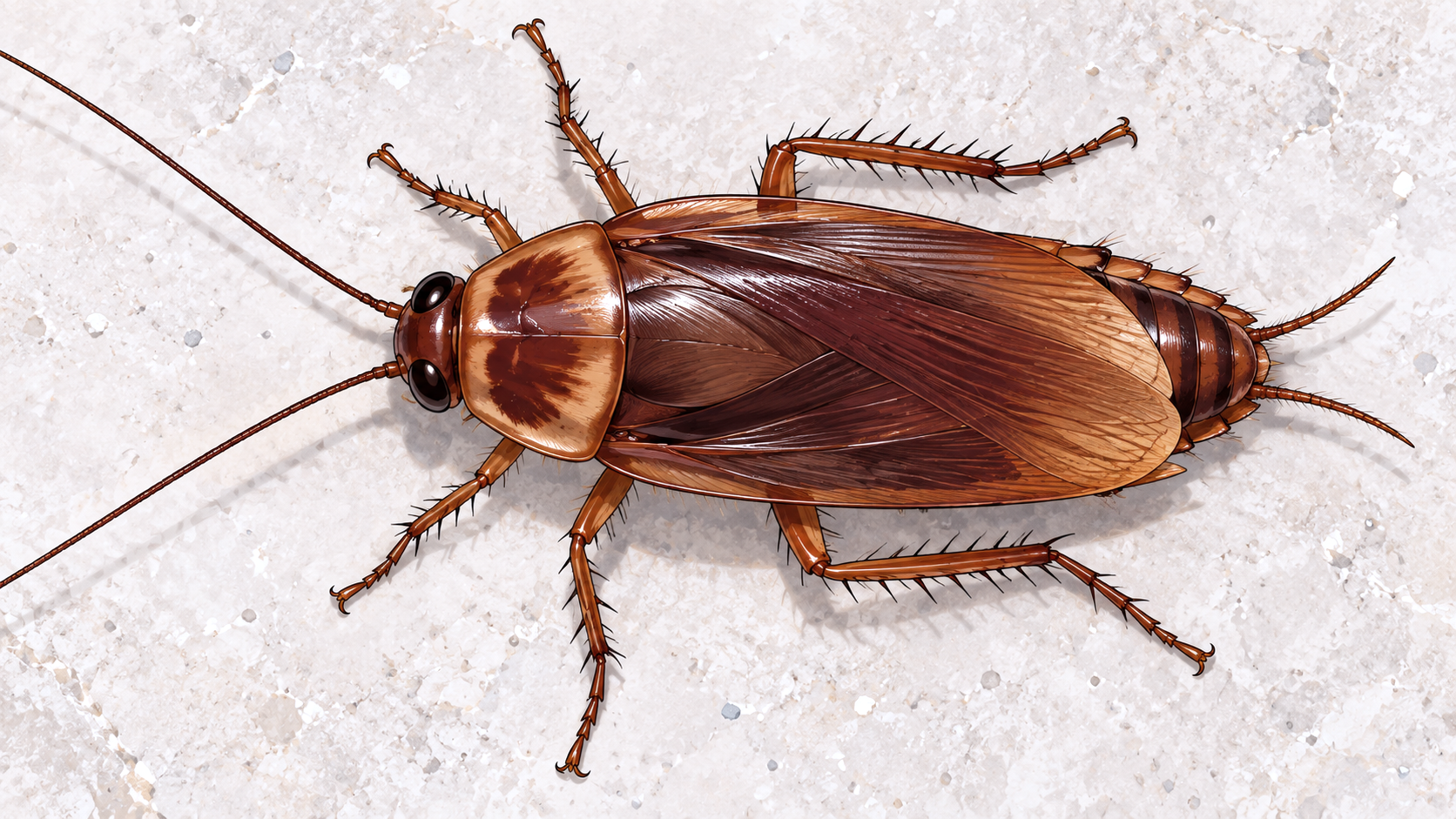
A cockroach is easier to understand when you stop looking at it as one flat brown shape. Its body is divided into three main regions: the head, thorax, and abdomen. The head carries most of its major sensory and feeding structures, the thorax supports locomotion and wings when present, and the abdomen contains much of the digestive and reproductive systems along with important sensory and respiratory structures.
That basic arrangement follows the insect body plan, but cockroaches have several particularly effective adaptations. Long sensory antennae investigate what lies ahead, chewing mouthparts handle varied foods, leathery forewings protect more delicate flight wings in many species, and rear appendages called cerci can detect disturbances behind the animal.
The Head Carries More Than the Features You Can Easily See
Two long antennae dominate the cockroach’s head. They are not decorative feelers. Cockroach antennae contain numerous sensory receptors that collect information about the surroundings, including chemical and mechanical stimuli. Research on their olfactory system has identified several types of sensilla containing sensory neurons, making the antennae major organs for detecting odors as well as physical contact.
Touch also feeds directly into evasive behavior. Mechanical stimulation of an antenna can activate neural pathways associated with rapid turning and escape. A cockroach moving through a dark crack can therefore gather information through physical contact instead of depending entirely on vision. Antennal receptors can also respond to environmental conditions such as humidity, adding another layer to their sensory role.
The head also carries compound eyes. Rather than functioning like a single-lens human eye, each compound eye consists of many individual visual units called ommatidia. Visual capabilities vary among cockroaches, but studies of Periplaneta have identified photoreceptors sensitive to ultraviolet and green wavelengths. Some cockroaches also possess simple light-sensitive organs called ocelli. These structures belong to the deeper explanation of how the animal senses its surroundings, while overall cockroach appearance is better judged from visible shape, size, coloration, and markings.
Cockroach Mouthparts Work Side to Side
Cockroaches have chewing mouthparts rather than a piercing tube or sucking proboscis. The major external components include the labrum, mandibles, maxillae, and labium. The mandibles are heavily hardened jaws that bite and grind with side-to-side movement, while the other mouthparts help manipulate material during feeding.
This generalized chewing arrangement suits an animal capable of using many organic food sources. It does not mean every material a cockroach touches is being eaten, and the mechanics of the mouthparts should not be confused with diet itself. Cockroach feeding behavior depends on available food and species ecology, while the anatomy simply provides the equipment for biting, processing, and handling suitable material.
Small appendages associated with the mouth also have sensory roles. Maxillary and labial palps help cockroaches examine potential food at very close range. Feeding is therefore not just a matter of mandibles cutting whatever happens to be in front of the insect; several structures participate in detecting and manipulating the material before and during consumption.
The Thorax Is the Cockroach’s Movement Center
Three segments make up the thorax: the prothorax, mesothorax, and metathorax. Each segment bears one pair of legs, accounting for the insect’s six legs. The dedicated question of how many legs a cockroach has involves their arrangement, joints, spines, feet, and locomotor function, so those details do not need repeating here.
A broad plate called the pronotum covers the upper surface of the prothorax. Because it sits immediately behind the head and can partly overhang it when viewed from above, people sometimes mistake the pronotum for the cockroach’s head. Its shape and markings can also contribute to species identification.
The two rear thoracic segments are where wings occur in winged adults. Cockroaches can have two anatomically different pairs: firmer forewings called tegmina and more delicate hind wings that fold beneath them. The forewings primarily form a protective covering, whereas the larger hind wings provide the principal flight surface. Wing development differs markedly among species and sexes, so visible wings do not guarantee strong flight ability. Those differences help explain why cockroach types can have noticeably different adult forms.
The Abdomen Houses Systems You Barely Notice From Outside
Behind the thorax lies the segmented abdomen. Much of what happens there is concealed by the exoskeleton, including major portions of the digestive and reproductive systems. Externally, however, several small structures reveal that the abdomen does far more than fill the rear half of the body.
Among them are spiracles, openings connected to the insect’s tracheal respiratory system. Cockroaches do not use lungs to move oxygen around the body in the vertebrate sense. Air enters the tracheal network through spiracles and travels through branching tubes toward tissues. Research on hissing cockroaches demonstrates how spiracle opening can coordinate with abdominal movement during ventilation, although respiratory mechanics vary with species, activity, and conditions.
The abdomen also contains the reproductive structures involved in mating and egg production. Their configuration differs between males and females, while the reproductive process extends far beyond external anatomy. Egg development and the characteristic egg case called an ootheca belong to cockroach reproduction and cockroach egg identification rather than to the body map itself.
Cerci Give a Cockroach Sensory Coverage Behind Its Body
At the rear of the abdomen sit two appendages called cerci. They can resemble a short second pair of antennae, but their location and sensory role are different. The cerci carry receptors capable of detecting small air movements, giving a cockroach information about disturbances approaching from behind.
Their sensitivity feeds into a remarkably fast escape system. Experiments recording the cockroach nervous system show that air movement across the cerci triggers sensory nerve activity. The signal can reach interneurons involved in initiating evasive movement, allowing the animal to react to a disturbance without first turning around to inspect it.
The antennae and cerci consequently cover different parts of the animal’s surroundings. Antennae project forward and actively contact objects, while the rear sensory system can detect changes in moving air. That combination helps explain why approaching a cockroach from behind does not necessarily catch it unaware.
The Exoskeleton Holds the Whole Arrangement Together
Like other insects, cockroaches carry their supporting framework outside the body. This exoskeleton provides structural support and surfaces for muscle attachment while protecting softer tissues underneath. It cannot simply stretch continuously as the animal grows, which is why immature cockroaches periodically shed the old cuticle. Cockroach molting allows a larger new exoskeleton to take its place.
The hardened outer covering is not equally rigid everywhere. Flexible membranes occur between plates and around joints, allowing the body and appendages to move. Sensory structures can also be incorporated directly into the cuticle. Cockroach campaniform sensilla, for example, are mechanoreceptors associated with the exoskeleton that respond to mechanical deformation.
Questions About Cockroach Body Parts
Do cockroaches have a brain?
Yes. A cockroach has a brain in the head as part of a nervous system that also includes ganglia and a ventral nerve cord. Considerable sensory processing and motor control can occur through neural circuits distributed beyond the brain itself.
Do cockroaches have bones?
No. Their structural support comes from the exoskeleton rather than an internal skeleton of bones. The jointed appendages move through muscles acting across this external framework.
Do cockroaches have blood?
Cockroaches have hemolymph rather than vertebrate blood. It circulates through an open circulatory system and performs several physiological functions, but oxygen delivery relies primarily on the tracheal respiratory system rather than red blood cells.
Is a cockroach’s head underneath its back?
No. The head is at the front of the body, but the pronotum immediately behind it can partly cover it from an overhead viewing angle. That overlap contributes to the characteristic profile people use when distinguishing cockroaches from beetles.