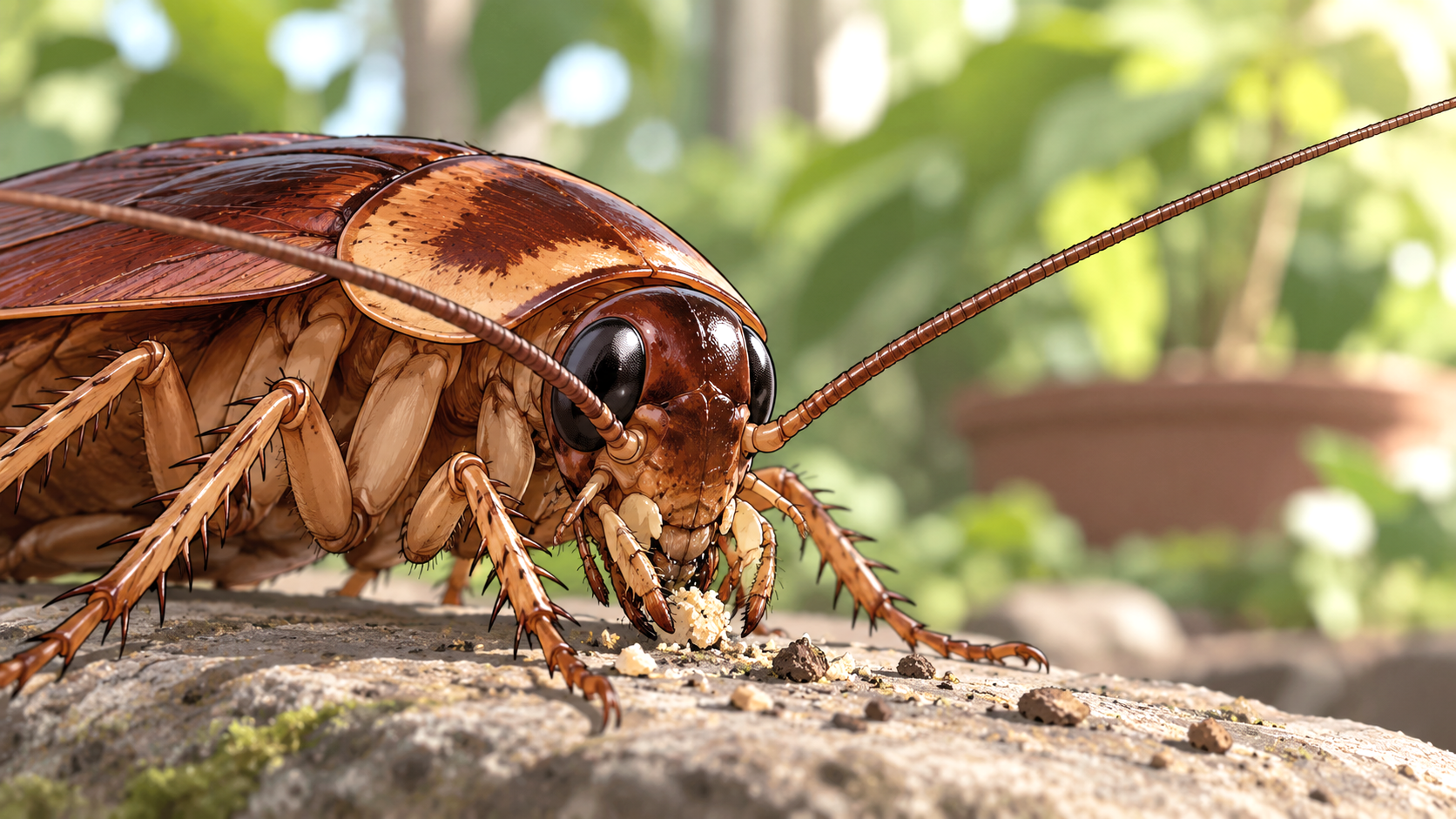
Venom requires more than an animal having unpleasant chemicals in its body. In biological terms, venom is a secretion actively delivered into another animal through a wound or specialized delivery mechanism for functions such as defense or feeding. Household cockroaches do not operate that way. Household cockroaches are not venomous. They have no venom apparatus that injects toxins when they bite or make contact with a person. Although some cockroach species produce defensive chemical secretions, those substances are released externally rather than delivered through a venomous bite or sting.
A Cockroach Bite Does Not Inject Anything
Venom systems combine a biologically active secretion with a way of delivering it into a target. Depending on the animal, that apparatus might involve fangs, stingers, spines, specialized teeth, or another structure that wounds the target while transferring the secretion. Modern toxinology generally defines venom as a specialized secretion actively delivered through an inflicted wound.
Nothing comparable exists in household cockroach anatomy. A cockroach has mandibles and other chewing mouthparts used to process food, not venom-injecting fangs. Its legs are spiny but lack venom-delivery structures, and there is no stinger hidden at the rear of the abdomen. The ordinary external features of a cockroach are therefore mechanically useful for feeding, movement, sensing the environment, and protection rather than envenomation.
Cockroaches are physically capable of using their mandibles on human tissue under exceptional conditions, but documented cockroach biting is extremely unusual. Even when a bite occurs, it is a mechanical injury. There is no accompanying injection of cockroach venom.
Defensive Secretions Do Not Make Cockroaches Venomous
Cockroach chemistry is more interesting than the simple answer might suggest. Studies covering multiple cockroach genera have identified dozens of compounds in defensive and signaling secretions, including quinones, phenols, acids, ketones, aldehydes, hydrocarbons, and alcohols. Their functions differ among species. Some deter predators, some appear to act as alarm signals, and the roles of others remain uncertain.
Certain examples are particularly striking. The Pacific cockroach Diploptera punctata can discharge an aerosol containing benzoquinones when disturbed, while defensive secretions studied in Eurycotis floridana contain several hexenal-derived compounds. Another cockroach, Therea petiveriana, releases a glandular secretion that experiments indicate functions as an alarm signal.
These examples describe chemical defenses, not venom systems. Producing a deterrent secretion does not automatically qualify an animal as venomous because toxicity alone is insufficient to define venom. The secretion must function through the relevant delivery process. A cockroach releasing material from a defensive gland is biologically different from a wasp driving a venom-bearing stinger into another animal.
Household Cockroaches Are Not Little Venomous Predators
German, American, Oriental, and brown-banded cockroaches are scavenging insects rather than predators that subdue prey with toxins. Their food choices span many forms of organic material, and their survival does not depend on immobilizing animals with venom. This differs sharply from arthropods such as many spiders, scorpions, and centipedes, whose venom systems help with prey capture or defense.
The enormous diversity within Blattodea also makes it unwise to take an unusual chemical adaptation discovered in one cockroach species and apply it to every roach encountered indoors. Thousands of cockroach species exist worldwide, while only a small subset commonly becomes a structural pest. Identifying the type of cockroach living around a building provides more useful information about its behavior and habitat than assuming all cockroaches share the specialized defenses documented in a few species.
A Reaction After Cockroach Exposure Is Not Envenomation
Someone can experience a genuine health problem associated with cockroaches without venom being involved. Proteins in feces, saliva, secretions, shed material, and body fragments can become indoor allergens. Susceptible people may experience allergic or asthmatic symptoms from exposure to cockroach allergen, which is an immune response rather than an effect of injected toxin.
Cockroaches can also acquire microorganisms while moving through contaminated environments. Their ability to carry microorganisms between unsanitary areas and food or surfaces involves mechanical contamination, not venom. Keeping these mechanisms separate prevents a broad health concern from being incorrectly described as a toxic bite.
Questions About Cockroaches and Venom
Do cockroaches have venom glands?
Household cockroaches do not have a venom system comparable to the glands and delivery structures of venomous animals. Some cockroach species possess glands producing defensive or signaling secretions, but a defensive gland is not automatically a venom gland.
Can cockroach leg spines inject venom?
No. The spines on cockroach legs are physical structures involved in locomotion and interaction with the environment. They are not hollow venom-delivery organs and are not connected to a venom gland.
Can a cockroach spray venom?
Some non-household cockroach species can discharge defensive chemicals, including species with particularly elaborate glandular defenses. Describing those secretions as “cockroach venom” would blur an important biological distinction because they are not injected through a venom apparatus.
Does crushing a cockroach release venom?
No. Crushing a household cockroach does not release venom. It can expose body fluids and allergenic material, however, so removing the insect and cleaning the affected surface is preferable to handling the remains unnecessarily.