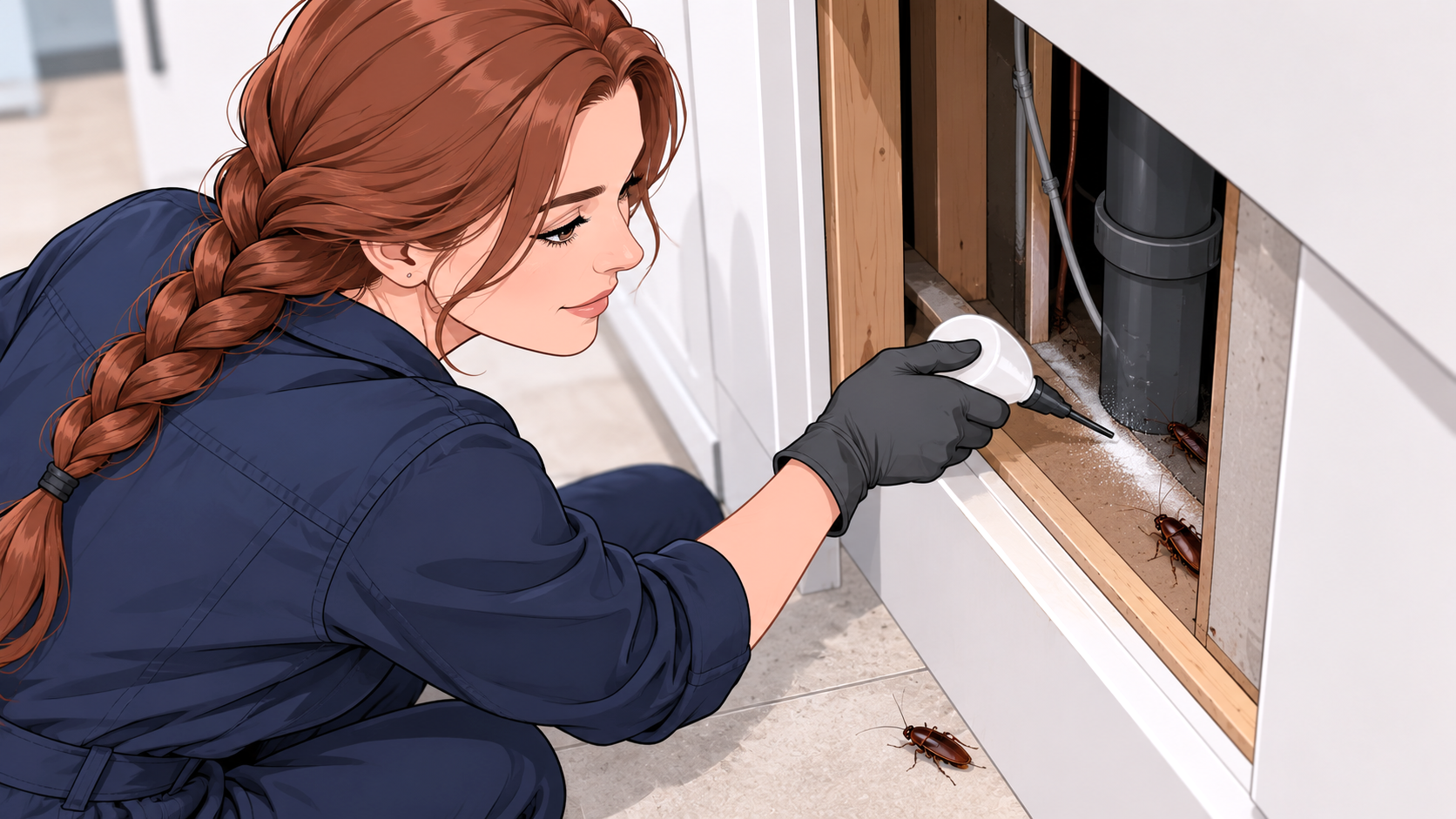
Boric acid has a legitimate history in cockroach control, but the familiar advice to scatter white powder around a kitchen leaves out two important details. Cockroaches have to encounter an effective formulation and application, and the product must be legally registered for the way you intend to use it. A pile of household boric acid is not automatically an appropriate cockroach treatment.
Boric acid can kill cockroaches. Cockroaches can be exposed after ingesting boric-acid bait or contacting appropriately applied insecticidal material and later ingesting residues during grooming. Use only a registered cockroach-control product and follow its label exactly, because permitted formulations and application methods differ between products and countries.
Boric Acid Is Slow Acting Rather Than an Instant Contact Treatment
Boric acid does not behave like an aerosol that rapidly knocks down a cockroach as soon as it is sprayed. German cockroaches are susceptible to boric acid through ingestion, and experimental work has found that ingested boric acid damages the cellular lining of the foregut. Cockroaches can also be affected after contact with boric-acid material, partly because residues adhering to the body can subsequently be consumed during grooming.
That slower action can still produce substantial mortality. Laboratory work has demonstrated that German cockroaches are susceptible to boric acid through both ingestion and contact, while experiments with ingested insecticidal baits found that boric acid consumed by adult German cockroaches could remain active in excretions and cause mortality in other cockroaches. These results establish that boric acid is genuinely insecticidal rather than a folk remedy, but laboratory efficacy does not mean every homemade mixture or household application will perform the same way.
Boric acid also does not remove the conditions supporting an infestation. Cockroaches still have access to their usual food sources, water, and protected harborages unless those conditions are addressed separately. A treatment placed in the wrong location may therefore coexist with an active infestation instead of eliminating it.
More Powder Is Not Automatically Better
The effectiveness of a dust treatment depends on cockroaches encountering it, not on making the application conspicuous. Thick lines and piles are unnecessary unless the particular product label specifically directs that type of placement. Some U.S.-registered boric-acid labels restrict dust to areas inaccessible to children and pets and require visible powder outside designated treatment areas to be removed.
Placement should follow observed cockroach activity and the exact label rather than a habit of spreading powder across every edge of a room. Cockroach infestation evidence such as trap catches, fecal spotting, nymphs, and activity around protected harborages can help identify where treatment deserves attention. Food and exposed preparation surfaces should never be contaminated.
Moisture also matters for some dust formulations. A powder that becomes wet, clumped, displaced during cleaning, or otherwise altered may no longer remain where the label intended it to work. Persistent water should be corrected anyway because cockroaches depend on available moisture and plumbing leaks can support continued activity independently of the pesticide.
Check the Product, Not Just the Ingredient Name
“Boric acid” on a container does not by itself tell you that the product is approved for cockroach control. Boric acid appears in pesticides as well as cleaning products, personal-care products, craft materials, and other consumer goods. Pest control requires a registered pesticide whose label includes the target pest and intended application.
This becomes particularly important when reading online instructions from another country. Canada cancelled domestic boron pesticide products in dust and granular formulations, along with most domestic solution products outside enclosed bait stations and localized gel treatments. Current Canadian use therefore has to follow the registration status and updated label for the individual product. Registered Canadian pesticide labels can be checked in the Pesticide Product Information Database.
U.S. registrations are not identical. Some boric-acid cockroach dust products have EPA-approved directions for particular indoor placements, but those directions belong to those products. They should not be copied onto a different boric-acid product or treated as universal instructions.
Borax and Homemade Boric Acid Recipes Are Not Substitutes for a Registered Product
Borax and boric acid are related boron compounds, but they are not interchangeable names for the same substance. A laundry product containing borax is not automatically a cockroach pesticide, and converting a household chemical into a homemade bait does not supply the tested formulation, legal directions, exposure controls, or application restrictions of a registered product.
Sugar-and-boric-acid recipes are particularly common online because cockroaches can consume boric acid in bait. Experimental evidence that a prepared formulation can poison cockroaches does not validate every kitchen recipe or concentration. Health Canada specifically advises consumers not to make homemade pesticides with boric acid.
The same caution applies to attempts to make boric acid part of a “natural” pesticide mixture. Boron occurs naturally, but natural origin does not make a substance harmless or exempt it from pesticide rules. A non-conventional approach to getting rid of cockroaches naturally can rely heavily on sanitation, trapping, vacuuming, moisture correction, and other nonchemical methods without improvising a pesticide formulation.
Boric Acid Needs to Be Kept Away From Children, Pets, and Food
Boric acid should not be treated like harmless household dust. Exposure can occur through ingestion, inhalation, and contact, and excessive exposure has potential health consequences. Current Canadian health information identifies concerns about developmental and reproductive effects from sufficiently high exposure, while toxicological information on boron compounds documents effects following substantial ingestion and irritation from airborne borate dust. Those hazards are why placement restrictions and exposure precautions on the individual pesticide label matter.
Keep the product in its original labeled container and store it where children and pets cannot reach it. Do not transfer pesticide powder into an unmarked food container, seasoning bottle, or other package that could be mistaken for something edible. Never put an exposed homemade mixture where a child or animal can consume it. If accidental ingestion occurs, contact the appropriate poison service or medical professional promptly rather than waiting for symptoms; significant borate ingestion can cause poisoning.
Pet access deserves the same care even when a product is sometimes described as having comparatively low acute toxicity. “Lower toxicity” is not the same as safe to eat. Follow the label’s restrictions for animals and placement rather than estimating a safe amount yourself.
Boric Acid Works Better as One Part of Control Than as the Entire Plan
A cockroach can only be affected by a treatment it encounters. Food debris, leaking water, clutter, and numerous untreated harborages can allow a population to persist around poorly placed pesticide. Cleaning and pesticide treatment are therefore used together in cockroach management, with traps helping identify where activity is concentrated.
Reproduction adds another limitation. Cockroach egg cases can contain developing young, and the cockroach life cycle means treatment success should be judged over time rather than by the disappearance of visible adults immediately after application. Continued nymph activity can indicate that the infestation remains established.
Boric acid can therefore fit within the broader cockroach removal process when an appropriate registered product is available, but sanitation, monitoring, moisture correction, and follow-up still have separate jobs. Reapplying more product without checking whether cockroach activity is actually declining can increase exposure without addressing the reason treatment is failing.
Practical Boric Acid Questions
How quickly does boric acid kill a cockroach?
There is no reliable household countdown because exposure route, dose, formulation, species, and individual product all affect the result. Boric acid is generally treated as a slow-acting cockroach insecticide rather than an immediate knockdown product.
Does boric acid lose effectiveness with age?
A stored product should be judged by its label, expiration information if provided, and physical condition rather than an assumed universal shelf life. Material already applied can be removed, contaminated, wetted, or displaced, so an old application should not automatically be considered active simply because some powder remains visible.
Can I put boric acid inside electrical outlets?
Do not place pesticide inside an electrical outlet merely because cockroaches have appeared nearby. Electrical equipment creates additional hazards, and the pesticide label determines where the product may legally and safely be applied. If cockroaches are using inaccessible electrical or structural voids, professional treatment may be more appropriate.
Will boric acid stop cockroach eggs from hatching?
Do not assume an exposed boric-acid treatment directly destroys every concealed egg case. Continue monitoring after treatment because newly emerged baby cockroaches can reveal that reproduction is continuing even after adult activity has declined.