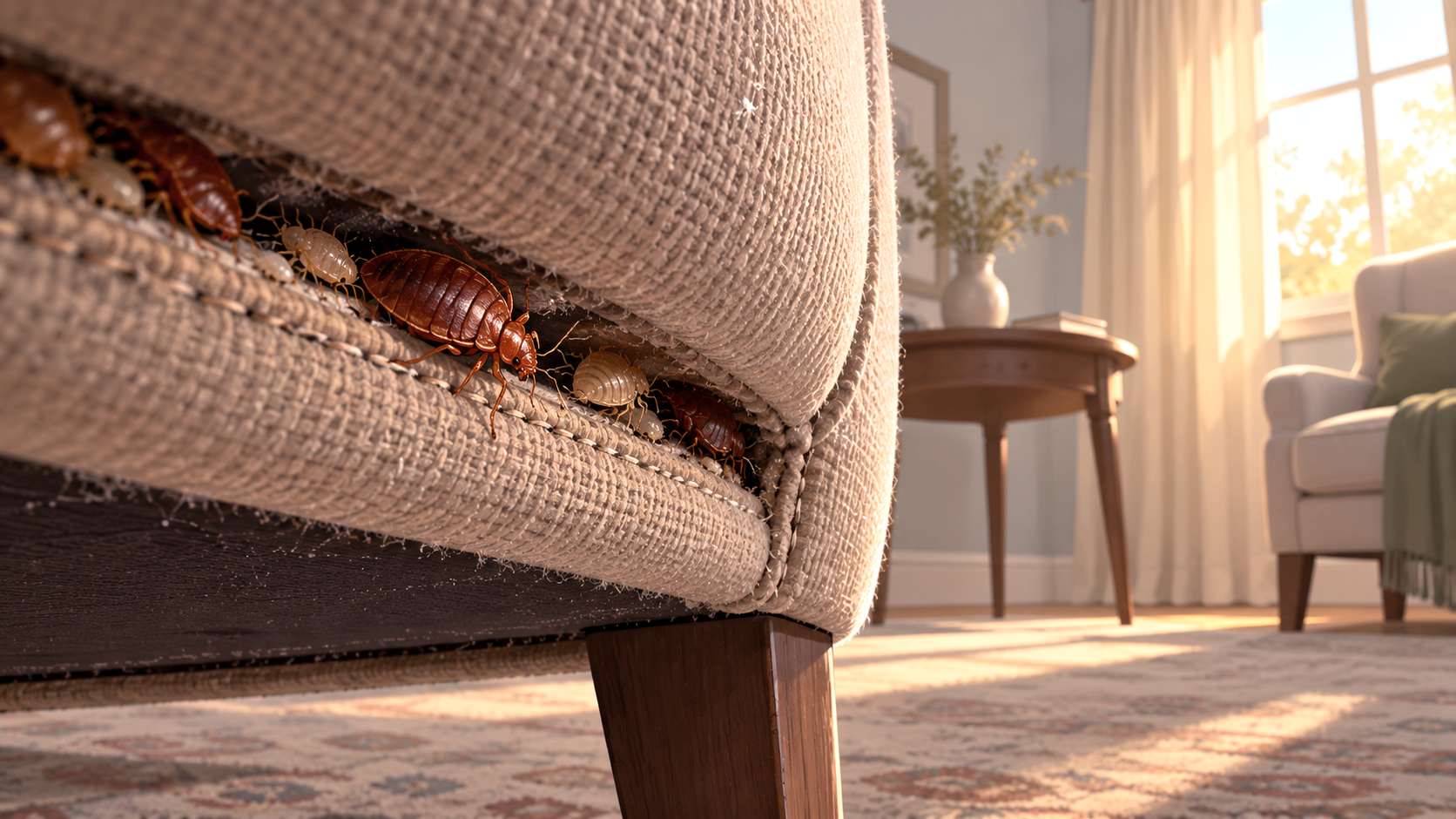
An established bed bug infestation is unlikely to disappear on its own while it still has access to people or other suitable hosts. Bed bugs can reproduce, remain hidden for long periods and survive extended gaps between blood meals. Seeing fewer bugs or receiving no bites for a while does not establish that the population has died out. A very small introduction can sometimes fail naturally if the insects die before reproducing. That possibility is not a dependable control strategy once continuing bed bug activity has been confirmed.
A Lone Hitchhiker Can Die Without Starting an Infestation
Not every bed bug brought into a home successfully establishes a population. A single male cannot produce offspring by itself. An immature bed bug might die before reaching adulthood, and an unmated female would need access to a male before reproduction could continue. Accidental introductions can therefore end without becoming established.
That possibility explains why finding one bed bug in a house does not reveal how many others are present. One insect could genuinely be alone, or it could be the visible member of a concealed population. Eggs, multiple developmental stages, fecal spotting, shed skins and repeated detections provide much stronger evidence that reproduction or continuing activity is occurring.
Once females are reproducing, natural extinction becomes much less plausible. Under favorable conditions, females can lay one to three eggs per day and hundreds during their lifetime, while the egg-to-egg life cycle can take approximately four to five weeks. An established population therefore has the capacity to replace insects that die naturally.
There is consequently no fixed number that defines a bed bug infestation. Waiting until many insects become visible gives a potentially small population additional time to develop.
An Empty Bedroom Does Not Reliably Starve Them Out
Leaving the room, going on vacation or temporarily moving elsewhere can remove the easiest blood source, but bed bugs tolerate starvation far better than many household pests. Their survival time depends on developmental stage, temperature, humidity and the bed bug population being studied.
Controlled research found substantial variation among strains. First-instar nymphs had mean starvation survival times of about 14 to 36 days, while fifth-instar nymphs and adults averaged roughly 42 to 143 days in the experimental conditions. The researchers also found significant differences between insecticide-resistant and susceptible strains, demonstrating why a single universal starvation period is misleading.
Cooler conditions can extend survival considerably. Federal bed bug training material notes that bed bugs have survived 20 to 400 days without feeding depending on temperature and humidity. Their physiology is unusually well suited to conserving water between meals, including low rates of water loss and substantial dehydration tolerance. Experimental work has documented adaptations that allow prolonged survival between blood meals.
A vacant room may therefore remain infested long after a person stops sleeping there. The exact limits belong to the broader question of how long bed bugs can survive without feeding, but the practical consequence is straightforward: absence of a host is not a quick extermination method.
Quiet Periods Can Make an Infestation Look as Though It Disappeared
Bed bug activity is not equally noticeable every night. Recently fed insects do not immediately need another meal, and hunger affects their movement. Laboratory observations found that recently fed adults moved less frequently than short-term-starved adults, while prolonged starvation eventually reduced activity. Bed bugs also showed a strong tendency toward greater movement during darkness.
Human skin reactions add another layer of uncertainty. Some people react strongly to bites, others react after a delay, and some develop little noticeable reaction at all. A week without obvious marks therefore cannot demonstrate that feeding stopped. Bed bug bites do not always itch, and skin symptoms are too inconsistent to function as a population monitor.
Hidden insects may be equally easy to miss. Bed bugs fit into narrow seams, joints and cracks around beds and furniture. Early infestations can contain so little visible evidence that physical inspection needs to concentrate on eggs, shed skins, fecal spots and live insects. A period with no sightings can mean the remaining population is concealed rather than gone.
Normal Winter or Summer Weather Is Not a Reliable Natural Cure
Bed bugs can die when their bodies reach lethal temperature extremes, but ordinary changes in household temperature do not reliably expose every hidden insect to those conditions. They can survive and remain active at surprisingly low temperatures, while lethal cold depends on both temperature and exposure duration.
Laboratory research found that bed bug survival under cold exposure varies considerably with temperature and time. Even continuous exposure above about -12°C could permit survival for a week under the tested conditions, whereas sufficiently colder exposures were required to reliably kill all stages. The researchers concluded that bed bugs are freeze-intolerant but can withstand substantial cold exposure.
Heat presents the opposite challenge. Bed bugs are vulnerable when their body temperature becomes sufficiently high, but warming a room casually is not equivalent to a controlled bed bug heat treatment. Federal safety guidance specifically warns against trying to eliminate an infestation by turning up a thermostat, using a fireplace or operating propane space heaters because such attempts can fail and create serious hazards. Effective heat control requires lethal temperatures to reach insects and eggs throughout their hiding places.
Moving to Another Room Can Move the Feeding Activity Instead
Sleeping elsewhere while waiting for bed bugs to starve can alter where they search for food. Hungry bed bugs can travel from established harborages to reach a host, and in multi-unit buildings they may also move through structural routes between units. Their ability to spread between apartments makes deliberate starvation especially unsuitable as a control strategy in shared housing.
Moving bedding, pillows or other belongings can create another route of spread if insects are concealed among them. Bed bugs readily hitchhike on furniture, bedding, luggage, boxes and clothing, which is why moving potentially infested possessions can introduce them elsewhere.
Remaining in the normal sleeping location while an appropriate control program is underway can help keep activity concentrated and monitorable. Measures such as isolating the bed and using interceptor cups beneath suitable bed legs can make moving insects easier to detect without deliberately relocating the host.
Elimination Requires Evidence, Not Just the Absence of Bites
A genuine end to an infestation means the reproducing population has been eliminated, including insects and viable eggs. Control commonly requires more than one action because bed bugs hide deeply, eggs can survive some interventions and insecticide resistance can reduce the effectiveness of certain products. Federal guidance describes bed bug control as a process that can take weeks to months and may require repeated inspection and treatment.
Integrated control can combine monitoring, clutter reduction, vacuuming, laundering and high-heat drying where appropriate, encasements, steam, targeted pesticides or professional treatment depending on the circumstances. Bed bugs are sufficiently difficult to eliminate that Health Canada strongly recommends professional pest control when an infestation is present.
After control begins, judge progress from physical evidence and monitoring rather than waiting for another bite. Determining whether bed bug treatment has worked requires enough time and observation to detect surviving insects or newly hatched nymphs. A quiet few nights alone cannot provide that certainty.
Questions About Bed Bugs Disappearing Without Treatment
Can bed bugs die naturally from old age?
Yes. Individual bed bugs eventually die from age, environmental stress, injury or other causes. Natural deaths do not eliminate an established infestation when surviving adults continue producing offspring.
What if I have not seen a bed bug for a month?
A month without a sighting is encouraging only when considered alongside systematic monitoring and the previous infestation level. Bed bugs can remain concealed and survive extended periods without feeding, so the calendar alone cannot confirm elimination.
Could predators make bed bugs disappear?
Some arthropods can prey on bed bugs, but household predators do not provide reliable population control. Introducing or tolerating another pest is not an appropriate bed bug management method.
Can bed bugs disappear after you throw away the mattress?
Not necessarily. Bed bugs can occupy the bed frame, headboard, upholstered furniture, baseboards, cracks and other harborages beyond the mattress. Discarding one infested object can therefore leave surviving insects behind and can spread them if the item is moved through a building without proper precautions.