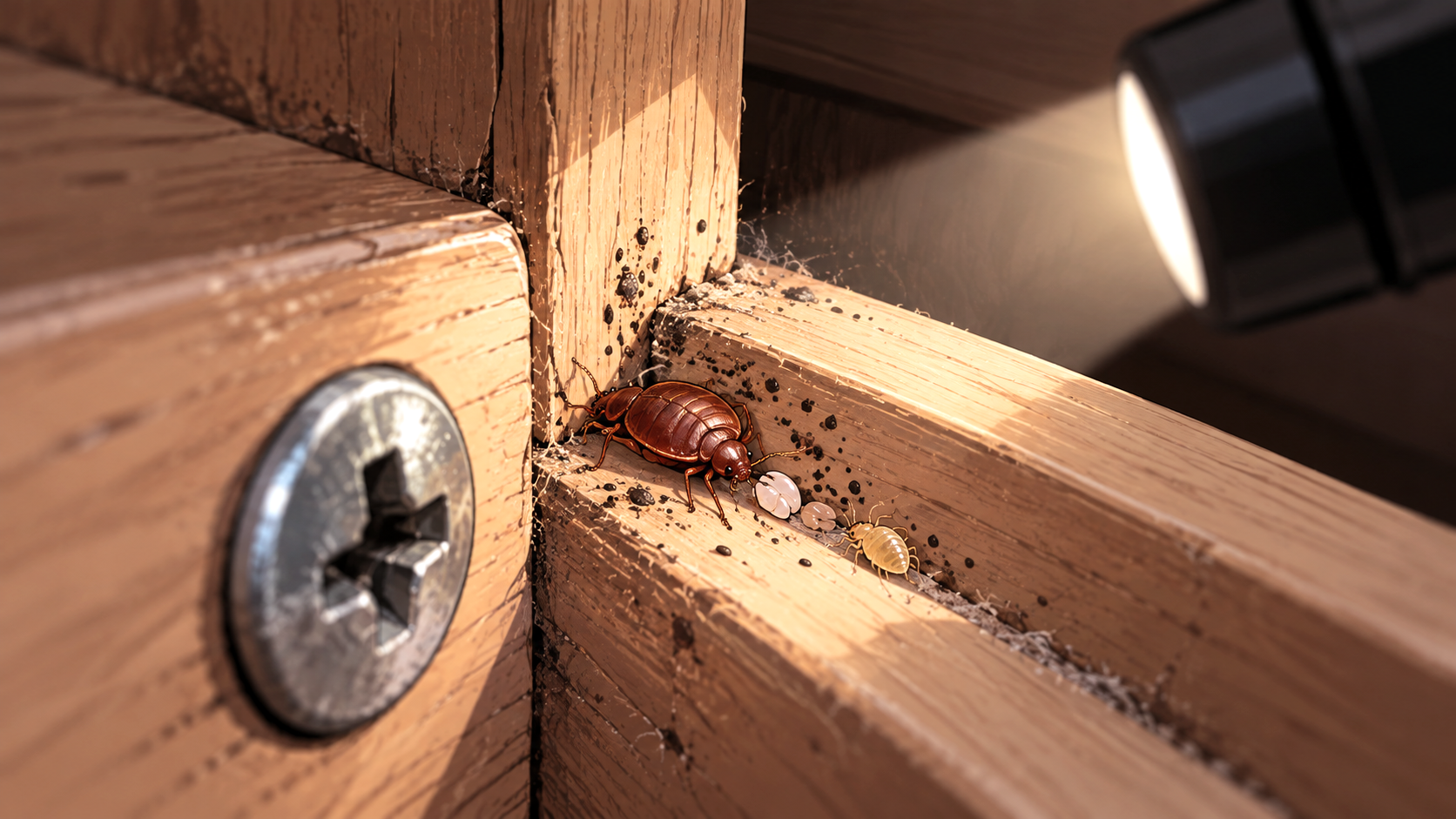
There is no official number of bed bugs that automatically counts as an infestation. One confirmed bed bug can be an isolated introduction, while multiple bed bugs, eggs, nymphs or repeated detections indicate an established population. In a home, even one verified bed bug deserves investigation because early infestations can contain very few detectable insects. The number you happen to see is also not a census. Bed bugs spend much of their time concealed, so visible bugs may represent only part of the population.
One Bed Bug and an Infestation Are Not Exactly the Same Thing
The word infestation implies that bed bugs have become established in a location rather than that a single insect merely arrived there. That difference is especially important in schools, workplaces, libraries and other public buildings. A bed bug can hitchhike into such a location on clothing or belongings without establishing a breeding population. Federal guidance for public places explicitly states that a single bed bug is not itself an infestation and recommends tracking an area after a sighting rather than assuming immediately that bed bugs are reproducing there.
A bedroom presents a different level of concern because it provides regular access to a sleeping host and abundant hiding places. A lone insect found on a mattress could still be newly introduced, but it could also be the only member of a small population that happened to be visible. A female that has already mated creates an additional concern because females can lay eggs after obtaining blood meals. Consequently, finding one bed bug in your house warrants a careful search even though the sighting cannot establish the population size by itself.
Eggs and Different Life Stages Reveal More Than a Head Count
Evidence of reproduction makes the situation much clearer. Finding eggs alongside adults, or finding adults with nymphs of different sizes, indicates that bed bugs have been developing at the location rather than simply arriving as a single hitchhiker. Bed bugs progress from egg through five nymphal stages before adulthood, and each nymphal stage requires a blood meal before the next molt.
Eggs are particularly useful evidence because they do not travel independently. Females place them in protected locations, and under favorable conditions the complete bed bug life cycle can proceed rapidly enough for a small introduction to become a growing population. Health Canada notes that females can produce approximately two to four eggs per day and at least 200 eggs during their lifetime.
Cast skins provide another record of development. Nymphs shed their exoskeletons as they grow, so bed bug shed skins and casings around a harborage can remain after the insects themselves have moved deeper into cracks. Eggs, nymphs, cast skins and repeated live-bug detections collectively provide much stronger evidence of an established infestation than an isolated adult discovered once.
Five Bugs in a Trap Does Not Mean Only Five Bugs Are Present
Bed bug numbers are unusually difficult to estimate from casual inspection. Unfed nymphs are tiny and pale, eggs are about one millimeter long, and adults can squeeze into narrow spaces. Low-level infestations are consequently among the hardest to detect. Even official guidance warns that minor infestations can be considerably more difficult to find than populations that have already spread.
Research comparing detection methods demonstrates how much the method changes the count. In lightly infested apartments, passive interceptors detected bed bugs more effectively than visual inspection alone. The investigators concluded that interceptors were useful for detecting small bed bug populations that could otherwise be missed. Another housing study found that nearly half of infestations discovered through systematic monitoring occurred in apartments where residents were unaware of any bed bug activity. Interceptors detected about 89% of the infestations, compared with approximately 72% detected through brief visual inspection.
A count therefore needs context. Catching five insects over several nights with bed bug interceptor cups establishes activity, but it cannot be converted into a reliable estimate such as “there are 20 bugs in the room.” Hidden harborages, trap placement, the number of monitors and the length of monitoring all influence how many insects are found.
Researchers Use Population Categories, but They Are Not Universal Infestation Thresholds
Scientific studies sometimes divide infestations into low, medium and high population levels. Those categories are useful for experiments and treatment decisions, but the numerical boundaries depend on the sampling system being used.
One apartment study calculated population levels by combining bed bugs caught in interceptors over a standardized period with bugs found during visual inspection. The researchers specifically cautioned that management thresholds need adjustment for housing type, bed numbers and sampling method. A count obtained from nine interceptors operating for two weeks cannot automatically be compared with a ten-minute visual inspection of one mattress.
Field studies illustrate the enormous range that can exist under the single label of infestation. One integrated pest management trial included apartments where initial monitoring found anywhere from one to 1,428 bed bugs. Both ends of that range required attention, but they clearly represented very different population levels.
For a homeowner, labels such as “light” or “heavy” are therefore more useful when based on the distribution and amount of evidence than on an arbitrary universal number.
Repeated Evidence Can Confirm a Population Even When Few Live Bugs Are Seen
Live insects are only one form of evidence. Dark fecal spotting around harborages, eggs, eggshells and shed skins can reveal activity that a brief inspection misses. Rust-colored marks may also occur when fed insects are crushed. These are among the physical signs used to locate bed bug infestations.
The pattern matters as much as any individual sign. One insect followed by additional bugs on later nights, fresh fecal spotting or developing nymphs provides evidence that activity is continuing. Bed bug fecal marks concentrated around mattress seams, furniture joints or other harborages can also indicate where insects have been spending time.
Bites cannot supply the missing population count. People differ greatly in their skin responses, and some do not develop noticeable itching after bed bug bites. One person waking with twenty marks does not prove that twenty insects fed, just as someone with no marks cannot conclude that the room contains none.
Population Size Changes How Widely You Need to Search
Small populations tend to be easier to overlook because relatively few insects and traces are present. As numbers increase, bed bugs may occupy more harborages beyond the immediate mattress and bed frame. Heavy infestations can extend into upholstered furniture, drawer joints, wall junctions, loose wallpaper and electrical receptacles.
That spread makes early detection valuable. Research on low-level apartment infestations has shown that populations containing relatively few detectable insects can be managed successfully, and sustained monitoring itself can contribute to population reduction. In one study, researchers followed low-level infestations with interceptors for up to 22 weeks and demonstrated the value of continued monitoring rather than relying on a single inspection.
In multi-unit housing, distribution also matters because bed bugs can move between neighboring apartments. A small number found in one unit can therefore justify checking adjoining areas rather than waiting for the visible count to become large.
What to Do When You Cannot Tell Whether There Is One Bug or Many
Confirm first that the insect is actually a bed bug. Carpet beetles, bat bugs and other small insects are sometimes mistaken for them. Once identification is secure, inspect mattress seams, the box spring, bed-frame joints, the headboard and nearby furniture for additional insects, eggs, cast skins and fecal marks. Interceptors beneath suitable bed or furniture legs can extend detection beyond the few minutes available during a visual search.
Do not wait for an arbitrary number such as five, ten or twenty before responding to confirmed activity in a home. Early populations are easier and generally less expensive to address than infestations allowed to spread. If treatment begins, continued monitoring is also necessary because determining whether bed bug treatment worked depends on the absence of continuing activity over time, not merely on finding zero bugs during one inspection.
Questions About Bed Bug Infestation Numbers
Does finding two bed bugs mean they are breeding?
Not necessarily. Two insects could have been introduced together, particularly through infested belongings. Finding eggs, nymphs or repeated activity provides stronger evidence that reproduction is occurring locally.
Can you have an infestation with fewer than ten bed bugs?
Yes. Research routinely recognizes low-level infestations containing small detectable populations. Ten is not an official minimum, and detection methods may miss insects concealed in harborages.
How quickly can a few bed bugs become many?
Growth depends on temperature, access to blood, sex and reproductive status of the insects, survival and other conditions. Under favorable circumstances, females can lay eggs repeatedly and the egg-to-egg life cycle can occur within several weeks, so delaying investigation gives an established population time to expand.
Does one male bed bug mean there cannot be an infestation?
No. Identifying one insect as male only describes that specimen. Other males, females, nymphs or eggs may still be hidden elsewhere, so sexing a single captured bug cannot establish what else is present.
One thought on “How Many Bed Bugs Count as an Infestation?”