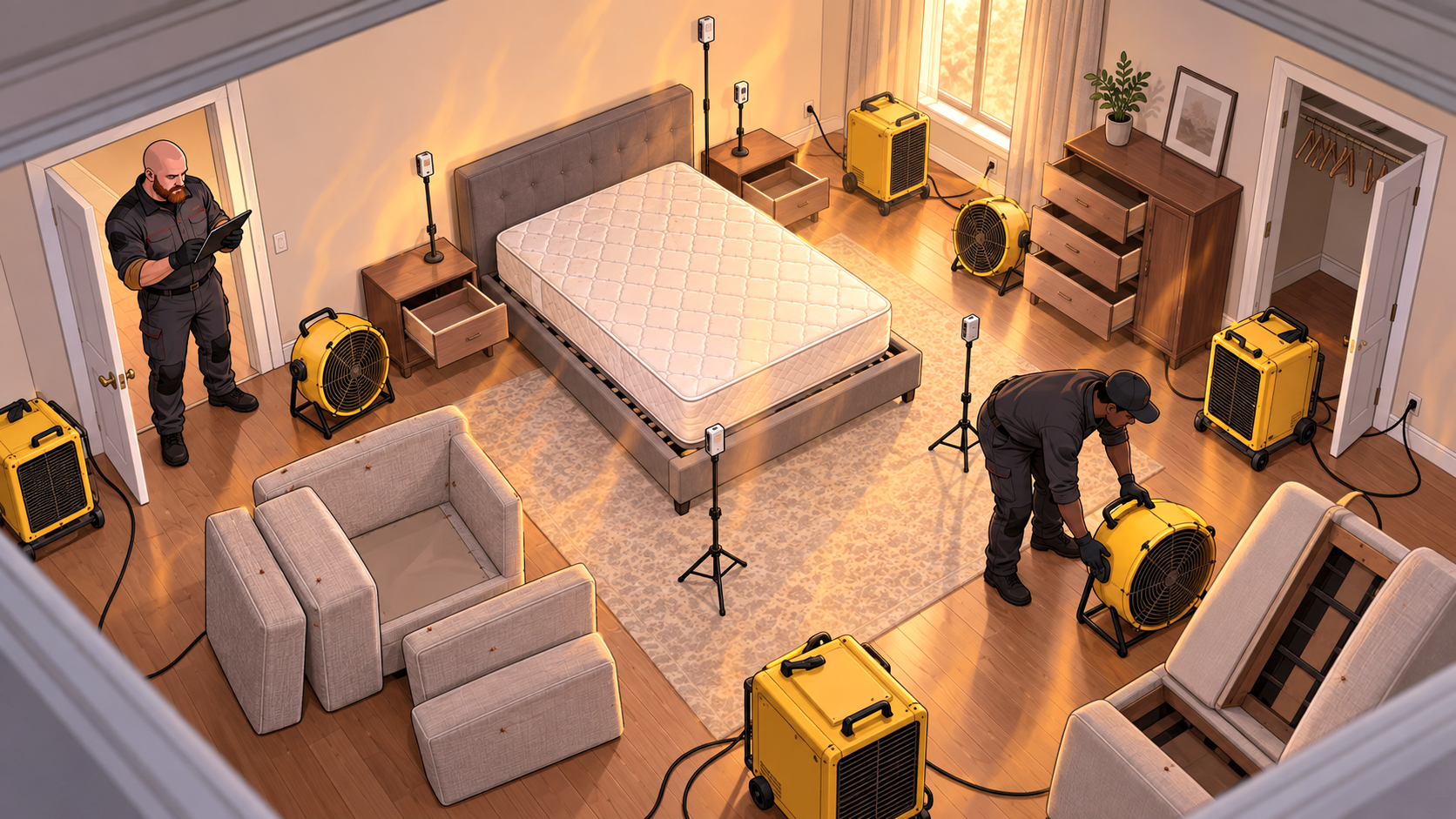
Bed bug heat treatment uses commercial heating equipment and fans to raise temperatures throughout an infested room or home until lethal heat reaches the places where bed bugs and their eggs are hiding. It can kill every life stage without relying on insecticides alone, but success depends heavily on temperature monitoring, airflow, treatment time, and technician skill.
Professional heat treatment can be worth the cost when you want a fast, whole-area treatment and the property can be heated effectively. However, heat is not automatically a one-treatment cure. Cold spots can allow bed bugs to survive, and heat provides no residual protection against bugs that survive or are introduced later.
How Does Professional Bed Bug Heat Treatment Work?
Technicians bring specialized heaters, fans, temperature sensors, and monitoring equipment into the property. The heaters raise the temperature while fans circulate hot air through rooms, around furniture, and into belongings. The objective is not merely to make the room hot. Lethal temperatures must reach the actual cracks, furniture interiors, wall-floor junctions, and other locations where bed bugs are sheltering.
Bed bugs and their eggs die when they receive sufficient heat exposure. University of Minnesota guidance gives minimum whole-room or container treatment conditions of 118°F (48°C) for 72 minutes or 122°F (50°C) for less than one minute. Those temperatures must reach the insects themselves, not simply the air near the heater.
That distinction explains why professional bed bug heat treatment requires more than powerful heaters.
Why Temperature Monitoring Matters So Much
A room can have very hot air while protected spaces remain substantially cooler. A bed bug concealed beneath a baseboard, inside furniture, under a pile of belongings, or deep within another insulated object does not die simply because a thermostat on the opposite side of the room reads 130°F.
Research on professional systems has shown that some hard-to-heat locations may fail to reach lethal temperatures unless technicians actively measure temperatures and reposition heaters and fans. Furniture, closets, floor-wall junctions, stored belongings, and structural voids can all create cooler areas.
During a properly managed treatment, technicians therefore place temperature sensors in difficult locations and adjust airflow as the treatment progresses. Mattresses, cushions, drawers, and other items may also be repositioned so heated air reaches previously protected surfaces. The quality of this monitoring can matter as much as the heating equipment itself.
What Happens Before the Heat Is Turned On?
The company should provide preparation instructions based specifically on its equipment and treatment plan. Heat-sensitive or potentially hazardous items may need to leave the treatment area. Depending on the company, this can include medications, plants, candles, aerosol cans, lighters, certain electronics, musical instruments, photographs, and other objects that could be damaged by high temperatures.
Preparation should also allow heated air to circulate around belongings. However, moving large amounts of potentially infested material between rooms can spread bed bugs, so do not begin relocating everything without instructions. Following the company’s specific bed bug treatment preparation is safer than improvising.
What Does the Technician Do During Treatment?
Heat treatment is an active process. The technician should monitor sensors, check difficult locations, adjust fans or heaters, and expose protected surfaces as temperatures rise. Virginia Tech emphasizes that technician attention is a major factor in successful heat treatment, particularly because some cracks and objects take much longer to heat than the surrounding air.
The total treatment can take several hours, but there is no universal number that guarantees success. Property size, construction, infestation extent, equipment, outdoor conditions, contents, and airflow all affect how quickly every important location reaches lethal temperatures.
Does Heat Kill Bed Bug Eggs Too?
Yes, when the eggs themselves receive sufficient heat exposure. This is one of heat treatment’s major advantages. A properly executed treatment can kill adults, nymphs, and eggs during the same treatment period.
The challenge is getting that heat to every egg. Eggs hidden deep inside protected spaces may take longer to reach lethal temperatures than the surrounding room. This is another reason a company’s ability to document temperatures in hard-to-heat areas matters more than simply advertising a high room temperature.
Can Bed Bugs Survive Professional Heat Treatment?
They can if portions of the treatment area remain too cool. Virginia Tech researchers warn that bed bugs may seek cooler cracks and crevices during heating and that even professionally conducted treatments can leave survivors when the building, equipment, or heat distribution creates inaccessible cool areas.
That does not mean heat is ineffective. It means heat should not be treated as an automatic “one and done” solution. Professional exterminators use several bed bug control methods, and some companies supplement heat with residual treatments or monitoring to address possible survivors.
A follow-up inspection is therefore valuable even when the initial heat treatment appears successful. Continued monitoring can help determine whether the bed bug treatment worked.
The Biggest Limitation of Heat Is What Happens Afterwards
Heat has no lasting killing effect once the property cools. If a bed bug survives in a protected cold spot, moves from an untreated neighboring apartment, or is carried into the home later, yesterday’s heat treatment offers no continuing protection.
University of Minnesota guidance specifically notes that heat treatment does not prevent reinfestation. This matters particularly in multi-unit housing, where bed bugs can spread between apartments.
Some pest-management programs therefore combine heat with monitoring and carefully selected residual controls. An integrated approach can provide protection against survivors that the heat failed to reach.
Is Bed Bug Heat Treatment Worth the Cost?
It can be. Heat is particularly attractive when an infestation involves numerous belongings or hiding places because properly distributed heat can penetrate areas that would be difficult to treat individually. It can also kill all life stages during the treatment rather than depending entirely on repeated insecticide exposure.
The expense becomes harder to justify when the company cannot explain how temperatures will be monitored, does not inspect first, provides no follow-up, or treats heat as automatically infallible. Paying for powerful heaters is not the same as paying for a well-executed heat treatment.
Compare the quoted price with what is actually included. Ask whether the service covers the entire affected area, temperature monitoring, follow-up inspection, supplementary treatment if bugs survive, and any warranty or retreatment provisions. Comparing heat treatment with conventional chemical treatment is more useful than choosing based on price alone.
What Should You Ask Before Paying for Heat Treatment?
Ask where temperature sensors will be placed and how technicians confirm that difficult areas reach lethal temperatures. Find out how long technicians remain on site, whether heaters and fans are repositioned during treatment, and whether you receive temperature records or other documentation afterward.
Also ask what happens if live bed bugs are found after treatment. A company offering follow-up inspection and a clear retreatment policy provides more information about the complete service than one promising that a few hours of heating will permanently solve the problem. The EPA specifically cautions against hiring bed bug professionals who do not provide follow-up inspection and additional treatment when needed.
Safety note: Whole-room heat treatment should be performed with equipment designed for pest control by trained professionals. Do not attempt to reproduce professional treatment with space heaters, ovens, fireplaces, or other improvised equipment. The EPA warns that DIY heating methods have caused house fires.
Other Questions About Bed Bug Heat Treatment
Does heat treatment kill bed bugs in mattresses and furniture?
It can when lethal temperatures reach the insects inside those items. Dense furniture and insulated areas may heat more slowly, which is why technicians monitor and reposition items during treatment.
Is one heat treatment enough for bed bugs?
It can eliminate an infestation when every bug and egg receives lethal heat, but survivors are possible. Follow-up inspection and monitoring are still important.
Do you have to throw away furniture before heat treatment?
Usually not. One advantage of heat is that many mattresses, couches, and other belongings can remain in the treatment area unless the company identifies a specific reason to remove them.
Can you stay inside during bed bug heat treatment?
No. Occupants and pets generally must leave the treatment area and follow the company’s instructions about when it is safe to return.
Is heat better than pesticides for bed bugs?
Neither method is automatically better in every property. Heat offers rapid whole-area control without depending entirely on insecticides, while properly selected residual treatments can continue killing bed bugs after application. The best approach depends on the infestation, structure, treatment plan, and quality of the provider.
8 thoughts on “Bed Bug Heat Treatment: How It Works, and Is It Worth the Cost?”