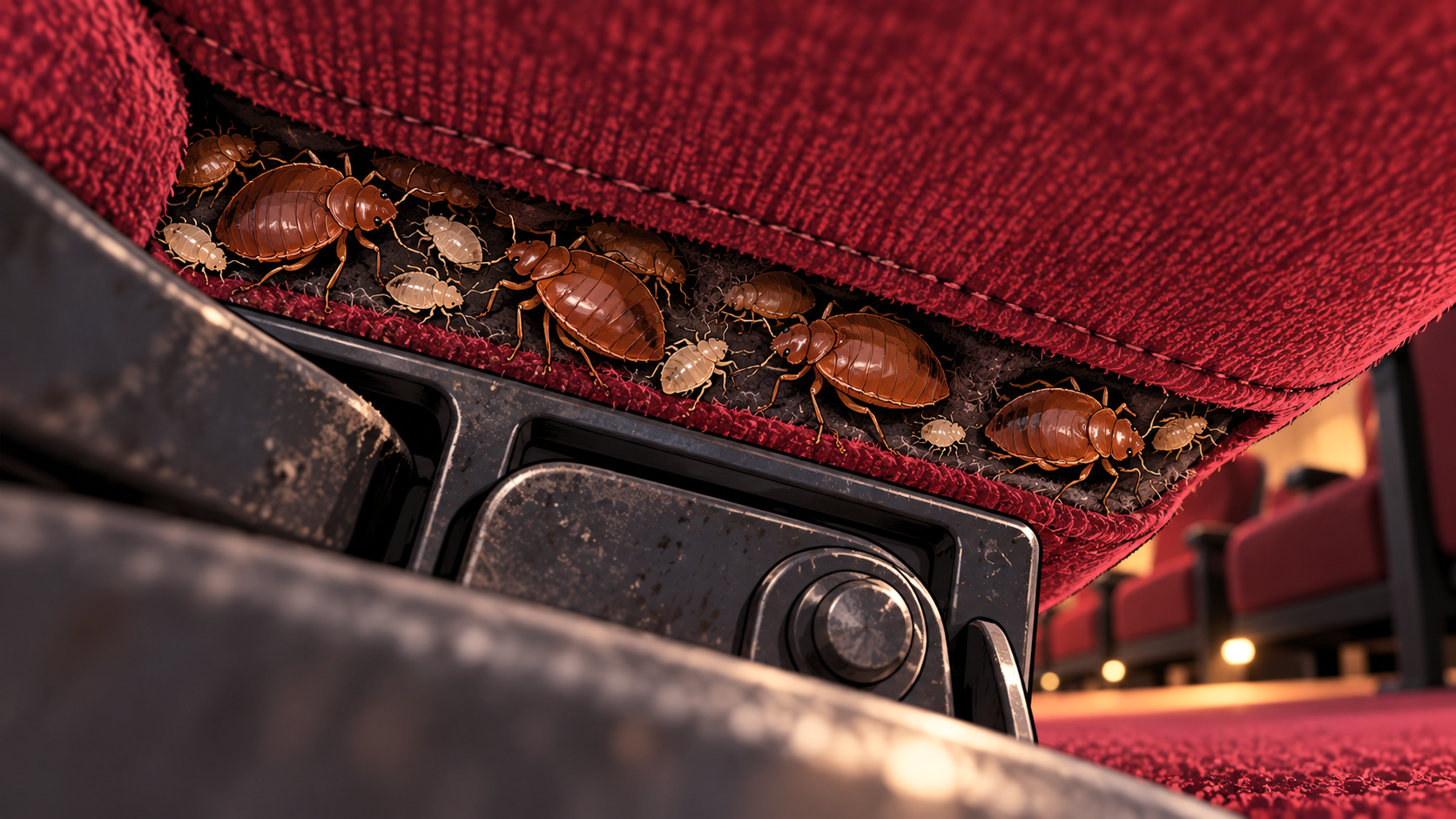
Bed bugs do not have a queen, king, worker caste or any other specialized reproductive caste. Adult females are ordinary members of the population, and many females within the same infestation can mate and lay eggs. A bed bug infestation is therefore not organized around one indispensable reproductive individual. Bed bugs do gather together in hiding places, but those groups are aggregations, not ant- or termite-like colonies with a queen.
A Bed Bug Harborage Is Not a Queen-Led Nest
The confusion makes sense when dozens of bed bugs are discovered packed into a mattress seam, box spring or furniture joint. Several life stages can occupy the same sheltered space, sometimes alongside eggs, shed skins and fecal material. Yet no individual in that group controls reproduction or occupies a permanent breeding role.
Bed bugs gather partly because chemical and physical cues make established hiding places attractive. Experiments have shown that adults and nymphs return to harborages after seeking hosts and respond to chemical signals associated with bed bug aggregations. Later work identified a combination of volatile compounds and histamine involved in attracting bed bugs to shelters and keeping them there. These signals help explain why numerous bugs can accumulate in one crevice without requiring a social hierarchy.
Aggregation also occurs across life stages. Research examining population composition found particularly strong grouping behavior among nymphs, with 94% to 98% aggregating under the experimental conditions. Adult females were more likely than males or nymphs to occur away from the main group, making females potential contributors to dispersal from established aggregations.
A dense cluster around a bed can consequently contain several reproductive females rather than one central mother. As populations disperse, bed bugs can occupy areas beyond the original room and establish additional harborages.
Any Mature Female May Become Reproductive
Female bed bugs do not undergo a special transformation into queens. They develop through the same basic sequence as other bed bugs: egg, five nymphal stages and adult. Federal life-cycle information identifies separate adult male and adult female bed bugs after the fifth nymphal stage, with no reproductive caste between an ordinary female and an egg-laying female.
Once mature, females can mate and produce eggs when biological conditions permit. Bed bug mating occurs through traumatic insemination, in which a male pierces a specialized region of the female’s abdominal wall and transfers sperm into her body cavity. The process imposes measurable reproductive costs on females, particularly when mating occurs excessively, and repeated insemination can reduce female longevity and reproductive success.
There is also no single breeding pair. Multiple adult males and females can reproduce within an infestation, and recent work examining bed bug sexual interactions describes a network of mating encounters rather than reproduction centered on one dominant individual. Repeated inseminations impose costs on females, which can alter their behavior during subsequent mating encounters.
The number of eggs produced by an individual female varies with feeding, age, mating history and other conditions. Under suitable circumstances, multiple females laying simultaneously can contribute to how quickly a bed bug population multiplies, while the reproductive output of each female is a separate question from the size of the entire infestation.
Killing the Largest Bed Bug Will Not Remove a “Queen”
Bed bugs change noticeably in size and shape after feeding. An engorged adult can become elongated and swollen with blood, making it look substantially larger than nearby unfed insects. Federal identification material describes unfed adults as flat and oval while recently fed adults become more elongated and balloon-like. A particularly large specimen in a harborage is therefore not evidence of a queen.
Removing that individual is useful because every bed bug removed reduces the population, but it does not shut down the infestation’s reproductive system. Other adult females may already be laying eggs, and immature females can eventually reach adulthood. Eggs and nymphs progressing through the bed bug life cycle also remain unaffected by the loss of one adult.
Even a single previously mated female deserves attention because stored sperm can allow one female bed bug to establish a new population under suitable circumstances. An established infestation containing several reproductive females has still less dependence on any particular individual.
Bed Bugs Aggregate for Shelter, Not to Divide Jobs
Social insects such as ants and termites can have distinct castes responsible for reproduction, defense, foraging or colony maintenance. Bed bugs do not divide their population into comparable occupational groups.
Both sexes and multiple developmental stages can occupy harborages, and both adult males and females take blood meals. Nymphs also feed on blood as they develop. Continued reproduction requires feeding by adults, with federal biological guidance noting that males and females both require periodic blood meals to maintain mating and egg production.
Their communal hiding behavior serves a different function from a highly organized insect society. Bed bugs use sensory information associated with occupied refuges, and research on off-host behavior has found that chemical and mechanical cues contribute to aggregation. They can share a favorable crack without assigning individuals to workers, soldiers or reproductive castes.
That biology also changes what matters during inspection. Finding a crowded harborage does not call for identifying the biggest female. Eggs, nymphs, adults, fecal spotting and shed skins around bed bug hiding places provide more useful evidence about how established the population has become.
Removing One Female Does Not End Reproduction
An infestation containing several mature females may have egg production occurring in multiple harborages. Health Canada notes that female bed bugs can deposit eggs in protected cracks, crevices and spaces behind woodwork, where the approximately one-millimeter eggs are difficult to see on many surfaces.
Finding and crushing one conspicuous female therefore leaves open the possibility of other females, concealed eggs and developing nymphs. A systematic inspection of the mattress, bed frame and surrounding hiding places provides much more information than searching for a supposed queen.
When no additional insects are immediately visible, interceptor cups can monitor bed bug movement over subsequent nights. Treatment decisions should be based on evidence of the infestation as a whole rather than the removal of one unusually large insect.
Questions About Bed Bug Social Structure
Do bed bugs have a king?
No. Adult males mate with females, but there is no king or dominant reproductive male whose presence maintains the population.
Do bed bugs have workers?
No. Bed bugs do not produce a sterile worker caste. Nymphs are immature bed bugs rather than workers, and they eventually become reproductive adults if they survive through all five nymphal stages.
Is the biggest bed bug always female?
No. Sex cannot be determined reliably from size alone. Feeding status strongly changes a bed bug’s apparent size, so a recently engorged individual can look much larger than an unfed adult nearby.
Do bed bugs have one main nest?
Not necessarily. They often aggregate in favorable harborages near hosts, but an infestation can contain multiple hiding sites. Their ability to travel away from the bed allows separate groups to occur elsewhere in a room or building.