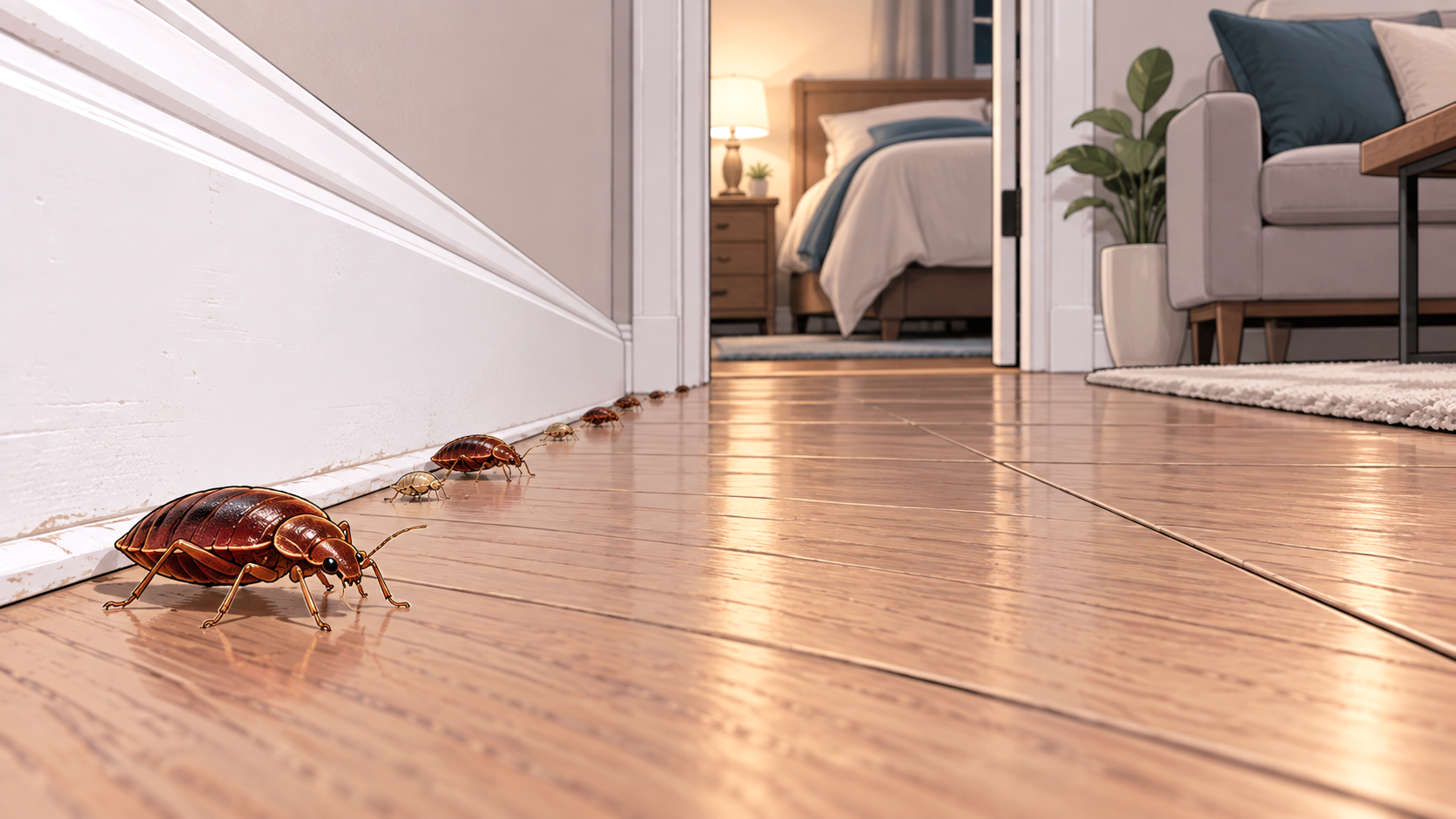
Bed bugs are often found close to where people sleep, but they can readily travel 5 to 20 feet from a hiding place to feed. Field studies have also recovered individual bed bugs at least 2.5 meters (8.2 feet) from sleeping areas and up to 9 meters (29.5 feet) from previously recorded resting locations. There is no scientifically established maximum distance that a bed bug can travel inside a building. Distance depends on why the insect is moving, the room layout, available hosts and whether it is walking independently or being transported on an object.
Five to 20 Feet Is a Useful Feeding Range, Not a Limit
The often-cited distance of 5 to 20 feet comes from guidance describing how far bed bugs will readily travel from established harborages to obtain a blood meal. It is useful for understanding routine host-seeking behavior, but it should not be interpreted as a biological boundary. A bed bug reaching 20 feet does not suddenly stop or become unable to continue.
Field observations show much wider movement. Researchers marked bed bugs in occupied apartments and monitored where they later appeared. Of the marked insects released on furniture where residents slept, 38% to 67% of those recaptured were found in interceptors at least 2.5 meters from the sleeping area. Among bed bugs released specifically in bedrooms, an average of 42% were subsequently recovered outside the bedroom. The experiment demonstrated extensive movement both near and away from sleeping locations.
Earlier observations cited in the same research followed marked bed bugs moving as far as 9 meters, or approximately 29.5 feet, from their previous resting sites. These measurements show why the distance between a bed and another part of an ordinary room cannot be relied upon to isolate an infestation.
Most Harborages Can Still Be Much Closer to the Sleeper
Ability to travel and preferred resting location are different questions. A bed bug may walk many feet during its activity period while still spending much of its resting time close to a dependable host.
Beds and surrounding furniture provide an unusually favorable combination: access to blood, darkness, narrow hiding spaces and long periods when the host remains relatively still. Health Canada lists box springs, mattress pads, night tables, electrical outlets and spaces behind picture frames and wallpaper among locations where bed bugs may conceal themselves. A search therefore normally begins near the bed rather than at the opposite end of the home.
Population size can alter what an inspection reveals. Earlier experimental observations found bed bug aggregations were rarely more than 2.3 meters from a sleeping host when populations contained fewer than 100 insects. Larger or more established populations can occupy increasingly dispersed harborages. Federal inspection guidance likewise notes that heavy infestations may extend into couches, curtain folds, drawer joints, electrical receptacles, wall hangings and junctions between walls and ceilings.
The insects’ ability to hide beyond the mattress is one reason a thorough bed bug mattress inspection can identify an important concentration of activity without defining the infestation’s full geographic extent.
Bed Bugs Do Not Follow Body Heat Across an Entire Room
A bed bug traveling several meters toward a person is not necessarily detecting body warmth from that entire distance. Host location relies on several sensory cues whose useful ranges differ.
Carbon dioxide is a particularly important activator and attractant. Experiments using traps found that adding carbon dioxide greatly increased captures in infested apartments, with bed bugs of all developmental stages responding to the cue. Carbon dioxide, heat and chemical cues can influence host-seeking behavior, although their individual contributions are not equal at every distance.
Heat operates much closer to the host. Controlled experiments found that bed bugs oriented toward heated targets, but positive orientation to heat alone was limited to distances of less than 3 centimeters in the test system. The researchers concluded that heat functions primarily as a short-range host cue. Human odor by itself also appears to have a relatively weak influence compared with combinations of host cues.
A bed bug crossing a bedroom can therefore begin searching without possessing a precise long-distance map of where a person’s skin is located. Carbon dioxide and other environmental information can guide host seeking broadly, while warmth becomes more useful at very close range. The combined sensory process behind how bed bugs locate people is more complex than simply following heat across the floor.
Some Bed Bugs Travel Away From the Bed Rather Than Toward It
Movement is not limited to hungry insects walking from a crack to a sleeping person. Bed bugs also leave feeding areas after taking blood, relocate among harborages and disperse through infested dwellings.
The apartment field study found marked insects in bedrooms, living rooms, bathrooms, kitchens, hallways and entry areas. Movement began quickly: within 24 hours, marked bed bugs had been captured both near and away from sleeping locations regardless of where they were initially released. Naturally occurring, unmarked insects showed the same broad distribution, supporting the conclusion that the observed travel was not merely caused by researchers relocating bugs during the experiment.
Consequently, finding insects several feet from a bed does not mean they became lost or that the infestation must have originated there. Bed bugs can occupy more than one room while retaining substantial activity around the primary sleeping or resting locations.
Apartment Buildings Allow Travel Beyond a Single Home
A bed bug’s walking range can extend beyond the walls of the room where it fed. Marked insects have been recovered in neighboring apartments beside, above, below and across a hallway from their original units. In the mark-release-recapture study, active movement into neighboring apartments was confirmed from five of six study units over the full monitoring period.
Movement between units is especially relevant because cracks, shared structural spaces, hallways and other connections can provide routes through a building. Separate high-rise research detected bed bugs in traps around apartment entry doors and found infestations clustered around affected units, supporting both active dispersal and human-assisted movement within multi-unit housing.
The practical search area in an apartment building can therefore extend farther than the physical distance from a bed to a wall. When bed bugs spread between apartments, adjoining units may need inspection even if residents there have not reported bites.
Hitchhiking Makes Walking Distance Almost Irrelevant
Active walking has a finite pace, but transportation on possessions allows a bed bug to cover a bedroom, building, city or much greater distance without walking it. Bed bugs can conceal themselves in luggage, clothing, furniture, bedding and other belongings. Public-health travel guidance specifically warns that bed bugs can hide in luggage, clothing and personal items.
A suitcase moved from the bed to a car can therefore carry a bug much farther in minutes than the insect would travel independently. The same applies within a home. Moving an infested blanket from a bedroom to a couch may relocate an insect instantly, while clothing can transport concealed bed bugs to another area.
For travel, separating luggage from sleeping surfaces reduces these opportunities. Keeping belongings away from beds and upholstered furniture forms part of preventing bed bugs from entering luggage precisely because passive transport can overcome any meaningful walking-distance limitation.
Search Outward From the Bed Without Assuming a Fixed Radius
Start where the host sleeps or rests, then expand the inspection according to the evidence rather than drawing a 5-, 10- or 20-foot circle. Examine the mattress, box spring, bed frame and headboard first, followed by nearby furniture, baseboards, cracks and upholstered resting areas. Evidence farther away justifies extending the search.
Interceptors can reveal travel that occurs when nobody is watching. Properly placed bed bug interceptor cups can capture insects approaching or leaving beds and suitable furniture, providing information about continuing movement over several nights.
Distance alone cannot establish where an infestation ends. Bed bugs hidden 15 feet from a bed may be part of the same population as those around the mattress, while an insect discovered much farther away may have been carried there on an object. Inspection and monitoring are more informative than assuming bugs beyond a particular distance cannot belong to the infestation.
Questions About How Far Bed Bugs Can Travel
How fast can a bed bug walk?
Walking speed varies with temperature, hunger, surface and individual behavior, so a single speed should not be used to calculate where an infestation can reach overnight. Field studies are more useful because they measure where insects actually move in occupied buildings.
Can a bed bug travel across a large bedroom in one night?
Yes. An ordinary bedroom is well within documented bed bug movement distances. Marked insects in apartment studies moved between rooms and were recovered several meters from sleeping areas.
Will moving the bed 10 feet away from the wall stop bed bugs reaching it?
No. Ten feet is within a distance bed bugs can travel while seeking a host. Moving the bed a short distance can help with isolation only when combined with measures that prevent access, such as keeping bedding off the floor and using appropriate interceptors beneath furniture legs.
Can bed bugs travel from one house to another by walking outside?
Bed bugs are primarily associated with indoor human environments, and passive transportation on belongings is a far more important mechanism for movement between separate homes. A bug is much more likely to reach a distant house in luggage, furniture or another transported object than by deliberately walking across outdoor terrain.