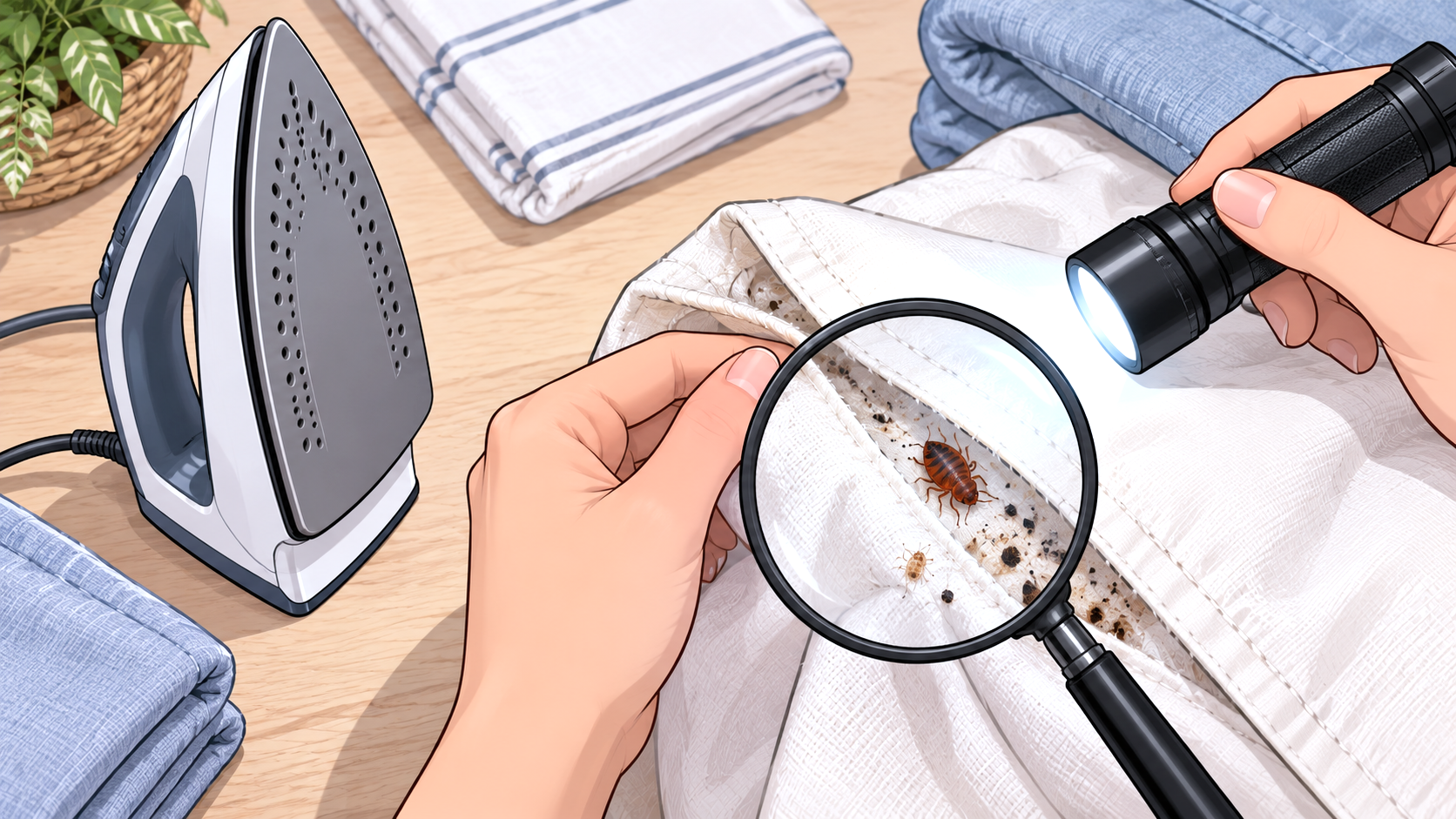
The iron trick is not a reliable way to find bed bugs. Heat can activate bed bugs and attract them at very short range, so an insect close to the heated area might move. But research does not establish a clothes iron passed over a mattress as an accurate bed bug detection method, and a negative result cannot show that the bed is clear. The idea borrows one real part of bed bug biology, their response to warmth, and stretches it beyond what the evidence supports.
What Is the Bed Bug Iron Trick Supposed to Do?
Versions of the trick vary, but the basic method involves warming part of a mattress or bedding with a clothes iron, sometimes with a layer of fabric or towel between the iron and mattress. The heat is supposed to imitate a warm human body and make hidden bed bugs crawl toward the surface where they become visible.
Bed bugs genuinely use temperature information while searching for hosts. Experiments using controlled heated targets found that warmth can activate resting bed bugs and trigger movement. Separate work using heated test arenas likewise confirmed that bed bugs can detect and respond to heat.
Those findings make the viral demonstration appear plausible. They do not establish an iron as a detector.
Bed Bugs Detect Heat Over a Much Shorter Distance Than the Trick Suggests
Heat is particularly useful to bed bugs when they are already close to a potential host. In controlled experiments, positive orientation toward a heated target occurred at less than about 3 centimeters. Another study examining their sensory system found similarly short-range heat detection and reported that bed bugs did not detect radiant heat in the tested setup. Their antennae played an important role in orienting toward nearby warmth.
An iron warming the upper surface of a mattress therefore does not create a dependable beacon capable of drawing every hidden bug from throughout the mattress, box spring, headboard or surrounding room. An insect already close to the warmed surface could become active, while another concealed farther away may never respond.
Actual host finding involves more than temperature. Bed bugs integrate heat with carbon dioxide and human-associated odors. Experiments comparing attractants found carbon dioxide considerably more effective than heat alone, with CO₂-baited traps capturing significantly more insects than traps relying only on warmth.
Heating One Part of a Mattress Leaves Most Harborages Untested
The trick also assumes the bugs are directly beneath the area being heated. Many are not.
During daylight, bed bugs may occupy mattress seams, box springs, frame joints, headboards, bedside furniture and structural cracks. The CDC identifies multiple harborages around rather than simply inside a mattress. An iron moving across the sleeping surface cannot meaningfully test a bug wedged behind a headboard or inside a bed-frame joint.
Even the mattress itself contains areas that surface heating may not reach uniformly. Bed bugs concealed deep in folds, beneath labels or along protected seams experience different conditions from the fabric directly beneath the iron. Their broader daytime hiding pattern makes a small heated patch a poor sample of the entire sleeping area.
The result can be especially misleading when no insects emerge. Bed bugs can be present without being readily visible, so failure to provoke movement cannot rule out an infestation.
Extreme Heat Can Make Bugs Flee Rather Than Approach
A human body provides moderate warmth. A clothes iron operates at a completely different temperature.
Bed bugs can approach warm targets within a biologically attractive range, but increasing temperature does not make a heat source progressively more appealing. Controlled research found that feeding responses increased as experimental targets warmed to certain temperatures and then dropped sharply at 48°C. More recent experiments found that bed bugs exposed to lethal or sublethal heat released alarm pheromones, while nearby bugs responded with rapid movement associated with the alarm signal.
A bug suddenly running after an iron heats nearby fabric therefore cannot automatically be interpreted as normal attraction to simulated body heat. The insect may instead be responding to stressful temperature conditions.
This also makes online demonstrations difficult to interpret. Seeing a bug emerge after heating proves only that a bug was present and moved. It does not establish that the method reliably detects low-level infestations, reveals all occupied harborages or produces an informative result when nothing appears.
An Iron Can Kill Exposed Bed Bugs Without Becoming a Detection Tool
A clothes iron has legitimate heat-treatment applications for certain items when used carefully. Cornell integrated pest-management guidance describes placing a towel over suitable infested materials and using a hot steam iron on seams and other areas where bugs or eggs are located. The purpose is direct heat treatment of known or suspected infested material, not diagnosis by waiting for insects to emerge.
Heat treatment depends on lethal temperatures actually reaching the insects. Federal guidance notes that bed bugs die when their body temperature reaches about 45°C, but whole-room treatment requires higher environmental temperatures so sufficient heat penetrates every location where insects are hiding. Heating the mattress surface with an iron cannot demonstrate that hidden bugs or eggs elsewhere received a lethal dose.
It also differs fundamentally from controlled bed bug heat treatment, where temperatures are monitored across treated areas rather than inferred from how hot one exposed surface feels.
Use the Iron to Inspect Visually, Not to Heat the Mattress
If an iron is already sitting on the bed because of the viral trick, leave it unplugged and use the time for a physical inspection instead. Mattress piping, seams, labels and tufts can be examined with a flashlight before moving to the box spring, frame and headboard. Look for live insects, eggs, dark fecal spotting and shed skins left by developing bed bugs.
Visual inspection has limitations, particularly with very small infestations, but it examines the places where evidence actually accumulates. A systematic mattress inspection also avoids interpreting an insect’s response to uncontrolled heating.
Monitoring can add another layer when inspection finds nothing. Interceptor devices placed beneath suitable furniture legs capture bugs during normal movement, and federal DIY guidance includes interceptors as a bed bug monitoring and control tool. Properly positioned bed bug interceptor cups can remain in place across multiple nights, providing a longer detection window than a few minutes with an iron.
Active monitors can go further by deliberately supplying attractants. Federal bed bug surveillance material recognizes monitors that use heat, carbon dioxide or scent lures to attract insects, and controlled studies have demonstrated effective detection using combinations of these cues. Such devices turn attraction into a repeatable trapping system rather than simply encouraging a bug to run somewhere.
Questions About the Bed Bug Iron Trick
Can an iron make a hidden bed bug move?
Yes, a nearby bed bug may respond to changing temperature, and excessive heat can also trigger escape or alarm-related movement. Movement alone does not establish that the method works reliably as a detector.
Does steam from an iron draw bed bugs out?
Steam can affect bed bugs through heat, but it is primarily a treatment mechanism rather than a validated lure. Health Canada notes that steam can flush surviving bugs from hiding while killing those it reaches, which is why steam treatment requires slow, deliberate application.
If no bed bugs appear after using an iron, does that mean the mattress is clean?
No. Hidden insects may be too far from the heated area, may occupy another part of the bed or room, or may not respond during the brief test. A negative iron test has no established diagnostic value.
Can you iron your entire mattress to eliminate bed bugs?
Surface ironing cannot guarantee lethal temperatures throughout a mattress, box spring, frame and surrounding harborages. An infestation requires control methods capable of reaching the population rather than only the exposed fabric.