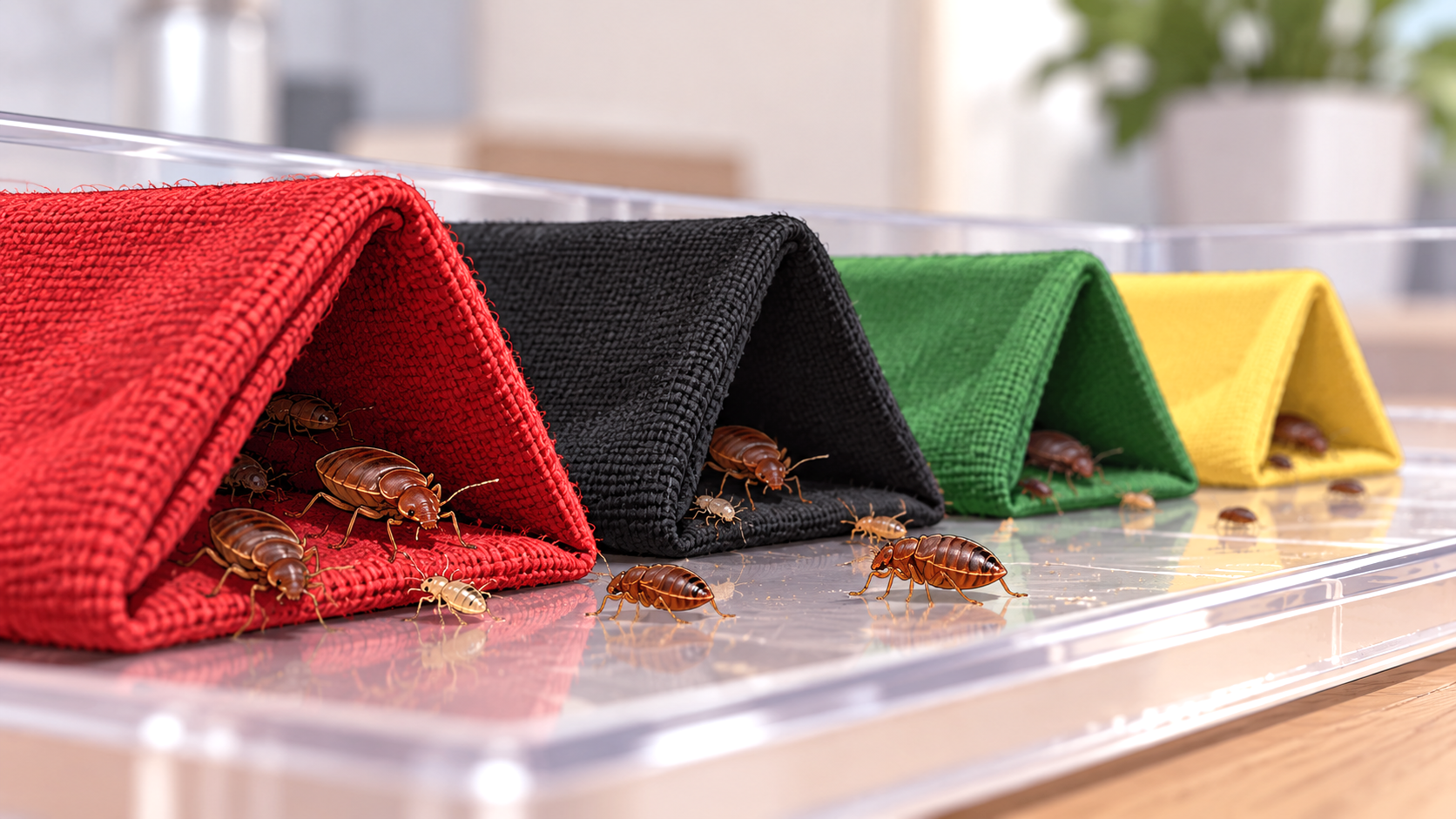
Bed bugs have shown the lowest preference for yellow and green harborages in controlled experiments, while red and black are generally more attractive. White has also performed poorly against darker colors in some tests. However, calling yellow, green or white “bed bug-repellent colors” goes too far. Color can influence where a bed bug chooses to shelter, but it will not reliably keep bed bugs away from a room, bed or person.
Yellow and Green Performed Poorly in Color-Choice Experiments
The strongest evidence comes from experiments that gave bed bugs a choice between small shelters of different colors. In one study, researchers tested red, orange, yellow, green, blue, lilac, violet and black harborages. Across the experiments, red and black were the most frequently selected overall, while green and yellow were among the least selected. In the seven-color trials, red accounted for 28.5% of choices and black 23.4%, while green received only 2.8% and yellow 6.8%. The researchers described yellow and green as colors bed bugs appeared to avoid when selecting harborages.
The response was not identical among every insect. Adult males showed particularly strong preferences for red and black, while females selected lilac and violet more often than males did. Feeding status also altered some choices. Newly hatched first-instar nymphs showed no significant color preference, whereas older nymphs increasingly favored colors also selected by adults. Even egg-laying behavior varied by shelter color, demonstrating that bed bug responses to color depend partly on sex, developmental stage and physiological condition.
For that reason, “bed bugs hate green and yellow” is an inaccurate interpretation of the experiment. The insects selected those shelters less frequently under particular test conditions. They were not universally incapable of entering or remaining on those colors.
White Is Often Less Attractive Than Black or Red
Another series of experiments compared black, white, green and yellow paper harborages. Bed bugs selected black shelters far more frequently than white ones. When black and white were tested directly, 85.2% chose black and 14.8% chose white. A separate red-versus-white test produced a similar result, with 77.4% selecting red.
Color also affected trap performance. Interceptors with black exterior surfaces captured more bed bugs than otherwise comparable white interceptors, while red interceptors also outperformed white ones. The experiments showed that visual appearance can influence both shelter selection and trap encounters.
White still cannot be treated as a repellent. Bed bugs entered white shelters and traps in the experiments. A white mattress, white bed frame or white bedroom therefore remains entirely capable of supporting an infestation. Light-colored materials may make dark fecal marks or adult bugs easier for a person to notice, but visibility to humans is separate from repellency.
Red and Black Tend to Be More Attractive, but the Reason Is Complicated
Researchers initially proposed several possible explanations for the preference for red. One idea was that the reddish color resembled other recently fed bed bugs and therefore helped promote aggregation. Later work on bed bug vision makes a simple “red looks like blood” explanation difficult to support.
Bed bugs have compound eyes capable of responding to several portions of the light spectrum. Electrophysiological testing found receptor sensitivity in the ultraviolet, green and yellow-green portions of the spectrum, while sensitivity declined strongly at wavelengths above 620 nanometers. Human color perception therefore cannot simply be projected onto what a bed bug sees.
Contrast may also contribute. In experiments where dark shelters appeared against pale backgrounds, black and red objects produced strong visual contrast. Researchers specifically cautioned that some apparent color preference could reflect contrast between the shelter and its background rather than an isolated attraction to a particular hue.
Bed bugs also select harborages using information beyond vision. Texture, vertical structure, aggregation chemicals and proximity to feeding areas can all influence shelter choice. The dark cracks and narrow contact surfaces where bed bugs commonly hide during the day provide several of these cues simultaneously.
Changing Your Sheets to Yellow or Green Will Not Protect the Bed
A color preference measured between experimental shelters is not equivalent to a pest-control effect in a bedroom. A hungry bed bug searching for a blood meal responds strongly to host-associated cues, including carbon dioxide, human odors and close-range warmth. Those signals remain present regardless of whether the sheets are yellow, green, white, red or black.
Color also becomes irrelevant in complete darkness. Experiments found that bed bugs could discriminate among colors under very low illumination but could not do so when all visible light was removed. Bed bugs nevertheless continue using nonvisual sensory information, which is why host-finding does not depend on seeing a person.
A green mattress cover therefore cannot override the biological cues coming from someone sleeping on it. Nor will painting walls yellow prevent insects from occupying the room. The same limitation applies to claims that particular smells automatically repel bed bugs: a behavioral response under experimental conditions does not automatically become dependable household protection.
Color May Be More Useful for Catching Bed Bugs Than Avoiding Them
The practical value of bed bug color research lies mainly in improving monitoring devices. If an insect naturally approaches certain visual features more readily, trap designers may be able to increase capture probability by incorporating those features alongside other attractants.
Black and red surfaces have already increased captures in controlled interceptor experiments. Researchers studying colored harborages likewise concluded that visual preferences could help optimize bed bug monitoring tools. Work on the tropical bed bug, Cimex hemipterus, has produced a similar pattern, with fed and unfed insects generally preferring red and black shelters over white ones.
Color is still only one component of trap performance. A monitor’s geometry, surface texture, placement and attractants can change whether a bed bug encounters and enters it. Properly positioned bed bug interceptor cups exploit normal movement around furniture rather than depending solely on a color preference.
For active detection, host-associated cues are substantially more important. Carbon dioxide has produced strong attraction in field experiments, and CO₂-baited traps have captured bed bugs missed during visual inspection. That makes scientifically tested monitoring methods more useful than decorating a room around colors bed bugs selected less often in laboratory shelters.
Choose Light Colors for Visibility, Not Repellency
When choosing bedding or an encasement, pale material can have one practical advantage: it may make certain evidence easier for a person to see. Adult bed bugs, blood marks, dark fecal spotting and some shed material can contrast more clearly against a light surface.
That benefit concerns detection rather than insect behavior. The dark fecal marks bed bugs leave on bedding may stand out against white or pale fabric, while a careful mattress inspection still needs to include seams, labels, piping, the box spring, frame and headboard.
Color cannot substitute for prevention or treatment. Bed bugs can occupy virtually any appropriately sheltered room if hosts and suitable harborages are available, and preventing bed bugs from entering a home depends far more on limiting introductions and recognizing infestations early than on interior color choices.
Questions About Bed Bugs and Color
Are bed bugs attracted to red because it looks like blood?
That explanation has been proposed, but it has not been established as the reason for the preference. Bed bug visual physiology and the influence of background contrast make their response more complicated than associating red with blood.
Do black sheets attract bed bugs to your bed?
There is no evidence that black sheets will cause an infestation or draw bed bugs into a home. Black performed well as a harborage color in experiments, but a bed occupied by a person already supplies much stronger host-associated cues.
Can bed bugs see colors at night?
They can distinguish visual features under very low light, but experiments found no color discrimination in complete darkness. Their other senses continue functioning without visual information.
Would green or yellow luggage help prevent bed bugs while traveling?
Color alone is not a dependable protective measure. Keeping luggage away from beds and upholstered furniture, inspecting accommodations and reducing opportunities for bed bugs to enter luggage are more meaningful precautions.