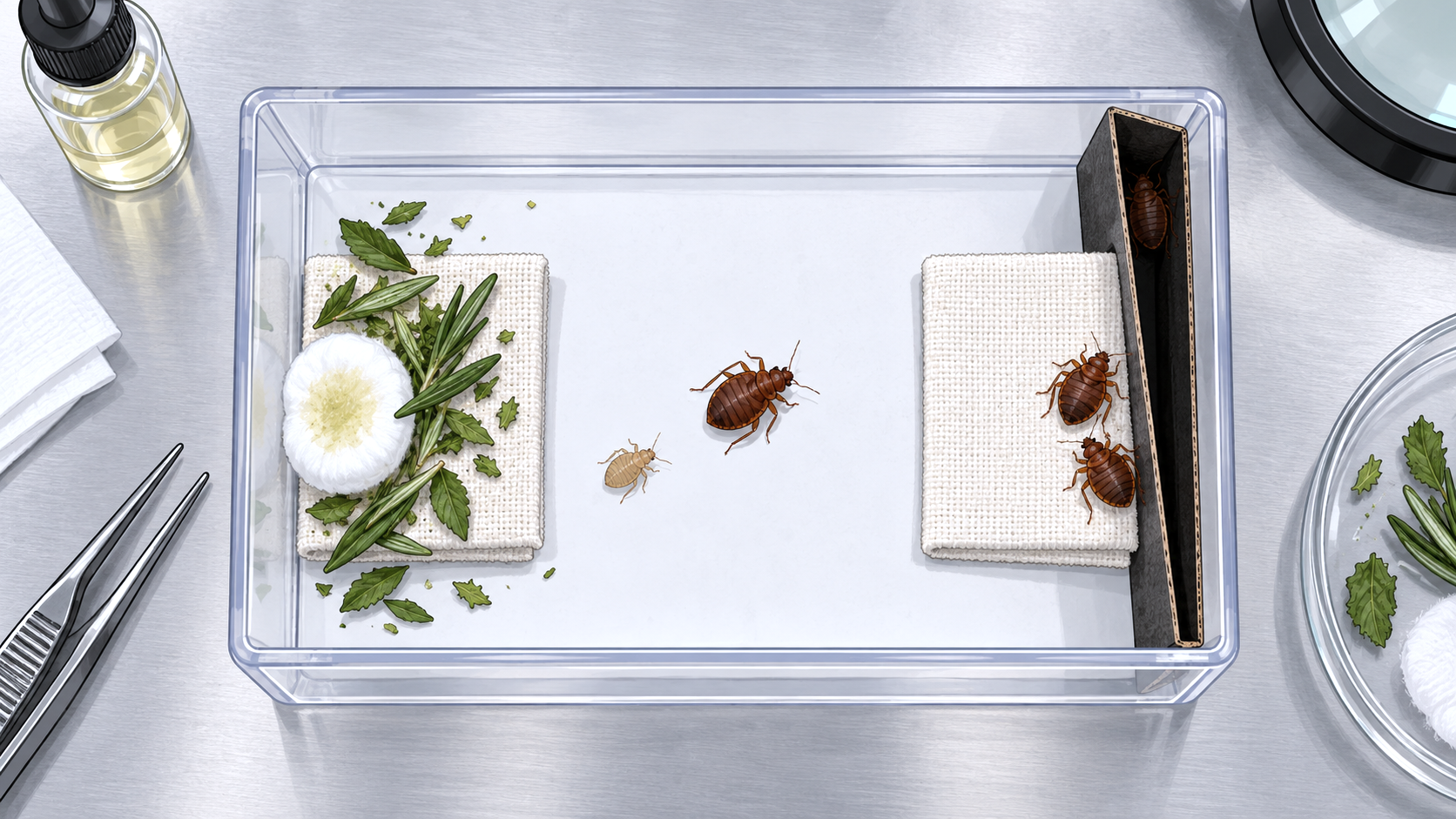
The internet gives bed bugs an oddly specific list of supposed dislikes. Peppermint, lavender, tea tree oil, eucalyptus, cinnamon, cloves, vinegar, dryer sheets, and dozens of other strong-smelling substances all get described as scents that will send them running. The problem is that a smell being strong to us tells us almost nothing about what it does to a bed bug. There is no ordinary household smell we would rely on to keep bed bugs away or eliminate an infestation. Some plant-derived compounds and formulated botanical pesticides can affect bed bug behavior or kill them under tested conditions, but that is very different from making a room smell like peppermint or lavender. The word “hate” hides several completely different questions, and separating them clears up most of the confusion.
First, Bed Bugs Do Not Experience a Room the Way We Do
A human walking into a bedroom can immediately notice perfume, lavender spray, eucalyptus oil, or vinegar. Bed bugs are not making the same judgment about whether the room smells pleasant or unpleasant.
They respond to chemical cues that help them locate hosts, communicate, aggregate, and move through their environment. Research on bed bug behavior has examined responses to carbon dioxide, human-associated cues, aggregation chemicals, and potential repellents. The fact that bed bugs use chemical information is well established, but it does not follow that every powerful odor interferes with that system.
This distinction matters because most online “smell” advice begins with the human nose. Peppermint smells intense to us, therefore the assumption is that an insect must find it even more overwhelming.
That reasoning is unreliable.
A substance deserves to be called a repellent only when bed bugs actually avoid it under controlled testing. Even then, avoidance does not automatically make it useful for protecting a sleeping person or controlling insects hiding throughout a room.
“They Avoided It” Is Only the First Level of Evidence
Laboratory researchers can give bed bugs a choice between treated and untreated areas and observe where the insects go. That type of experiment can tell us whether a chemical has repellent activity.
Several plant-derived substances have produced measurable bed bug repellency in laboratory research. Bed bug studies catalogued by Rutgers researchers include work on catnip oils, oregano essential oil, coconut-derived compounds, and other repellent chemicals.
That sounds promising, but the laboratory result needs to stay in its proper place. A specific oil or isolated chemical tested at a defined concentration is not interchangeable with a bottle of scented household oil, a candle, a plant beside the bed, or a homemade spray.
Concentration matters. Formulation matters. How long the material remains active matters. The surface it is applied to matters as well.
Most importantly, a bed bug moving away from a treated patch has not disappeared from the home.
Peppermint Is a Good Example of Why Smell Alone Tells Us Very Little
Peppermint may be the most commonly repeated bed bug smell claim.
Interestingly, peppermint oil has appeared as an ingredient in commercial botanical bed bug products. That does not mean peppermint odor itself is a reliable repellent.
In one laboratory comparison of essential-oil-based bed bug products, a formulation containing peppermint oil and clove oil produced substantial mortality under certain direct and forced-exposure tests. Yet researchers found no detectable repellency from that product when bed bugs could choose where to move in the presence of a carbon dioxide source. The same study also found large differences between the effectiveness of different botanical products. (rutgers.edu)
We think that result is especially useful because it breaks the assumption that smell intensity and repellency are the same thing.
A peppermint-containing formulation may affect an insect because of its full formulation and exposure conditions without creating some invisible mint barrier around your bed.
Our dedicated guide to peppermint oil and bed bugs keeps that question separate from the broader issue of scent repellency.
Lavender Has an Excellent Reputation and Much Weaker Practical Value
Lavender is another scent that repeatedly appears in DIY bed bug advice.
The problem is not that insects are incapable of responding to plant chemicals. The problem is jumping from that broad fact to a specific claim that lavender fragrance will protect a bedroom.
A lavender-scented room is not a recognized bed bug control method. Bed bugs can remain tucked inside mattress seams, furniture joints, baseboards, and other protected spaces regardless of whether humans can smell lavender nearby.
This is where the idea of a “smell bed bugs hate” can actually become counterproductive. A person may continue sleeping in an infested room while repeatedly adding more scented oil, assuming the odor is forming a protective boundary.
It is not a boundary we would trust.
Our article on lavender and bed bugs goes deeper into that individual remedy without turning this article into a list of oils.
Catnip Is More Interesting Than the Usual Household-Scent Claims
Catnip deserves separate treatment because researchers have actually studied compounds associated with it as bed bug repellents.
Laboratory work has found repellent activity from certain catnip oils and compounds against bed bugs. This is part of a broader research effort into botanical repellents, and newer work continues to examine catnip-derived materials and their effects on bed bug behavior.
That does not mean scattering dried catnip around the bedroom will repel an infestation.
This distinction between the plant, an essential oil, purified components, and a finished pest-control formulation is critical. Once those are treated as interchangeable, useful laboratory research turns into unreliable DIY advice.
Catnip research tells us that bed bugs can respond strongly to particular plant-derived chemicals. It does not give us a recipe for making the bedroom smell unpleasant enough that the insects leave.
Oregano Shows the Same Formulation Problem
Oregano provides another useful example.
Research has documented repellent activity from oregano essential oil against common bed bugs under laboratory conditions. Again, that is real evidence of behavioral response, and the study appears among the bed bug repellency research collected by Rutgers’ urban entomology program.
But “oregano oil repelled bed bugs in a laboratory assay” and “bed bugs hate the smell of oregano” are not equivalent claims.
The first statement describes a specific material tested under specific conditions. The second invites someone to improvise with kitchen herbs, diffusers, or an unknown essential-oil concentration.
We would not cross that gap.
This is one reason our broader guide to essential oils for bed bugs treats formulation and evidence as more important than fragrance.
Neem Is Different Because Formulated Products Have Been Evaluated as Pesticides
Neem often gets grouped together with lavender and peppermint as another “smell bed bugs dislike,” but that framing misses what makes neem interesting.
Cold-pressed neem oil has been evaluated as a biochemical pesticide for indoor bed bug control. Regulatory testing of formulated neem products included effects on adults, nymphs, eggs, and treated residues. That evidence supported an indoor bed bug use for products containing cold-pressed neem oil. (epa.gov)
That is not evidence that the garlic-like odor of neem simply frightens bed bugs away.
The formulated pesticide contains active material that affects the insect. Its performance is tied to the product, concentration, application, and label rather than the fact that humans find neem strongly scented.
This difference is fundamental. A pesticide can smell strongly and work. It can smell strongly and fail. It can also have very little noticeable odor and work extremely well.
Our separate article on neem oil for bed bugs addresses its pesticidal role rather than treating it as room fragrance.
A Repellent Can Create a Problem Even When It Works
Suppose you did find a substance that reliably made bed bugs avoid one section of a mattress. That still would not necessarily be good infestation control.
Bed bugs can hide in numerous locations around a sleeping area. Forcing them away from one treated surface does not guarantee they encounter something lethal. Depending on the layout and treatment, they may simply remain in untreated harborages or move elsewhere.
This is why bed bug management focuses on elimination rather than trying to create a pleasant-smelling force field around the sleeper. Effective programs combine inspection, physical control methods, monitoring, heat where appropriate, and pesticides specifically labeled for bed bugs.
The available pesticide approaches for bed bug control include several very different modes of action. Smell is not what unites them.
In fact, a product’s repellency can sometimes be a disadvantage if avoiding a treated area reduces the insect’s contact with something intended to kill it.
That is a much more useful way to think about bed bug odor than asking which fragrance they dislike most.
Your Own Smell Is Competing With Whatever You Spray
Bed bugs are trying to locate a host, not evaluate a scented room.
Human occupancy provides strong cues, including body heat and carbon dioxide. Bed bug research has repeatedly examined carbon dioxide as an important host-associated cue, and it is even incorporated into some monitoring strategies.
That creates a problem for DIY scent barriers. A few drops of essential oil are being asked to alter the behavior of an insect living close to a dependable blood meal.
Even some commercial essential-oil formulations that affected bed bugs in direct exposure tests did not show measurable repellency when insects were given a choice in the presence of carbon dioxide. (rutgers.edu)
We think this is one of the strongest reasons to stop thinking about the problem as “finding a smell stronger than bed bugs can tolerate.”
The insects do not need to like the bedroom. They only need to keep reaching the host.
Strong Odor Is Not a Safety Test Either
Another mistake is assuming that a natural scent can be used freely because it comes from a plant.
Essential oils are concentrated chemical mixtures. Their safety depends on the substance, concentration, route of exposure, formulation, and how they are used. Applying undiluted oils to skin, saturating bedding, diffusing large quantities around people or pets, or mixing several substances together is not something we recommend as improvised bed bug control.
A registered pesticide gives you something a homemade scent mixture cannot provide: instructions for where it may be used, how it should be applied, and what precautions are required.
When choosing a pesticide, use a product specifically labeled for bed bugs and follow its directions. The EPA’s bed bug pesticide guidance is a better starting point than increasing the concentration of whichever essential oil smells strongest.
“Natural” and “safe to use anywhere” are not synonyms.
Stop Trying to Make the Bed Smell Wrong and Make It Hard for Bed Bugs to Survive
Once bed bugs are established, scent experiments address the wrong part of the problem.
Start with identification. Inspect mattress seams, the box spring, bed frame, headboard, nearby furniture, and cracks around the sleeping area. Our guide to checking for bed bugs explains where physical evidence tends to appear.
Then use control methods designed around the insect’s biology. Bed bugs can be managed through a combination of laundering and heat-drying suitable items, vacuuming, steam, encasements, monitoring, reducing hiding places, and appropriately labeled pesticides. A broader integrated approach is recommended because no single shortcut reliably solves every infestation.
If you specifically want a natural approach, our guide to getting rid of bed bugs naturally separates useful nonchemical methods from household-remedy folklore.
The answer to “What smells do bed bugs hate?” is therefore less satisfying than the online lists suggest. Certain chemicals can repel bed bugs under tested conditions. Some botanicals can even form part of effective pesticide formulations. But there is no household fragrance we would use as the foundation of a bed bug control plan.
Other Questions About Smells and Bed Bugs
Do bed bugs hate perfume or cologne?
Perfume and cologne are not bed bug control products. A strong fragrance to a person does not establish that bed bugs will avoid the wearer or the surrounding room. They should not be used as substitutes for inspection, monitoring, or treatment.
Will scented candles keep bed bugs away from the bed?
No dependable bed bug protection comes from burning a scented candle. The fragrance concentration in room air is not equivalent to applying a tested repellent compound under controlled conditions, and a candle does nothing to eliminate insects or eggs hidden in furniture.
Can bed bugs get used to a smell that initially repels them?
Repellency can depend on concentration and how long a substance remains present, so a fading treatment may stop producing the same behavioral effect. That does not require assuming the insects have become accustomed to the odor. The chemical exposure itself may simply have changed.
Is there a smell that makes bed bugs leave the entire house?
No household odor is a dependable way to drive an established bed bug population out of a home. Bed bugs occupy protected harborages close to hosts, and successful management focuses on locating and eliminating them rather than attempting to force them out with fragrance.
Why do some bed bug sprays smell like essential oils if smell does not work?
Some botanical pesticides use plant-derived substances as active ingredients. Their pesticidal performance comes from the formulated ingredients and tested exposure, not from creating a smell that the insects simply dislike. A commercial formulation and a homemade scented mixture should not be treated as equivalent.
3 thoughts on “What Smells Do Bed Bugs Actually Hate?”