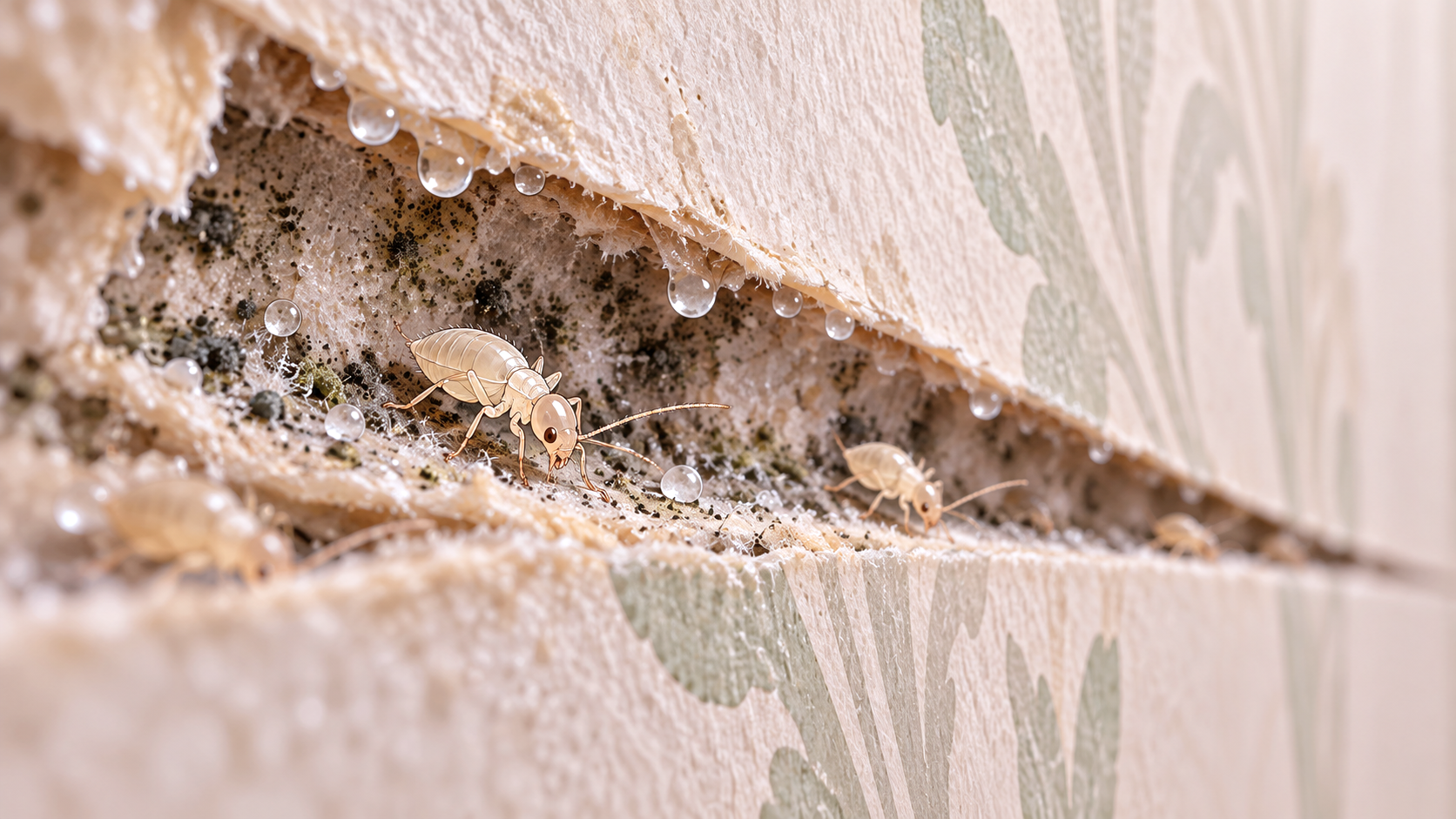
Booklice can be a sign that an area is damp enough to support mold, but finding them does not prove you have a serious or visible mold infestation. They commonly feed on microscopic fungi and thrive in humid conditions, so repeated sightings are best treated as a clue to investigate moisture rather than as a mold diagnosis.
Booklice Are More Reliable as a Moisture Warning Than a Mold Test
A cluster of booklice tells you that the surrounding environment has been favorable enough for tiny moisture-dependent insects to survive and reproduce. Indoor psocids are strongly associated with damp conditions, and conservation guidance treats their presence as a warning that an object or building may be excessively damp. Mold often accompanies that dampness because fungi also depend on moisture. The two conditions frequently overlap, but they are not interchangeable. A few booklice cannot tell you what fungus is present, how much is growing, or whether a hidden surface is contaminated.
That limitation is important because booklice also consume fungi and mold rather than relying on a single food source. Psocids may also feed on grains, starches, yeasts, insect fragments, and other organic material. Household infestations nevertheless remain strongly tied to humidity, and why booklice need moisture to survive helps explain why repeated activity often deserves an inspection for leaks, condensation, damp materials, or persistently humid air rather than an assumption that visible mold must be present.
Mold Can Be Present Before You Can See It
Visible mold is not required for booklice to find fungal food. Microscopic fungal growth can develop on damp cardboard, books, wall surfaces, wood, stored products, and other materials before obvious black, green, white, or fuzzy patches appear. Household booklice commonly occupy warm, damp areas where molds and fungi are growing, so a surface can support them while still appearing clean at ordinary viewing distance.
Indoor humidity can also create fungal growth without a dramatic leak. Mold can grow when moisture remains high enough on a surface, and indoor relative humidity above roughly 60% increases the likelihood of mold problems. Condensation on a cold window, an exterior wall behind furniture, a poorly ventilated bathroom, or damp cardboard in a basement can create a small local habitat even when the rest of the room feels dry.
This is one reason signs of a booklice infestation can be useful before visible fungal growth becomes obvious. Repeated sightings in one location are more meaningful than a single wandering insect because persistence suggests that the immediate area continues to provide enough moisture and food for the population.
Where You Find the Booklice Changes What You Should Suspect
Booklice concentrated around a leaking pipe, window condensation, damp drywall, wet cardboard, or a humid bathroom give moisture much greater diagnostic weight than one insect found on a dry countertop. Their distribution can help narrow the inspection area because psocids tend to remain where conditions support them rather than randomly spreading through a dry building.
Books and paper collections are a classic example. Damp paper can develop microscopic fungal growth that attracts psocids, while booklice around books often reflect moisture rather than heavy paper feeding. Canadian conservation guidance identifies psocids among the pests that graze micro-moulds on damp paper and similar materials. Cardboard behaves similarly once it absorbs enough moisture to remain humid.
Stored food creates another pattern. Psocid infestations become more common in high-moisture commodities contaminated with mold, so booklice inside flour, grain, cereal, or another dry product can point toward excess moisture or fungal contamination even if mold is not obvious. The situation differs from booklice on a dry wall, where concealed condensation, a wall cavity, or another nearby moisture source may be more plausible.
New construction deserves separate attention because building materials can retain significant moisture after the house looks finished. The conditions behind booklice appearing in newly built homes can include damp wall cavities, plaster, drywall compounds, concrete, or lumber that has not completely dried. A newly finished room with booklice therefore does not need visible mold for excess moisture to be involved.
What Booklice Cannot Tell You About Mold
Booklice cannot identify a mold species. They also cannot tell you whether the fungal growth is toxic, allergenic, extensive, hidden inside a wall, or insignificant. Their presence should not be used as a substitute for inspecting the building or evaluating an actual moisture problem.
They also do not prove that every surface they walk across is moldy. Booklice are mobile and can wander away from their breeding area. A specimen on a desk may have originated from damp cardboard nearby, a window frame, a wall void, or another humid location. Confirming that the insect is actually a booklouse using its small soft body, broad head, and long antennae should come before interpreting what its presence means.
The useful response is to follow the moisture pattern. Check for recurring condensation, leaking plumbing, roof or window leaks, damp stored materials, water-damaged cardboard, poorly ventilated rooms, and concealed areas that remain wet. Booklice become much less informative once the surrounding environment is dry because individual insects can survive temporarily after conditions have changed.
Questions About Booklice and Mold
Can you have booklice without visible mold?
Yes. Fungal growth can remain microscopic or hidden behind materials, and booklice can also eat foods other than mold. A lack of visible mold does not rule out a moisture problem.
Does one booklouse mean there is mold in the house?
No. One insect may have wandered from elsewhere or arrived on an object brought indoors. Repeated sightings in the same damp area provide much stronger evidence that the local environment is supporting them.
Do booklice cause mold?
No. Booklice do not create the water that fungi need. Moisture usually comes first, then fungal growth and booklice can both benefit from the resulting conditions.
Can booklice appear after a leak has already dried?
Yes. Individuals or eggs may remain for a period after the moisture source has been corrected. Continued reproduction becomes much less likely once the habitat stays dry, so ongoing sightings over time deserve another search for concealed moisture.
Should you remove the mold or the booklice first?
The shared moisture source deserves priority. Drying the affected area, correcting leaks or condensation, and dealing appropriately with water-damaged material removes the conditions supporting both. The broader process for getting rid of booklice is much more effective when the underlying dampness has been corrected.