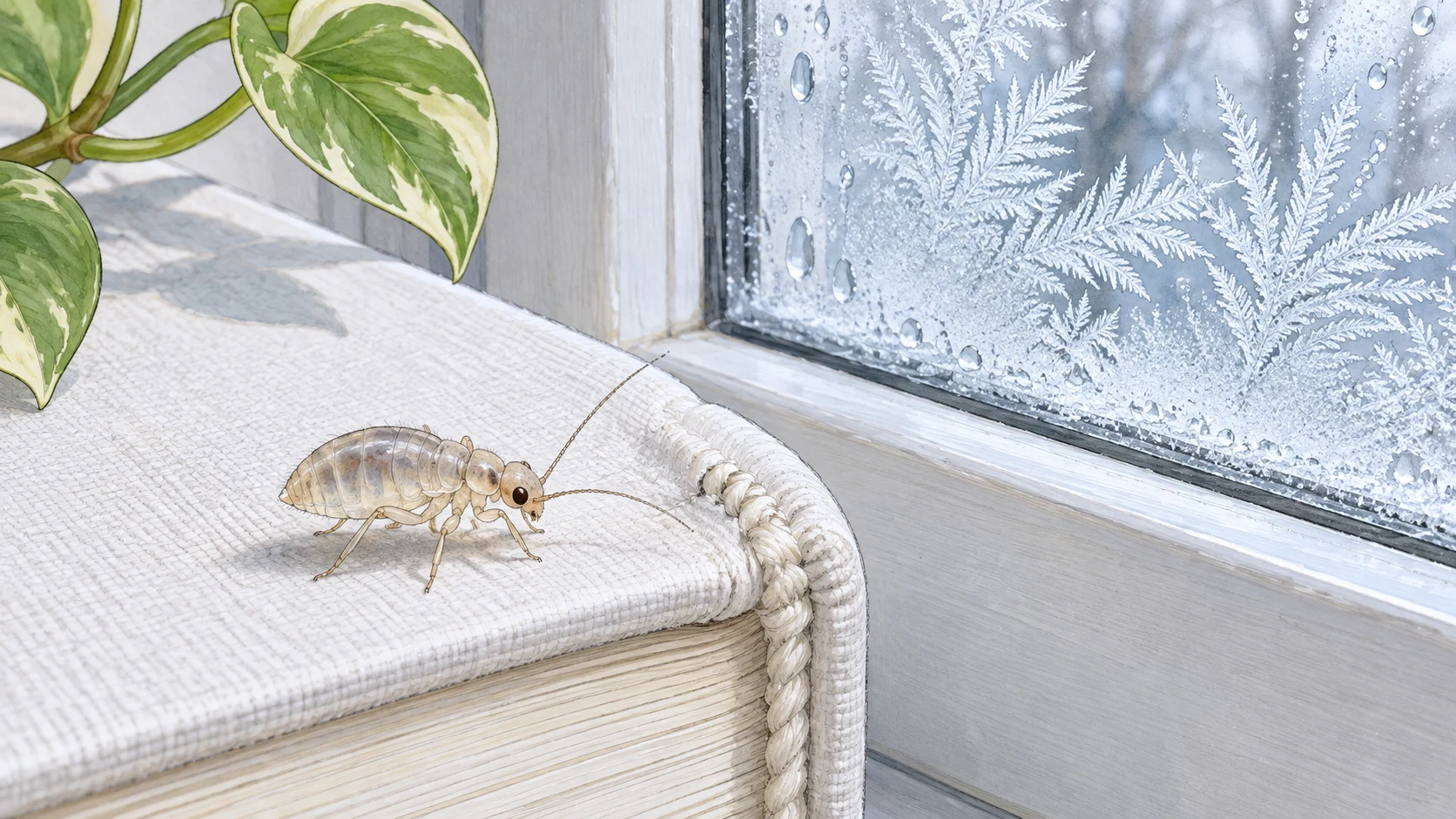
Booklice often become less noticeable during winter, but winter itself does not automatically kill them. In cold climates, indoor heating can lower relative humidity enough to make many rooms unsuitable, causing populations to shrink. Booklice can still survive and reproduce through winter wherever moisture remains high, including damp basements, bathrooms, kitchens, wall cavities, stored foods, and condensation-prone areas.
Winter Heating Can Remove the Conditions That Supported Them in Summer
The seasonal change most likely to reduce indoor booklice is not cold outdoor air reaching the insects. Most household booklice are living inside a heated building, where they are protected from outdoor freezing temperatures. Their environment changes because heated winter air can become exceptionally dry. EPA guidance recognizes that indoor humidity can become very low during winter months, and that reduction can push a previously suitable room below the humidity range psocids tolerate.
Booklice are especially vulnerable to prolonged dryness. Indoor Liposcelis can use internal water reserves for a limited period, but continued exposure below their critical relative humidity eventually causes death; conservation research records survival in dry air for roughly three weeks before prolonged dehydration becomes fatal. Household guidance likewise reports that psocids do not persist when relative humidity stays around 45% to 50% or lower. The strong relationship between survival and booklice humidity requirements therefore explains many apparent winter disappearances.
Cooler Temperatures Can Slow the Population Even Before It Dies Out
Winter can also alter development in parts of a building that become cooler without becoming lethally dry. Booklice reproduce and develop faster under warm favorable conditions, while cooler temperatures reduce egg production and lengthen the time needed to reach adulthood. Under warm conditions, the egg-to-adult period can be shorter than a month, whereas cooler temperatures can extend development beyond three months.
A winter population may consequently become much less visible because fewer new insects are being produced and immature stages are progressing slowly. That seasonal slowdown is different from complete elimination. The booklice life cycle can resume more quickly when temperatures and humidity rise again if enough insects survive in protected locations.
The normal lifespan of booklice also means disappearance from a windowsill does not establish that every insect in the building has died. Some may remain in places where environmental conditions differ sharply from the occupied room.
A Warm House Can Still Have Winter Booklice if It Stays Humid
Heating does not guarantee dryness everywhere. Cooking, showers, indoor laundry, humidifiers, plumbing leaks, wet basements, and poor ventilation can continue adding moisture throughout winter. EPA moisture guidance explains that showers, cooking, leaks, and seepage can maintain indoor moisture even during cold weather.
Booklice can remain active if those sources keep a local habitat sufficiently humid. Stored-product psocids generally favor breeding conditions with both high temperature and high humidity, so a warm pantry with a moisture problem can support insects in January just as readily as another suitable indoor environment during summer.
This makes the room or microhabitat more important than the calendar. Booklice around a continuously damp cupboard may show little seasonal decline while those living on exposed walls elsewhere in the house disappear.
Cold Windows Can Create Winter Refuges Instead of Eliminating Them
Winter produces one condition that can work in the opposite direction: condensation. Warm indoor air contacting a cold window, exterior wall, or other chilled surface can deposit liquid water even when the rest of the room does not feel particularly humid. EPA guidance describes winter condensation on cold windows and walls as a common building-moisture issue.
That small wet zone can support fungal growth and provide a booklice refuge. Repeated insects around a particular windowsill during winter may therefore indicate local condensation rather than a contradiction of their preference for humid conditions. Similar pockets can occur behind furniture pushed against exterior walls or inside poorly insulated wall cavities.
The places booklice live and hide can have humidity levels very different from the air measured in the center of a heated room. One hygrometer reading cannot rule out a damp microclimate a few centimeters away.
Basements and Crawlspaces May Barely Experience the Seasonal Drying Upstairs
Winter can produce a dramatic humidity drop in heated bedrooms and living rooms while doing much less to an unheated or partially heated basement, crawlspace, storage room, or wall void. Ground moisture, seepage, plumbing leaks, limited airflow, and colder surfaces can keep these locations damp throughout the season.
Indoor moisture can support mold and other biological growth even in concealed areas between interior and exterior walls. Booklice living there may continue feeding and surviving while sightings elsewhere decline. Individuals emerging periodically from baseboards or utility penetrations can make a supposedly winter-free house appear to become reinfested when the source never disappeared.
Persistent winter activity concentrated in one area fits the broader signs of an established booklice infestation better than occasional isolated insects scattered through an otherwise dry home.
Humidifiers Can Prevent the Winter Decline
Homes that become uncomfortable during the heating season are sometimes humidified deliberately. That can be beneficial for comfort, but excessive humidification may preserve conditions favorable to booklice. EPA guidance on home humidifiers warns that adding too much moisture can encourage molds and other biological organisms.
A humidifier does not specifically attract booklice from elsewhere. It can simply raise relative humidity enough that insects already present survive longer and fungal food remains available. Condensation appearing on windows after humidification is useful evidence that moisture levels are high enough to create locally wet surfaces.
The goal should not be to make a home excessively dry merely because booklice exist. It is to avoid the persistent dampness that supports the insects while maintaining appropriate indoor conditions for the building and occupants.
New Homes May Show a Strong Winter Decline as Construction Materials Dry
Booklice outbreaks in recently completed homes can behave seasonally for another reason. Plaster, joint compounds, lumber, concrete, and other construction materials release moisture as the building ages. Heating and ventilation during the first cold season may accelerate drying enough for a population to collapse.
The connection between residual construction moisture and booklice in newly built homes means an infestation that was conspicuous during late summer or fall may fade during winter without insecticide. Clemson reports that booklice associated with moist new construction decline when building humidity is reduced below favorable levels.
Continued insects around one wet wall after the rest of the property has dried deserve more attention than a gradual house-wide decline. A concealed leak or persistently damp cavity can keep supporting them after temporary construction moisture should have diminished.
Disappearing in Winter Does Not Guarantee They Will Stay Gone
A population that becomes undetectable during dry winter conditions can reappear when spring or summer raises humidity again. New insects may also enter later, so recurrence does not necessarily prove that the exact same individuals survived continuously through winter.
A repeating seasonal pattern suggests that part of the home becomes suitable during humid months. Storage boxes on a basement floor, poorly ventilated shelving, damp window areas, or another recurring moisture source can recreate the habitat each year. Measures aimed at preventing booklice from returning are more relevant to that cycle than relying on winter to suppress them temporarily.
Questions About Booklice During Winter
Are booklice active in December and January?
They can be. Indoor booklice are not tied to a particular month if the building remains warm and humid enough for them.
Does freezing weather outside kill booklice inside a house?
Not normally. Insects living inside heated spaces are insulated from outdoor freezing temperatures. Their indoor temperature and humidity determine survival.
Why did my booklice disappear when the furnace came on?
The heating season may have lowered indoor relative humidity below the range that supported the population. Drying can also reduce the microscopic fungal growth they use as food.
Why do I still have booklice in my bathroom during winter?
Showers, condensation, plumbing moisture, and poor ventilation can maintain a humid bathroom despite dry conditions elsewhere in the house.
Can booklice survive winter in cardboard boxes?
Yes, if the boxes remain in a sufficiently humid location. Dry cardboard stored in dry air is much less suitable than boxes on a damp basement floor or near condensation.
Will opening windows in winter get rid of booklice?
Outdoor air exchange may affect indoor humidity, but opening windows is not a universal treatment and can create comfort, condensation, or building-moisture issues depending on the conditions. Persistent booklice are better evaluated by measuring humidity and locating moisture sources.
Should booklice be completely gone by spring?
Not necessarily. Winter may suppress a population without eliminating every favorable habitat. If numbers increase again as humidity rises, the seasonal conditions supporting them have likely returned rather than winter having provided permanent control.