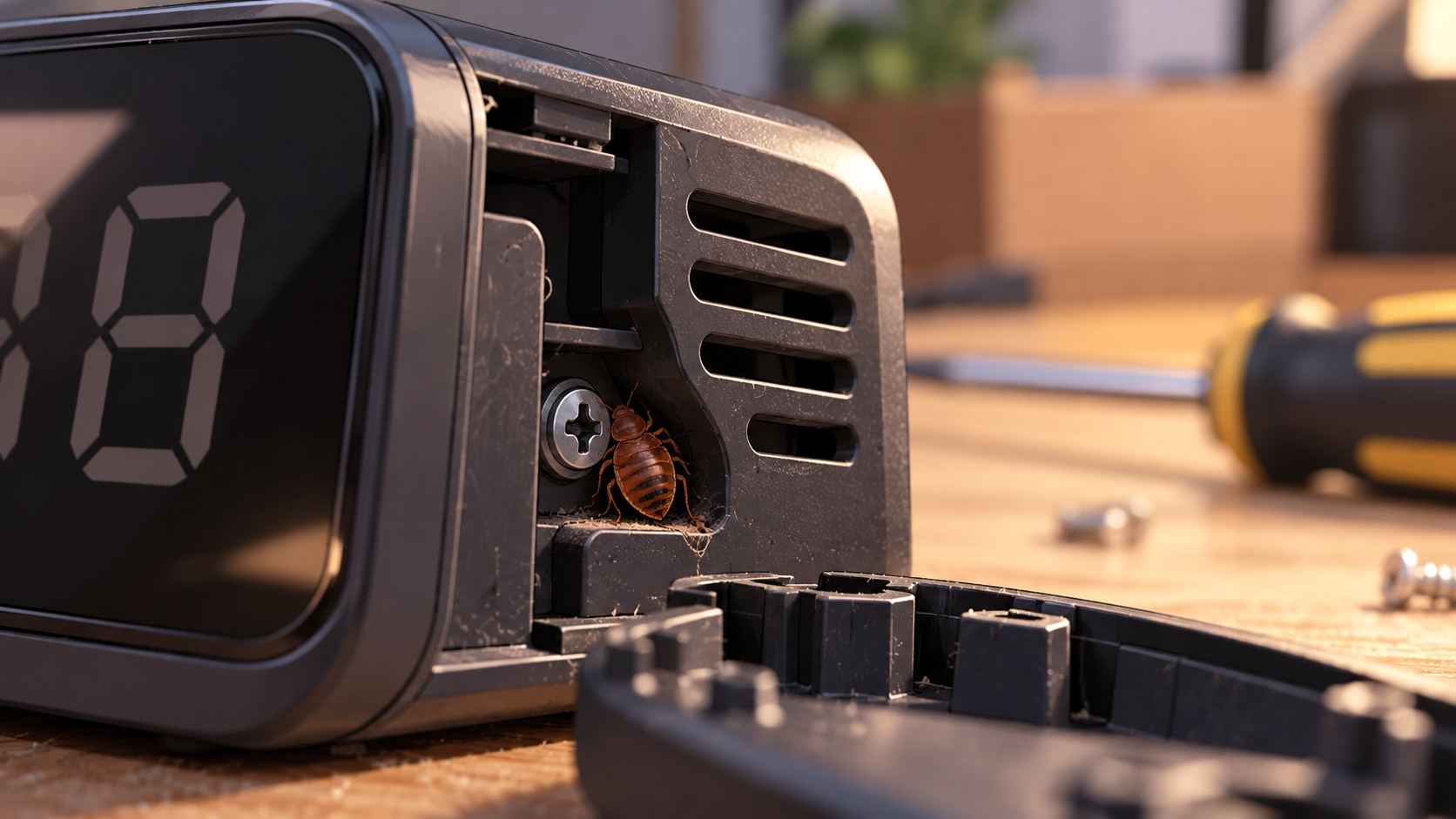
Bed bugs can hide and survive inside electronics. However, they do not eat wires, circuit boards, or electrical components, and electronics are not their preferred habitat. A device becomes useful to them when it offers narrow protected openings close to a person who sleeps or rests nearby, especially during a larger infestation.
Bed Bugs Use Electronics as Shelter, Not Food
Bed bugs feed exclusively on blood, so a laptop, television, router, alarm clock, or game console provides no nourishment. Their interest is physical shelter. Their flattened bodies allow them to enter very small cracks, and bed bugs commonly hide in protected crevices near sleeping hosts. Vents, screw recesses, speaker openings, battery compartments, cable ports, seams in plastic housings, and gaps around buttons can provide similar protection.
This makes location more important than the fact that an object is electronic. An alarm clock sitting beside an infested bed has a greater chance of harboring bugs than an identical clock stored in a distant kitchen cabinet. The insects normally remain concentrated near places where hosts rest, although established infestations can spread farther through a room. Their ability to exploit small gaps is one reason bed bugs can remain hidden even when an infestation is present.
Bedside Electronics Carry More Risk Than Devices in Remote Rooms
Electronics close to beds, sofas, and recliners deserve the most attention. Alarm clocks, charging stations, remotes, bedside lamps, laptops used in bed, tablets, game controllers, speakers, and televisions positioned near sleeping areas can sit within normal bed bug movement range. Bed bugs generally establish near hosts and can occupy cracks, furniture, wall voids, and other sheltered locations surrounding beds.
Devices elsewhere in the home can still acquire hitchhikers, particularly during a severe infestation, but finding one bug near a desktop computer across the house does not mean computers inherently attract them. Bed bugs can also move through electrical wiring and plumbing conduits between rooms, which may place them around outlets, wall-mounted electronics, and cable penetrations without the device itself being the original harborage.
Heat From Electronics Is Not a Substitute for a Human Host
Warm devices are sometimes described as bed bug magnets. Bed bugs do respond to heat as one component of host location, but experimental work found that their orientation toward a heat source operates only across short distances. Human hosts also provide carbon dioxide, body odors, and other cues that an electronic device does not reproduce.
A warm laptop may make a nearby opening suitable for shelter, but the heat generated by ordinary electronics does not feed bed bugs or create an independent population far from people. A powered device beside a bed is more relevant because it combines shelter and proximity to the host.
Laptops and Desktop Computers Offer Difficult-to-Inspect Voids
Computers can contain cooling vents, keyboard gaps, removable panels, cable ports, internal cavities, and seams between housing components. Those spaces make inspection harder than examining a smooth tabletop. Bed bugs may remain behind external panels or around openings where direct visual confirmation is difficult.
If a suspicious computer has been used beside an infested bed or sofa, inspect the exterior vents, keyboard perimeter, docking connections, underside, cable openings, and removable battery area if the manufacturer permits access. Do not dismantle a device beyond normal user-serviceable components merely to search for an insect. The same hiding behavior that makes bed bugs difficult to eradicate from furniture and structural cracks also limits what can be confirmed by looking through a computer vent with a flashlight.
Televisions, Consoles, Routers, and Printers Can Harbor Them Too
Any device with openings large enough for a bed bug can potentially provide temporary shelter. Televisions have ventilation slots and housing seams; game consoles contain cooling openings; printers have paper paths and removable trays; routers and cable boxes often remain undisturbed for long periods. These features become more relevant when the device sits close to an active infestation.
Older or rarely moved electronics may be especially difficult to inspect because dust and internal shadows can obscure evidence. Visible fecal spotting around seams, shed skins near openings, live bugs entering vents, or insects emerging after the device is moved are stronger evidence than simply finding a device in an infested room. The same approach used to recognize early signs of bed bugs applies here: look for multiple forms of physical evidence rather than assuming every dark speck is bed bug activity.
Bed Bugs Can Enter Electrical Outlets Without Living in the Wiring
Outlet and switch boxes can act as sheltered wall access points, particularly when infestations spread away from the bed. Electrical outlets and wall switches are recognized inspection points in infested rooms, and insects can move through the spaces around conduit, boxes, and wall cavities.
That does not mean bed bugs feed on electricity or normally inhabit copper wiring. They use the surrounding void as shelter or as a route between rooms. Never insert insecticide, liquid, steam, tools, or vacuum attachments into a live electrical outlet unless a product or procedure is specifically approved for that use. Electrical areas require different handling from mattress seams or furniture cracks.
Steam Is a Poor Choice for Electronics
Steam can kill bed bugs on suitable surfaces, but it should not be directed into powered electronics, outlets, ports, or internal circuitry. Moisture can damage components and create an electrical hazard. Even bed bug steam guidance warns against using steam around switch plates, electrical outlets, and plugged-in appliances.
The same restriction applies to televisions, game systems, computers, chargers, speakers, and similar equipment. A method that works well on a mattress seam is not automatically appropriate for a circuit board.
Whole-Room Heat Can Treat Electronics, but Temperature Limits Matter
Bed bugs are vulnerable to sustained heat. Adults and eggs die when lethal temperatures reach them for sufficient time, with eggs generally requiring greater thermal exposure than adults. Controlled research found adult and egg mortality depended strongly on both temperature and exposure duration.
Professional whole-room heat can therefore kill bed bugs hiding inside some electronics if the internal components reach the required temperature. Electronics themselves may have lower safe operating or storage limits, however. High structural-treatment temperatures can damage displays, batteries, adhesives, plastics, capacitors, and other components, and heat-sensitive belongings require separate handling during bed bug treatments.
Do not place a laptop, phone, television, or battery-powered device into an oven, clothes dryer, microwave, sauna, hot car, or improvised heat chamber. The manufacturer’s temperature limits take priority over a generic pest-treatment temperature.
Spraying Pesticide Into a Device Can Damage It
Household insecticide should not be sprayed through ventilation slots, charging ports, keyboard openings, or other electronic components unless the pesticide label specifically permits that application. Liquid formulations can damage electronics, while aerosols may contain solvents or propellants that create additional risks.
A registered bed bug product must match both the pest and the treatment site. Pesticide labels determine where a bed bug product may legally and safely be applied, so a spray labeled for baseboards or cracks around furniture should not be redirected into a game console simply because a bug disappeared through the vent.
The broader bed bug treatment process works best when electronics are treated as one possible harborage within an infested room rather than saturated individually with pesticide.
Isolation Can Be Useful for Nonessential Electronics
A device that cannot safely tolerate heat, moisture, or pesticides can sometimes be isolated in a sealed container while the surrounding infestation is treated. Isolation prevents bugs from leaving the object and reaching a host, although the waiting period must account for their long starvation tolerance.
Bed bugs can survive many months without a blood meal, particularly under favorable temperatures, so putting a device in a bag for a few days is not dependable. Cornell IPM guidance for electronics identifies extended airtight isolation as an option for devices that cannot be treated conventionally.
Isolation is more practical for a spare alarm clock or old game console than for a phone or work computer needed every day.
Vacuuming Can Remove Visible Bugs but Not Hidden Ones
A small vacuum attachment can collect an exposed bed bug from the exterior of a device, cable bundle, desk surface, or removable compartment. It cannot be assumed to pull insects from deep internal cavities, and excessive suction around delicate parts can damage equipment.
If a bug is visible outside the housing, capture or vacuum it before it retreats farther inside. Inspect the surrounding desk, nightstand, wall junction, outlet, and furniture at the same time. A device sitting on an infested office chair or beside other bed bug harborages may only be one part of a larger local cluster.
Finding a Bed Bug in One Device Does Not Mean Every Electronic Is Infested
Bed bugs tend to aggregate near suitable shelter and hosts rather than distributing themselves evenly among every object in a room. One alarm clock containing bugs does not justify opening every phone, television, appliance, and router in the home.
Inspect outward from the confirmed location. Concentrate on sleeping and resting areas, nearby furniture, wall cracks, outlets, and devices within that zone. The severity of the surrounding infestation matters more than the total number of electronics in the property. A mild bed bug infestation may involve only a few nearby harborages, whereas a long-established population is more likely to occupy unusual objects farther from the bed.