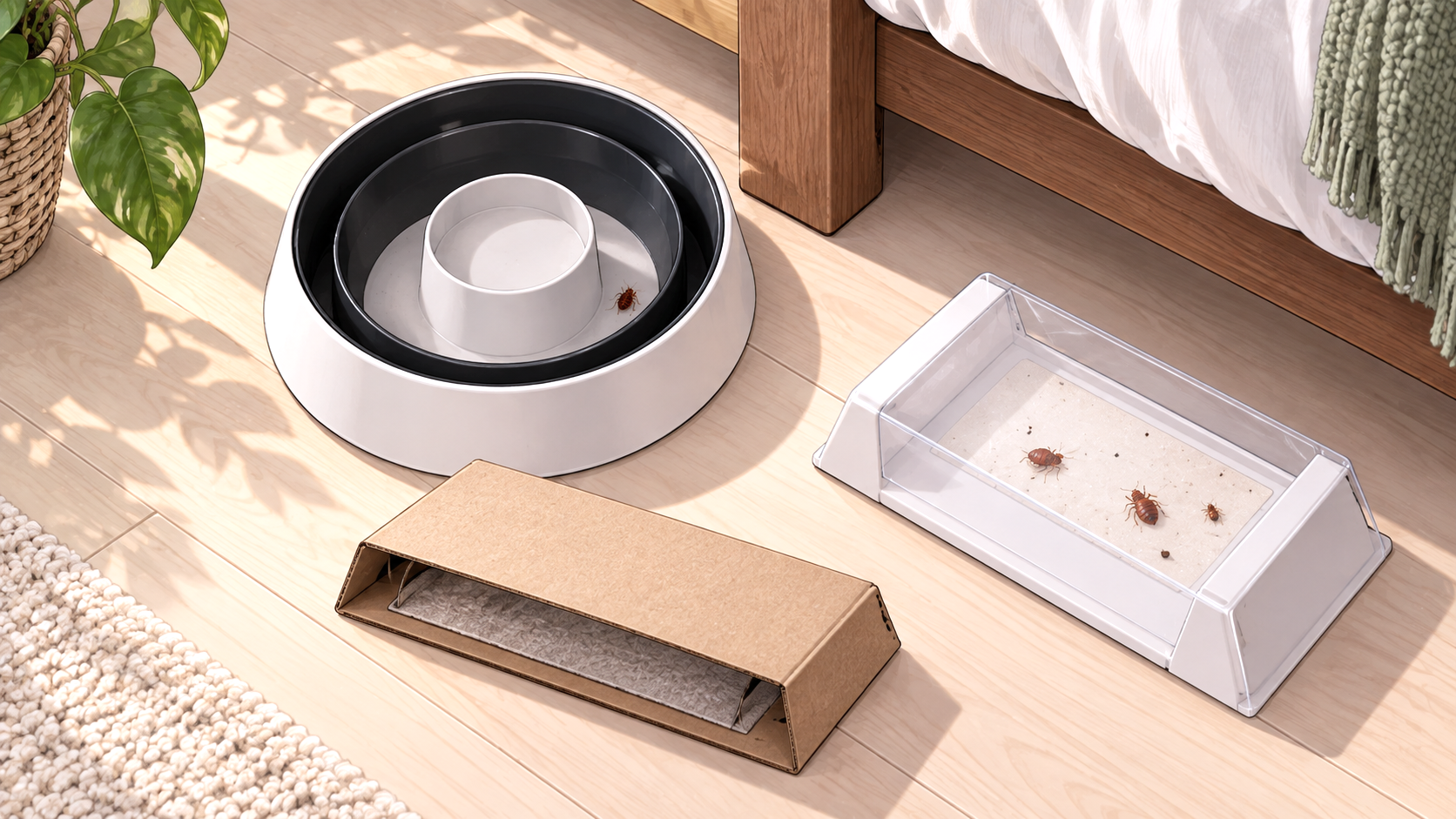
For most homes, the ClimbUp Insect Interceptor is the best bed bug trap overall because it has strong independent research behind it, requires no lure or pesticide, and can detect very small infestations when correctly installed beneath furniture legs. The SenSci BlackOut is a strong reusable alternative, while the SenSci ActivVolcano is more useful where a trap cannot sit beneath a bed leg or where an added lure is desirable.
Best Bed Bug Traps at a Glance
| Trap | Best Use | Trap Type | Main Advantage |
|---|---|---|---|
| ClimbUp Insect Interceptor | Best overall | Under-leg pitfall interceptor | Strong independent field evidence |
| SenSci BlackOut | Best durable under-leg alternative | Under-leg pitfall interceptor | Dark, sturdy design with good detection performance |
| SenSci ActivVolcano | Best free-standing trap | Lured pitfall monitor | Can be placed beside furniture or along walls |
| SenSci Volcano | Best lure-free free-standing option | Passive pitfall monitor | Small footprint and flexible placement |
These devices are primarily monitoring tools. They capture individual bed bugs and can reduce the number reaching furniture, but an established infestation still requires a broader bed bug elimination strategy.
ClimbUp Insect Interceptor Is the Best Overall Bed Bug Trap
The ClimbUp Insect Interceptor has one advantage that matters more than elaborate marketing claims: it has been used extensively in independent bed bug research. Each interceptor sits beneath a bed, couch, or chair leg. Bugs approaching the furniture climb the textured exterior and fall into an outer pitfall, while bugs leaving the furniture can be captured in the inner section.
In occupied apartments with light infestations, seven days of ClimbUp monitoring caught similar numbers of bugs to a dry-ice active monitor operated for one day and detected low-level infestations more effectively than visual inspection. That field comparison also found the interceptor competitive with several more complicated active monitoring systems. In a larger housing study, ClimbUps detected about 89% of known infestations during the inspection program, while brief visual inspections detected about 72%. Almost half of the infestations found during that program were in apartments whose residents had not realized bed bugs were present.
The standard ClimbUp is roughly six inches across with an inner well large enough for many conventional bed legs, while larger versions are available for oversized supports. It works best when the furniture is isolated from other access routes. Sheets cannot touch the floor, the bed should not press against a wall, and cords or nearby furniture should not provide alternative bridges. EPA likewise recommends placing interceptors beneath every bed leg while keeping the bed isolated from walls and floor-touching bedding.
For a homeowner trying to verify early physical evidence of bed bugs or monitor after treatment, this is the easiest trap to recommend.
SenSci BlackOut Is the Best Heavy-Duty Under-Leg Alternative
The SenSci BlackOut uses the same basic under-furniture interception principle but in a dark, durable design. It is particularly useful when a black trap is less visually intrusive beneath dark bed frames or commercial furniture.
Independent research comparing passive monitors in occupied apartments found that BlackOut traps detected bed bugs in 79% of infested apartments, compared with 88% for ClimbUp BG interceptors and 39% for the sticky Bedbug Detection System. When the weak sticky monitor was excluded, researchers found detection rates of roughly 80–90% with the pitfall devices even when relatively few monitors were deployed. Pitfall-style monitors clearly outperformed the tested sticky monitor.
BlackOut is therefore a legitimate alternative rather than simply another look-alike plastic tray. Its larger physical presence may suit substantial bed frames better than small free-standing devices, although the furniture leg still needs to fit inside the center well without touching the trap walls.
Both BlackOut and ClimbUp are most effective when a person regularly sleeps or rests on the furniture because the occupant supplies the heat, carbon dioxide, and odors that naturally draw bed bugs toward the trap. That makes under-leg interceptors particularly useful when trying to determine whether bed bugs are present around an occupied sleeping area.
SenSci ActivVolcano Is the Best Free-Standing Trap
Not every bed can accept an under-leg interceptor. Platform beds may sit directly on the floor, some frames have broad continuous bases, and commercial rooms may need a discreet monitor positioned along a wall rather than beneath furniture. The SenSci ActivVolcano is designed for those situations.
The device combines the small Volcano pitfall monitor with a chemical lure intended to increase attraction. Because it does not need to support a furniture leg, it can be placed beside bed or couch legs, along baseboards, or at other suspected travel routes. Manufacturer directions recommend placing free-standing monitors near furniture legs and room edges where bed bugs commonly travel.
A Texas A&M field evaluation in an occupied shelter found that Volcano traps containing the Activ lure captured significantly more bed bugs than identical Volcano traps without the lure. The lured version produced a measurable improvement in field captures.
Chemical lures can improve detection, but they should not be confused with the much stronger attraction created by carbon dioxide. Laboratory and field experiments have repeatedly found that CO₂ release rate has a major effect on active monitor performance. The ActivVolcano’s main attraction is convenience: it provides enhanced free-standing monitoring without requiring dry ice, a CO₂ cylinder, or a fermentation setup.
This format can complement the other bed bug detectors used for difficult low-level infestations when furniture design makes conventional interceptors impractical.
SenSci Volcano Is the Best Passive Trap When Nothing Can Go Under the Furniture
The SenSci Volcano uses the same compact pitfall body without the Activ lure. Its rough exterior encourages bugs to climb upward, while the interior capture area is designed to keep them from escaping. At approximately three inches square and one inch tall, it fits beside furniture and against baseboards more discreetly than full-size under-leg interceptors.
Its greatest advantage is placement flexibility. Instead of depending on an insect climbing one specific bed leg, multiple Volcanos can be positioned along probable travel routes. Current directions recommend placement against baseboards near beds or couches and beside furniture legs, with additional monitors used during active or post-treatment monitoring.
A passive free-standing trap is less attractive than a person sleeping nearby, so placement deserves more attention than with a bed-leg interceptor. Bed bugs commonly move along room edges and between harborages and feeding sites, which makes targeted locations more productive than scattering devices randomly across open floor space.
For rooms containing divan bases, platform beds, or furniture without usable legs, this design solves a practical problem that standard interceptor cups cannot.
Ordinary Glue Traps Are Not the Best Choice for Bed Bugs
Sticky boards can catch a bed bug that happens to walk over the adhesive, but they do not exploit bed bug climbing behavior as effectively as a purpose-built pitfall interceptor. Their performance also deteriorates as dust, lint, hair, and other debris cover the adhesive.
The passive-monitor apartment study that compared ClimbUp, BlackOut, and a sticky detection system found only 39% detection with the sticky monitor, substantially below the pitfall traps. The sticky device also took longer to reveal infestations.
Glue traps can still provide incidental evidence, particularly in constrained spaces where a pitfall device will not fit, but they should not be the first purchase for a bed bug-specific monitoring program. A negative sticky card is especially weak evidence that the room is clear.
The same caution applies to many generic at-home bed bug detection products: a device should be judged by how bed bugs actually encounter it rather than by packaging claims.
CO₂ Traps Are Powerful but Less Convenient for Routine Home Monitoring
Carbon dioxide is one of the strongest known host-seeking cues for bed bugs. Active experimental monitors using dry ice or generated CO₂ have caught large numbers of insects rapidly, sometimes outperforming passive interceptors over short deployment periods.
In naturally infested apartments, a sugar-and-yeast system generating roughly 405 mL of CO₂ per minute performed similarly to a dry-ice trap using the same chemical lure. One active monitor operated for a day produced trapping results comparable to 6–18 ClimbUp interceptors deployed for 11 days. Adding the chemical lure to the CO₂ monitor increased catches more than sevenfold.
That performance is impressive, but active CO₂ traps are less attractive for routine household ownership. Dry ice must be replenished, fermentation systems vary in output, and cylinders add equipment and handling requirements. A passive interceptor can simply remain beneath the bed for weeks or months.
CO₂ systems make more sense for professional inspections or temporarily unoccupied rooms where no sleeping person is present to attract bugs naturally.
Trap Design Matters Even Within the Same Category
Not every smooth plastic cup performs equally. Diameter, wall height, surface texture, color, and the anti-escape coating can all change capture rates. Recent research with the tropical bed bug, Cimex hemipterus, found that pitfall dimensions and inner-wall treatments significantly affected trapping success. Taller pitfall designs and effective slippery barriers improved containment.
Species can matter as well. Adult tropical bed bugs have stronger climbing ability than common bed bugs and have escaped from several commercial pitfall traps under laboratory conditions. Tests involving ClimbUp, BlackOut, SenSci Volcano, and another detector found adult tropical bed bugs capable of escaping all four devices, while escape by common bed bugs and nymphs was much lower.
That limitation is relevant in tropical and subtropical regions. An interceptor can still be useful, but no negative trap result should override clear physical evidence elsewhere in the room.
Use Enough Traps to Cover the Furniture That Actually Matters
For an occupied bed, the simplest arrangement is one under-leg interceptor beneath every support that touches the floor. If using free-standing monitors instead, prioritize the head of the bed, nearby baseboards, and furniture used regularly for sleeping or prolonged resting.
EPA advises checking and cleaning interceptors regularly because dust and debris can create footholds that make escape easier. With under-leg models, furniture should remain isolated throughout monitoring so bugs cannot bypass the trap through walls, sheets, cords, or adjacent furniture.
Couches also deserve attention when occupants routinely sleep or spend long periods on them. A bed-only monitoring arrangement can miss activity centered on upholstered furniture elsewhere in the room.
For broader inspections, placing monitors according to the rooms and furniture most likely to contain bed bugs produces better information than placing identical numbers in every room.
Do Not Treat an Empty Trap as Proof There Are No Bed Bugs
Traps sample movement. They do not inspect every seam, void, mattress fold, and piece of furniture. A bed bug already living in the mattress or frame may feed without crossing an under-leg interceptor, and recently fed insects can remain hidden for days.
Repeated empty traps become more meaningful when visual inspections also remain clear and no fresh fecal spotting, cast skins, eggs, or live bugs appear. During post-treatment monitoring, trap counts can help establish whether bed bug treatment is continuing to suppress activity.
Interceptors are valuable partly because they can remain in place long after treatment. EPA recommends using bed-leg interceptors for extended monitoring, potentially for a year, rather than removing them after the first negative inspection. A good trap is therefore less about catching the largest number in one night and more about providing reliable evidence over time.