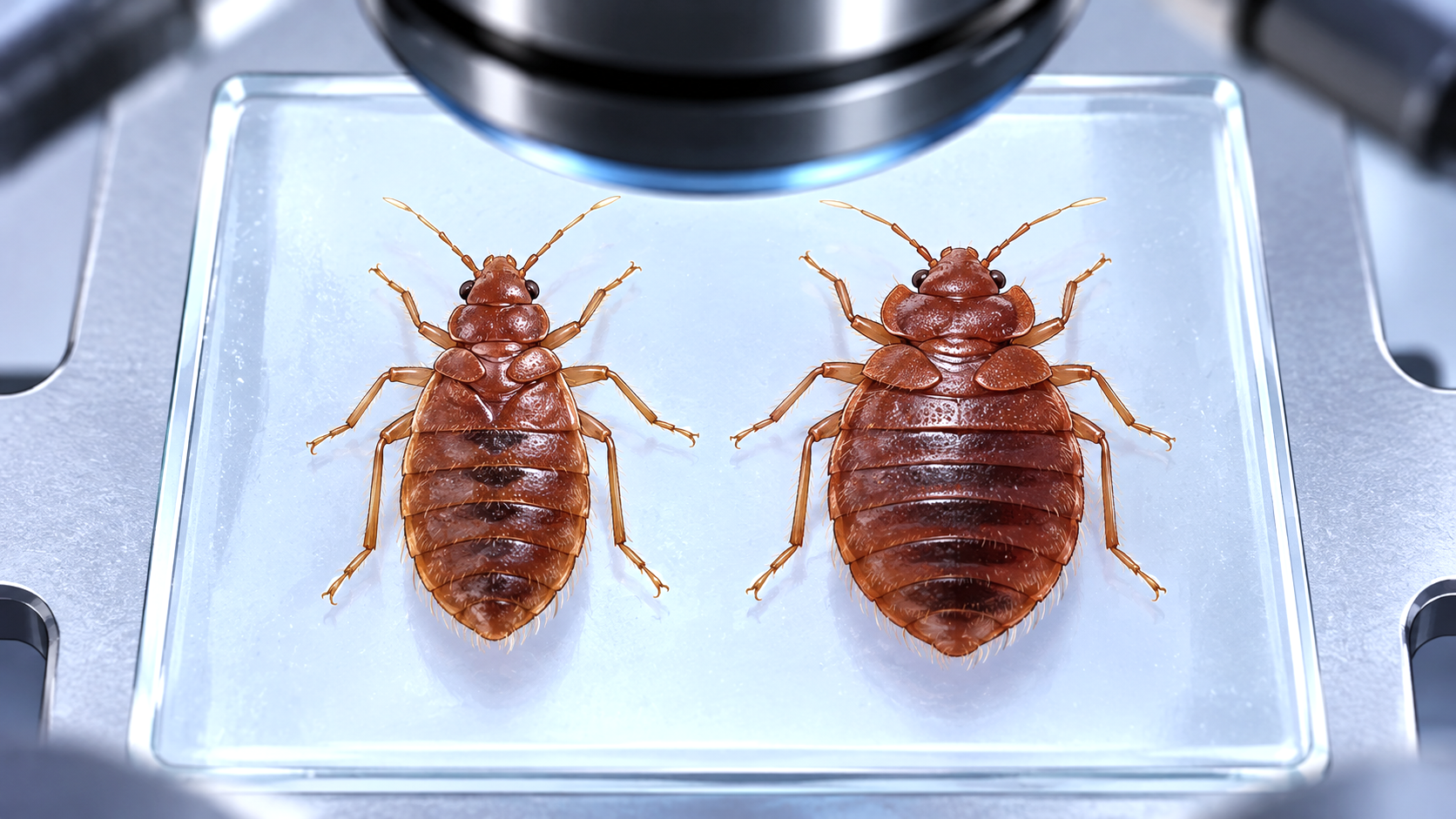
Tropical bed bugs (Cimex hemipterus) and common bed bugs (Cimex lectularius) are separate species that infest homes and feed on people in much the same way. The most reliable physical difference is the pronotum behind the head: it is narrower with less-expanded sides in tropical bed bugs and broader in common bed bugs. The difference is subtle enough that species identification often requires magnification or an entomologist rather than a casual visual check.
The Pronotum Is the Most Useful Physical Difference
Both species are small, reddish-brown, flattened, wingless bugs with similar abdominal shapes, feeding behavior, and life stages. General characteristics such as color or whether the abdomen becomes elongated after feeding therefore do little to distinguish them. The diagnostic area is the pronotum, the plate immediately behind the head. In C. lectularius, its lateral margins flare outward more strongly, giving the front of the insect a wider, more deeply curved appearance. C. hemipterus has narrower lateral extensions and a less deeply excavated front margin. A medical entomology identification key describes the tropical species as having a moderately excavated pronotum and the common species as having a more deeply excavated one.
Measurements provide a more objective distinction. Research identifying tropical bed bugs morphologically uses a pronotum width-to-length ratio below roughly 2.5 for C. hemipterus, while C. lectularius generally exceeds 2.5. A recent Kenyan study likewise identified narrower pronotal margins and a lower width-to-length ratio in tropical bed bugs. These differences are much easier to evaluate under magnification than with the naked eye, particularly in immature bugs. Anyone simply trying to determine whether an insect belongs to the bed bug group can first compare it with the broader appearance of adult bed bugs before attempting species-level identification.
| Feature | Tropical Bed Bug | Common Bed Bug |
|---|---|---|
| Scientific name | Cimex hemipterus | Cimex lectularius |
| Adult appearance | Flattened, reddish-brown, wingless | Flattened, reddish-brown, wingless |
| Pronotum | Narrower, less flared at sides | Broader, more strongly flared |
| Pronotum width | Usually below about 2.5 | Usually above about 2.5 |
| Main distribution | Tropics and subtropics | Worldwide |
| Smooth-surface climbing | Adults are generally better climbers | Adults have weaker grip on very smooth surfaces |
| Human infestation behavior | Very similar | Very similar |
Their Geographic Ranges Overlap More Than Their Names Suggest
The tropical bed bug is associated primarily with tropical and subtropical climates, while the common bed bug has a much broader global distribution. CDC describes C. lectularius as cosmopolitan and C. hemipterus as mainly tropical and subtropical. Older literature often placed the tropical species mainly within about 30 degrees north and south of the equator, but modern travel, urbanization, climate conditions, and repeated introductions have made geography less dependable as an identification shortcut.
Both species can occur within the same country or region. Research examining African populations found substantial geographic variation, including areas where tropical bed bugs predominated and others where common bed bugs were more frequent; modeling also identified zones where the two species could coexist. Similar overlap has been reported in parts of Asia. Genetic work on specimens from southern China confirmed C. hemipterus through both morphology and DNA despite the wider regional history of both bed bug species.
Location can therefore change the probability of finding either species without proving identity. The broader worldwide distribution of bed bugs reflects both climate and human movement, so a specimen from a warm region still needs anatomical confirmation if knowing the exact species matters.
Tropical Bed Bugs Are Better at Climbing Smooth Surfaces
One practical difference involves the feet. Adult tropical bed bugs possess more developed adhesive structures that give them stronger traction on smooth vertical surfaces. In controlled comparisons, adult C. hemipterus escaped from several commercial pitfall-style bed bug monitors that successfully contained C. lectularius. Microscopic examination found a greater number of adhesive hairs on the tropical species’ tibial pads, corresponding with greater vertical friction and stronger climbing performance.
That difference can affect monitoring. Conventional interceptor traps that rely on extremely smooth inner walls may be less reliable against adult tropical bed bugs than against common bed bugs. More recent experiments confirmed that trap height, wall coating, and anti-escape treatments substantially affect pitfall-trap performance against C. hemipterus.
The species difference does not mean common bed bugs are poor climbers in ordinary rooms. Both readily crawl over fabric, wood, walls, furniture, and other textured materials, and bed bugs can climb walls and ceilings when the surface offers enough grip. The unusual advantage of the tropical species becomes most apparent on smooth materials used specifically to contain or monitor them.
Both Species Can Be Resistant to Insecticides
Neither species should be assumed susceptible to a pesticide merely because it is labeled for bed bugs. Pyrethroid resistance, metabolic detoxification, target-site mutations, and other resistance mechanisms have been documented in both C. lectularius and C. hemipterus. A systematic review of global resistance research found substantial evidence in both species, with much of the published C. hemipterus resistance work coming from Asia and much of the C. lectularius literature from North America. The review concluded that insecticide resistance is widespread across both major human-associated species.
Species identification can still help pest-management programs because their resistance genetics and physiology are not identical. Recent researchers developing molecular tests for the two species noted that accurate identification can support species-specific trapping and resistance assessment. For a household infestation, however, treatment choice should be driven primarily by evidence of infestation extent, product labeling, local resistance experience, and whether several control methods are being combined. The broader reasons bed bugs can be difficult to eliminate apply to both species.
Their Bites and Indoor Signs Are Essentially the Same
A bite reaction cannot distinguish a tropical bed bug from a common bed bug. Both pierce the skin, take blood meals, and can produce no visible reaction, small itchy papules, or larger inflammatory responses depending on the person. CDC notes that the main medical importance of both species is associated with skin reactions to feeding rather than efficient disease transmission.
Their indoor evidence is also similar: live bugs, pale eggs, shed skins, and dark fecal spotting may appear around mattresses, bed frames, upholstered furniture, and nearby cracks. Finding these signs establishes a bed bug infestation without revealing which Cimex species is present. The same early signs used to recognize bed bug activity apply to either species.
Species-level identification is therefore most useful when surveillance, research, regional resistance patterns, or trap performance matter. For an ordinary household deciding whether bed bugs are present, confirming that the insect is a bed bug is usually more urgent than separating C. hemipterus from C. lectularius.
Questions About Tropical and Common Bed Bugs
Can tropical and common bed bugs live in the same building?
Yes. Their geographic ranges can overlap, and both use human sleeping environments. Coexistence within a region has been documented, although one species may dominate locally.
Can the two species reproduce with each other?
Laboratory crosses have occasionally produced first-generation offspring, but successful reproduction does not continue normally. They remain biologically distinct species.
Are tropical bed bugs larger than common bed bugs?
Not reliably enough for identification. Adult size ranges overlap, so pronotum structure is far more useful than overall length.
Do tropical bed bugs require different treatment?
Most core control methods apply to both, including heat, steam, appropriately labeled insecticides, desiccant dusts, encasements, and monitoring. Stronger smooth-surface climbing and local insecticide-resistance patterns can require adjustments in traps or pesticide selection.
Can you identify the species from a photograph?
A sharp close-up showing the head and pronotum may allow an experienced entomologist to make a preliminary identification. Blurry phone photographs, distant images, and bite photos are not reliable for separating the two species. When exact identification matters, preserving the specimen is preferable.