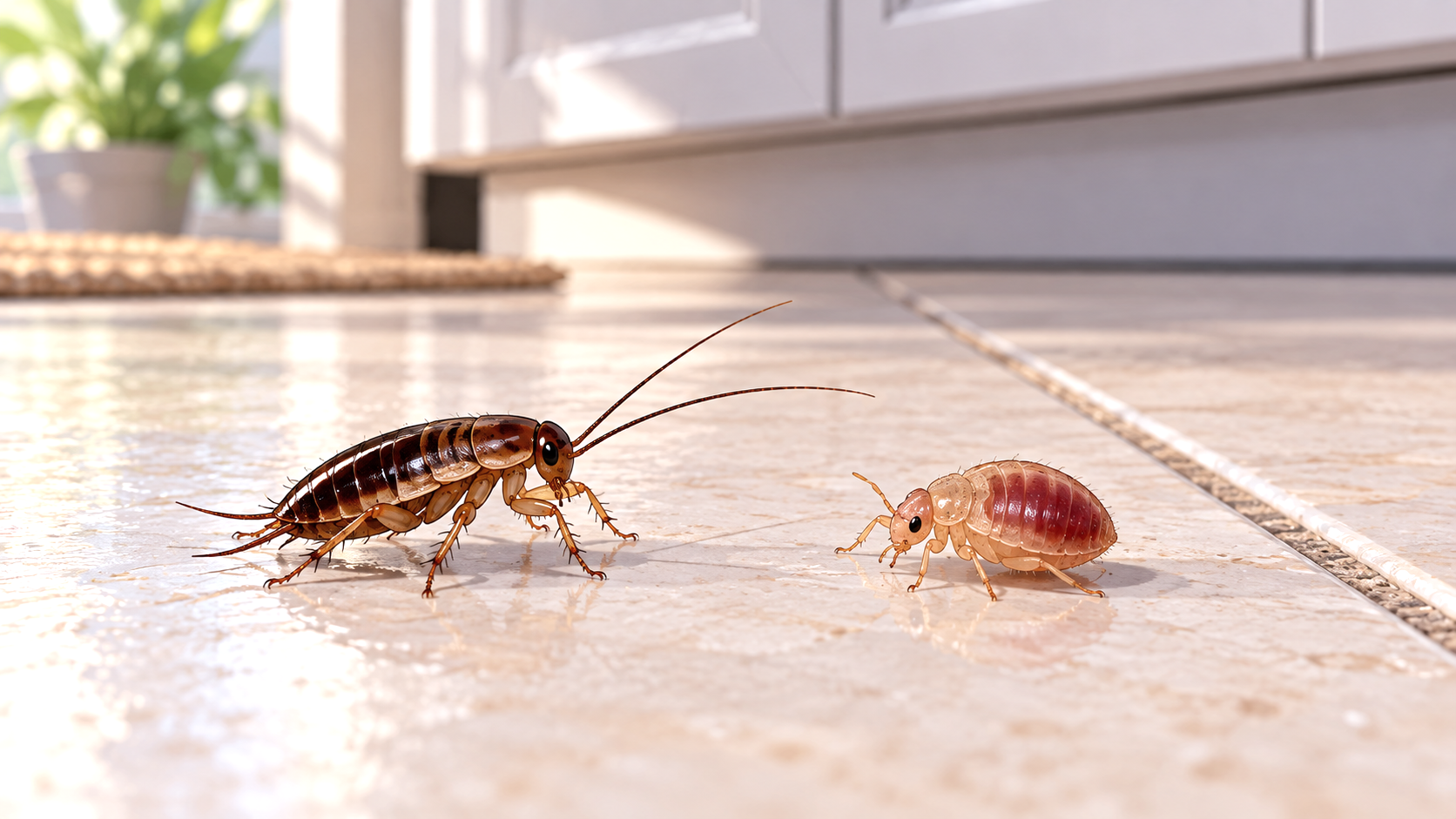
Baby cockroaches and baby bed bugs can both be tiny, wingless, and active at night, but their proportions are different. Cockroach nymphs usually have very long antennae, conspicuous legs, and a darker, more elongated body. Bed bug nymphs are broadly oval, flatter, and often translucent or yellowish-white before feeding. A recently fed baby bed bug can turn bright red or dark red because blood is visible through its thin body.
The Antennae and Legs Usually Give Baby Cockroaches Away
Cockroach nymphs are miniature versions of adult cockroaches without fully developed wings. UC IPM describes cockroaches as flattened insects with long antennae and a shield-like pronotum behind the head, and those proportions are already apparent in the juvenile stages. Their antennae commonly extend as long as the body or farther, while the legs project prominently from the sides and are adapted for rapid running. Many species also have two small rear appendages called cerci at the end of the abdomen.
Baby bed bugs have much shorter-looking appendages relative to their broad body. Their antennae contain four segments but do not create the long, threadlike silhouette of a cockroach nymph. The legs are also shorter and less conspicuous. EPA describes bed bugs at every stage as six-legged, flattened and oval-bodied insects, with the young stages resembling pale, smaller versions of adults. The rounded outline is easier to recognize once compared with the normal shape of an adult bed bug.
| Feature | Baby Cockroach | Baby Bed Bug |
|---|---|---|
| Body shape | Elongated to oval, often narrower | Broadly oval and very flat when unfed |
| Antennae | Very long and threadlike | Shorter relative to body |
| Legs | Long, obvious, often spiny | Shorter and less prominent |
| Color | Usually brown, tan, reddish-brown, or dark | Often translucent to pale yellow when unfed |
| After feeding | Appearance changes little from food intake | Abdomen may become visibly red with blood |
| Movement | Usually very fast and scattering | Crawls readily but typically looks less roach-like in motion |
| Typical setting | Kitchens, bathrooms, appliances, cabinets, utility areas | Beds, couches, headboards, mattress seams, nearby cracks |
First-Stage Bed Bug Nymphs Can Be Almost Colorless
Color causes many misidentifications because young bed bugs do not initially resemble the reddish-brown adult most people expect. EPA lists a first-stage bed bug nymph at only about 1.5 mm long, increasing through five nymphal stages to approximately 4.5 mm before adulthood. Unfed nymphs are translucent or whitish-yellow and can be difficult to see. Their size and pale coloration explain why an early infestation can remain unnoticed even when live insects are present.
After feeding, the abdomen fills with blood and may appear bright red through the thin cuticle. As digestion proceeds, it becomes darker. That temporary red abdomen is a useful clue because a cockroach nymph does not become visibly blood-filled after eating. Bed bugs require a blood meal before progressing through each immature stage, as outlined in the CDC’s bed bug life-cycle description.
Cockroach nymph color varies much more by species. Young German cockroaches can be dark brown with a lighter stripe along the back, while other species may be reddish, nearly black, or patterned. The University of Minnesota lists German cockroach nymphs from approximately 1/16 to 1/2 inch long, so their size can overlap substantially with bed bug nymphs. Color alone is therefore much weaker than antenna length and body proportions.
Where You Find the Insect Can Narrow the Identification
A tiny insect discovered inside a mattress seam, box spring fold, headboard joint, or couch seam deserves closer comparison with a bed bug. CDC notes that infestations are typically concentrated around places where people sleep or rest, while EPA recommends looking for live insects, pale shed skins, eggs, dark fecal spots, and reddish staining around the bed. Those accompanying early signs of bed bugs provide stronger evidence than one unidentified insect.
Cockroach nymphs are more strongly associated with food, moisture, warmth, and protected cracks. Kitchens, bathrooms, cupboards, refrigerator compressors, dishwashers, sinks, plumbing voids, and appliance cavities are common locations for indoor pest species. German cockroaches in particular are persistent indoor pests that frequently arrive in boxes, bags, luggage, and other infested items.
Location is not absolute proof. A cockroach can wander into a bedroom, and bed bugs can move away from a bed. The surrounding evidence carries more weight than the room name itself.
Baby Cockroaches Usually Move With a Different Body Posture
Movement can reinforce what the anatomy already suggests. Cockroach nymphs typically sprint rapidly when disturbed, with long legs raising much of the body away from the surface. UC IPM notes that cockroaches characteristically scatter quickly when disturbed. Their antennae continuously probe ahead as they run.
Bed bug nymphs can also move quickly for their size, so speed by itself should not be used as a diagnostic test. Their body remains flatter and closer to the surface, however, and the shorter appendages produce a compact crawling profile. Bed bugs cannot jump or fly at any stage, and their normal movement is limited to crawling and hitchhiking; bed bug movement does not include jumping or flight.
A tiny insect that disappears rapidly beneath a refrigerator while sweeping two body-length antennae ahead of itself fits a cockroach much better than a bed bug. A pale oval insect crawling from a mattress seam beside dark spotting deserves the opposite interpretation.
Shed Skins and Nearby Evidence Can Resolve a Difficult Specimen
Both insects molt as they grow, so a shed skin by itself is not automatically evidence of bed bugs. Context changes its value. EPA recommends looking for eggs, eggshells, cast skins, fecal spotting, and live insects together. Bed bug cast skins are pale, flattened outlines shaped like the insect and commonly accumulate inside established harborages.
Cockroach infestations leave a different combination of evidence, including pepper-like droppings, egg cases, shed skins, and insects of several sizes. German cockroach egg cases are elongated capsules rather than individual small white eggs glued into mattress seams. Cockroaches also feed on a wide variety of organic material, whereas bed bugs rely on blood meals.
When the specimen is too small or damaged for confident identification, preserve it with clear tape or inside a sealed container rather than treating the home immediately. EPA specifically recommends having uncertain specimens identified because other household insects are frequently mistaken for bed bugs. An unnecessary bed bug treatment can be expensive while leaving the actual cockroach infestation untouched.