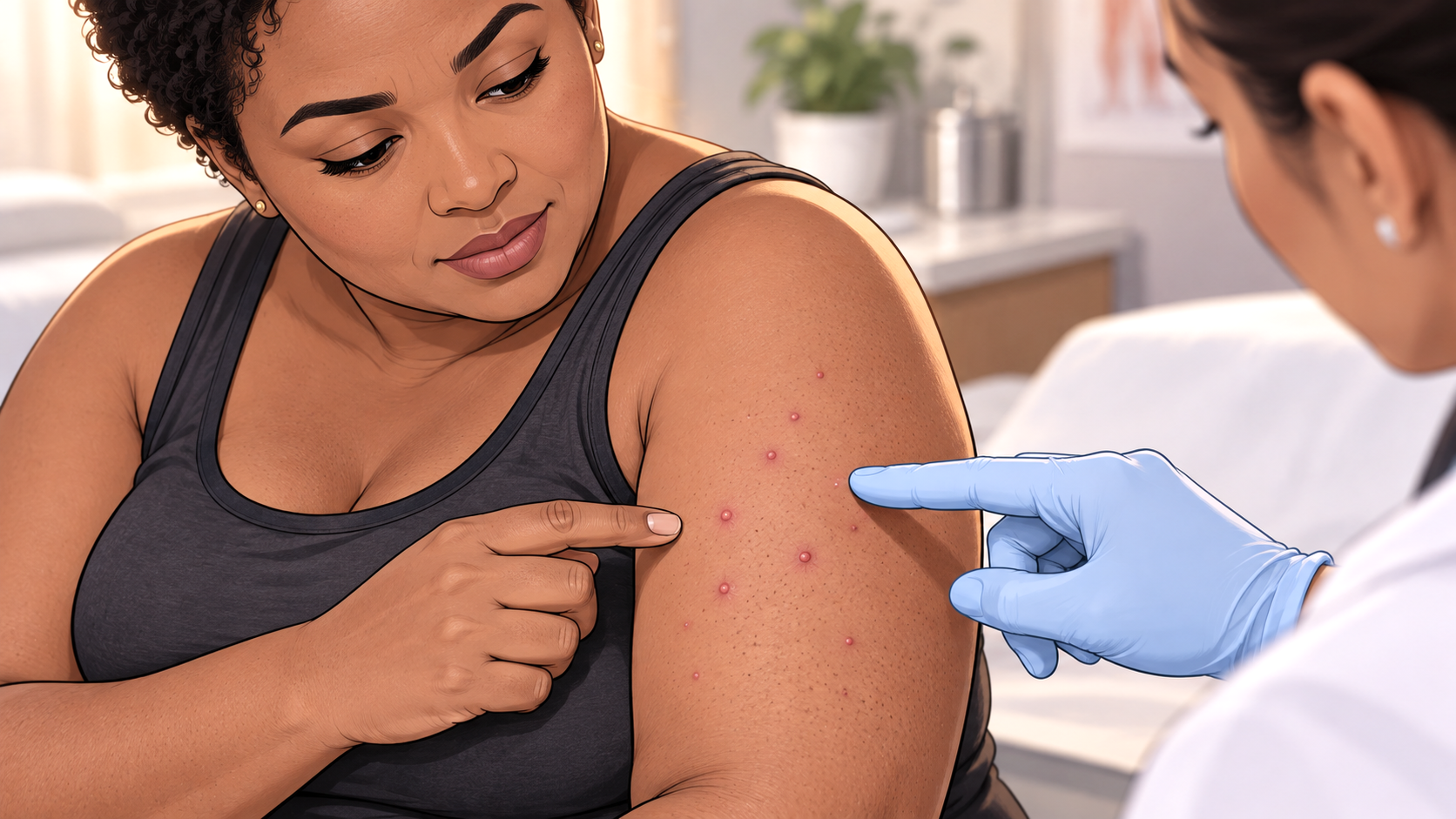
Bed bug bites and folliculitis can both appear as clusters of itchy red bumps, but they originate in different parts of the skin. Folliculitis develops around individual hair follicles and may form pimple-like pustules, while bed bug bites are reactions to feeding and do not consistently center on hairs. Recent shaving, sweating, friction, or hot-tub use favors folliculitis; physical evidence of bed bugs around a sleeping area favors bites.
A Hair Follicle at the Center Is the Most Useful Visual Clue
Folliculitis literally means inflammation of a hair follicle. The American Academy of Dermatology describes it as an acne-like eruption involving individual follicles, with bumps that may have surrounding redness and can itch or hurt. DermNet similarly describes folliculitis as a tender red spot that often develops a surface pustule. Under good lighting, a hair may emerge directly through the middle of the bump, although the hair is not always easy to see.
Bed bug bites have no necessary relationship with follicles. The CDC describes them as slightly swollen, red areas that may itch, with marks appearing randomly or sometimes in a line. Reactions differ substantially among people, so bed bug bites may be raised, flat, or swollen rather than having one uniform appearance. A central puncture may occasionally be visible, but it should not be confused with a hair-centered pustule.
Pus provides another useful clue. Mayo Clinic lists clusters of pimples and pus-filled blisters around hair follicles among common folliculitis signs. An uncomplicated bed bug bite does not normally develop a white or yellow pus-filled head. Scratched bites can become secondarily infected, however, so a previously ordinary bite may later become crusted or pustular. At that point, its altered appearance no longer reliably identifies what caused the original mark.
Location Makes More Sense When You Consider What Triggered the Bumps
Folliculitis can develop almost anywhere hair grows. Common sites include the beard area, scalp, thighs, buttocks, back, chest, arms, and legs. Mayo Clinic identifies shaving, waxing, tight clothing, excessive sweating, and poorly maintained hot tubs or pools among factors that can damage or expose follicles to infection. Cleveland Clinic likewise notes that shaving, sweating, and hot-tub exposure can precede folliculitis.
The distribution often corresponds with the trigger. Bumps following the shaved edge of a beard, appearing beneath tight athletic clothing after repeated sweating, or covering swimsuit areas after hot-tub exposure fit follicular inflammation better than an insect feeding pattern. Folliculitis on the buttocks or heavily clothed torso also does not require any nighttime exposure.
Bed bug reactions are more closely associated with skin available while someone is resting. Face, neck, arms, shoulders, hands, and legs are common locations, although clothing does not create an absolute boundary. The range of appearances and locations possible with bed bug bites means exposed skin alone cannot confirm them. Skin tone also affects how inflammation is perceived; bed bug reactions on dark or Black skin may appear brown, purple, or darker than surrounding skin rather than bright red.
Several bumps appearing precisely where hair follicles have been irritated offer a stronger folliculitis clue than whether the spots happen to form a cluster.
Folliculitis Has Several Causes, So Not Every Case Looks the Same
Bacterial folliculitis is common, often involving Staphylococcus aureus, but infection is not the only pathway. Mayo Clinic notes that bacteria, fungi, viruses, parasites, medications, and physical injury can all produce folliculitis. Malassezia folliculitis, for example, often affects the upper chest and back and can become itchy with sweating, while hot-tub folliculitis can emerge after exposure to inadequately disinfected water.
This variety prevents a simple rule such as “folliculitis always has pus.” Some cases consist mostly of red follicular papules, making them easier to mistake for insect bites. Tenderness or burning can accompany itching, whereas ordinary bed bug reactions are more often dominated by itch.
The timing is also imperfect as a diagnostic test. Bed bug marks may not appear immediately; the CDC notes that visible reactions can develop from one to several days after feeding. Folliculitis may follow an identifiable trigger, but inflammation can also develop gradually or recur. A person who wakes with bumps should therefore not assume the bed caused them merely because they were first noticed in the morning.
The Skin Cannot Confirm Bed Bugs Without Evidence From the Room
A bite-like rash alone cannot establish a bed bug infestation. If the skin lesions do not clearly follow follicles, inspect the environment rather than trying to diagnose the pest from their arrangement. Mattress seams, box springs, headboards, bed-frame joints, upholstered furniture, and nearby crevices should be checked for live insects, eggs, cast skins, rusty stains, and dark fecal spotting.
Finding those signs on or around a mattress provides far stronger support for bites than a photograph of irritated skin. A broader inspection can establish whether bed bugs are actually present before insecticides or other pest treatments are used.
Folliculitis is evaluated differently. A clinician can often recognize it from the follicular pattern and medical history. Persistent, recurrent, or unusual cases may require testing to determine whether bacteria, yeast, or another cause is involved. Treating suspected folliculitis as a bed bug infestation does nothing for an inflamed follicle, while assuming true bites are folliculitis leaves the insects in place.
Spreading Pain, Fever, or Deep Lumps Need More Attention
Mild superficial folliculitis can resolve without complications, but worsening symptoms deserve medical evaluation. Mayo Clinic recommends medical care when folliculitis is widespread or does not improve after self-care and identifies rapidly increasing redness or pain, fever, chills, and malaise as signs of a potentially spreading infection. Deep follicular infections can also develop into boils or abscesses.
Bed bug reactions require a different threshold. Severe allergic symptoms need urgent care, while repeated scratching can introduce bacteria into damaged skin. The situations in which suspected bed bug bites should be evaluated by a doctor include significant allergic reactions and signs of secondary infection.
A group of small itchy bumps centered neatly on hairs, especially after shaving, friction, sweating, or hot-tub exposure, fits folliculitis more closely. Marks without a follicular center become more convincing as bed bug bites only when the sleeping environment supplies independent evidence of the insects.