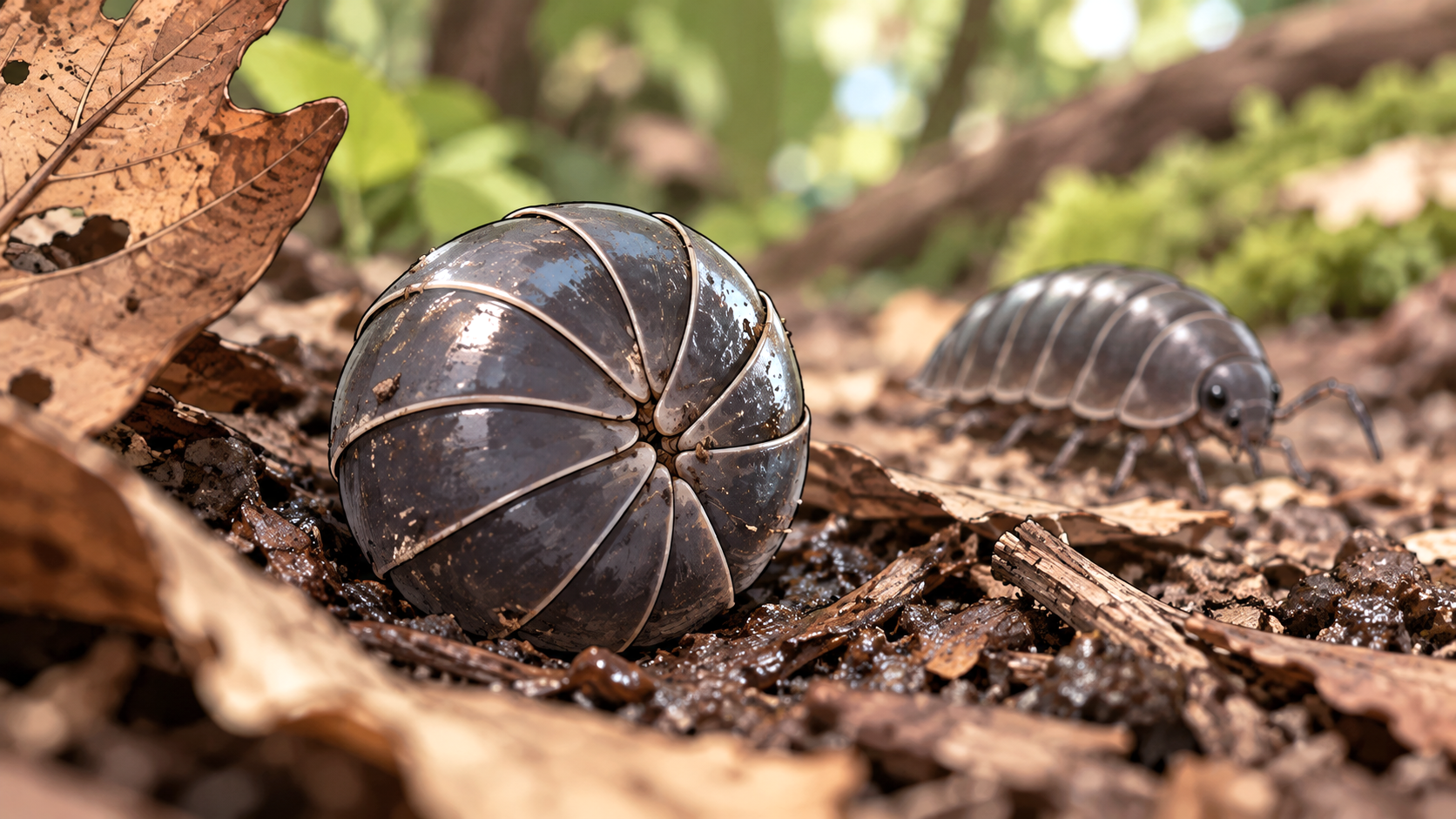
Roly-polies get their name from their ability to roll into a tight, rounded ball when threatened or disturbed. Their segmented bodies fold inward, protecting the softer underside and giving them the appearance of tiny rolling balls. The nickname comes from the English expression roly-poly, which describes something short, round, or inclined to roll. It is particularly fitting for the common pill bug, Armadillidium vulgare, whose defensive curling behavior is one of its most recognizable features.
Where Did the Name Roly-Poly Come From?
The expression roly-poly existed long before people began using it for pill bugs. It developed from the English verb roll, with the repeated, rhyming sounds giving the word a playful character. Early forms appeared in English during the seventeenth century, including uses associated with rolling games and round objects. By the nineteenth century, the expression was also used to describe short, plump people or animals.
The historical development of the word roly-poly shows that its meaning was established independently of the crustacean. The American Heritage Dictionary preserves both meanings, describing a rounded person or object and identifying the pill bug as an animal commonly called a roly-poly. The exact date when people first applied the nickname to pill bugs is less clearly documented than the history of the expression itself.
In American English, the name emphasizes the animal’s movement and rounded defensive shape. British English more commonly uses woodlouse, although that term also includes related terrestrial isopods that cannot roll themselves into a complete ball. The Cambridge Dictionary’s definition reflects this regional difference in everyday terminology.
Why Do Roly-Polies Roll Into Balls?
Curling into a ball is a defensive behavior called conglobation. When threatened, a pill bug bends its segmented body inward until its head and vulnerable underside are enclosed by the hardened plates along its back. This creates a compact protective barrier against predators that might otherwise attack its exposed legs or softer body surfaces.
The movement depends on the arrangement of the animal’s overlapping body segments. Each section can move relative to the others, allowing the head and rear portions to fold toward each other. The common pill bug’s body structure supports this specialized defensive response, which can be observed when an individual is disturbed beneath a stone or piece of fallen wood.
A curled roly-poly remains motionless until it is ready to unfold. Once the perceived danger has passed, it extends its body and resumes walking. Unlike animals that escape primarily through speed, pill bugs can use their armored backs to withstand threats while keeping their less protected parts concealed.
This behavior also helps protect against moisture loss by reducing the amount of exposed body surface. Terrestrial isopods depend on moist conditions for respiration, and their ability to conserve water influences how successfully they survive outside aquatic environments. Rolling provides temporary protection, although it cannot substitute for access to a suitably humid habitat.
Why Are They Also Called Pill Bugs?
The alternative name pill bug describes the same rounded defensive posture. A fully curled individual resembles a small pill or tablet, particularly when viewed from above. The University of California’s identification guidance recognizes the ability to roll into a ball as a defining difference between pill bugs and typical sowbugs.
Other informal names, including potato bug and doodlebug, are sometimes used for these animals. Both names are ambiguous because they can refer to unrelated creatures. Potato bug, for example, is also used for Jerusalem crickets, while doodlebug commonly refers to antlion larvae in parts of the United States. Roly-poly is therefore a more descriptive name for the rounded, rolling behavior of pill bugs, although it remains an informal nickname rather than a scientific classification.
Can Every Woodlouse Roll Into a Ball?
Only certain terrestrial isopods possess the body structure necessary for complete conglobation. Common sowbugs, such as Porcellio scaber, have flatter bodies and projecting rear appendages that prevent them from forming the tightly enclosed sphere associated with roly-polies.
Even among pill woodlice, the degree of closure varies. Armadillidium nasatum, commonly called the nosy pill woodlouse, can curl into a rounded posture but leaves a small opening rather than forming the tightly closed ball characteristic of Armadillidium vulgare. The British Myriapod and Isopod Group’s identification material documents this difference.
An animal found beneath mulch or a garden stone should therefore not be identified as a roly-poly simply because it resembles a pill bug. Observing whether it can close into a complete ball provides a useful identification clue without requiring close examination of its smaller anatomical features.