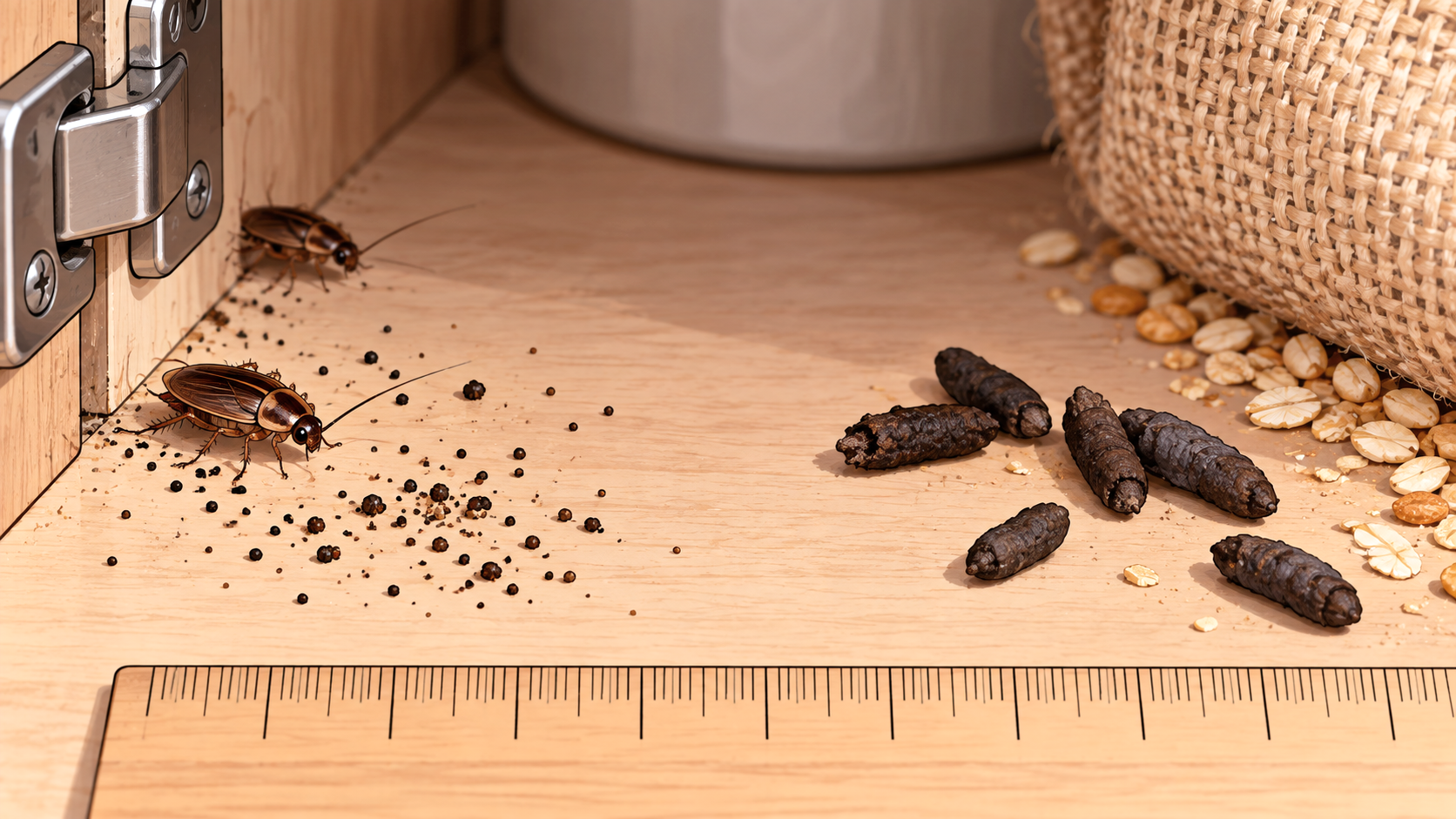
Mouse droppings are usually distinct, elongated pellets with at least one pointed end, while cockroach droppings vary from tiny dark specks to small cylindrical feces depending on the cockroach species and size. Shape and scale are more useful than color because both pests can leave dark brown or black waste around kitchens, cabinets and other sheltered areas. When the material is too small or degraded for a confident identification, its location and the other pest evidence nearby become especially useful.
Start With the Shape of Individual Droppings
House mouse droppings have a recognizable pellet form. They are elongated rather than round and are commonly compared with grains of rice. Mouse droppings are typically pointed, and recognizable individual pellets usually remain visible even when several accumulate in the same place. Fresh gnaw marks, tracks and nesting material can provide additional evidence that the pellets came from mice.
Cockroach feces are more variable because cockroach species range considerably in body size. Small cockroaches, particularly German cockroaches and their nymphs, can leave fecal material that resembles dark pepper-like specks or stains rather than miniature mouse pellets. Larger cockroaches produce more substantial cylindrical droppings. A close examination may reveal ridges along these larger feces, but size, condition and viewing angle can make such surface details difficult to see.
Color is a weak discriminator on its own. Both kinds of waste can appear very dark, and age, diet, moisture and the surface beneath the material can affect its appearance. A black speck in a cupboard is not automatically cockroach feces, just as a dark pellet is not automatically from a mouse.
Mouse Droppings Are Usually Larger and More Uniform
The size difference becomes clearer when house mouse pellets are compared with feces from small household cockroaches. House mouse droppings are commonly described as about the size and shape of a grain of rice. Cockroach specks from German cockroaches can be much smaller, especially when deposited by nymphs.
Large cockroach droppings create more room for confusion. American and Oriental cockroaches can produce feces large enough to look pellet-like at first glance. Their waste is still generally shorter and differently shaped than the elongated, pointed feces expected from a house mouse. Identifying the appearance of cockroach feces becomes particularly useful when the material is large enough to show its form clearly.
Size also needs to be judged across several pieces rather than one fragment. Broken mouse feces, debris, dried food and damaged cockroach droppings can all produce misleading individual pieces. A group of intact samples gives a more reliable picture of the characteristic shape and dimensions.
The Pattern Around the Droppings Can Break a Close Tie
Mouse activity often leaves evidence that a cockroach cannot produce. Gnaw marks, tracks and shredded nesting material near dark pellets strongly favor a rodent explanation. Mice may leave droppings in drawers, cabinets, behind stored boxes and along routes between nesting areas and food.
Cockroach evidence has a different combination. Egg cases, shed skins, live nymphs and repeated fecal deposits around narrow harborages strengthen a cockroach identification. These materials together are among the more useful signs of an active cockroach infestation. Sticky monitors can also capture the insects responsible for activity around an uncertain patch of feces.
Location alone cannot settle the comparison because both pests use many of the same rooms. Food, water and shelter make kitchens attractive to each, so dark waste beneath a sink or behind a refrigerator could belong to either. Cockroaches commonly exploit the tight, warm spaces that make kitchen infestations difficult to notice, while mice readily travel along walls and enter cabinets or food-storage areas.
Distribution can still provide clues. Cockroach fecal material may become concentrated close to harborages and along surfaces where the insects repeatedly rest or travel. Mouse pellets tend to remain recognizable as separate fecal pieces along areas the animal has accessed. Neither pattern is reliable enough to override clear physical characteristics of the droppings.
Smears and Tiny Specks Favor Cockroaches Over Mice
Very small cockroach feces can create markings that mouse pellets generally do not. Repeated deposits from German cockroaches may appear as scattered pepper-like dots, dark spotting or staining around crevices and sheltered surfaces. These marks can occur around cabinet hinges, cracks, appliance areas and other places where the insects spend time.
A mouse normally leaves solid, formed fecal pellets rather than fields of tiny pepper-like specks. Finding numerous rice-shaped pieces points much more strongly toward a rodent, while clusters of extremely small dark dots near cockroach harborages fit insect activity better.
Do not confuse either type with an egg case. A cockroach ootheca has a structured capsule-like appearance and is substantially different from fecal spotting. Shed skins, dead insects and fragments of food can also become mixed into debris around an infestation, so not every dark object beside confirmed cockroach feces is another dropping.
Do Not Sweep Unknown Droppings Until You Rule Out Rodents
An uncertain identification changes how the material should be handled. Dry sweeping or vacuuming suspected mouse waste can disturb contaminated material and send particles into the air. For rodent urine and feces, the safer approach is to wet the material thoroughly with an appropriate disinfectant before removal, wear rubber or plastic gloves, allow the required contact time, and wipe the waste up with paper towels. Follow the disinfectant label for its required use and contact time.
Cockroach debris presents a different concern. Proteins in cockroach feces can trigger allergic reactions or asthma symptoms in susceptible people, and fecal particles can become incorporated into indoor dust. Large accumulations of cockroach debris therefore also warrant careful removal rather than unnecessary disturbance.
If you cannot confidently decide whether small dark material came from cockroaches or mice, treating it initially as potential rodent waste avoids using the riskier cleanup method. Once the pest has been identified and controlled, cleaning contaminated surfaces after cockroach activity can address feces, shed material and other remaining debris.
Fresh Droppings Can Help Confirm Ongoing Activity
Droppings establish that a pest has been present, but appearance alone does not always reveal whether the infestation is still active. Old feces can remain in undisturbed cabinets, wall voids, storage spaces and appliance areas long after the animal or insect that produced them has gone.
After safe cleanup, new waste appearing in the same area provides stronger evidence of continuing activity. For suspected rodents, new droppings after an area has been cleaned indicate active rodent presence. With cockroaches, fresh fecal deposits become more informative when accompanied by live sightings, trap captures, nymphs or other current signs.
The response can then target the animal actually present. Cockroach management requires eliminating harborages, food and moisture while using appropriately placed controls as needed; a cockroach-control plan will not solve a mouse infestation, and rodent traps will not address cockroaches.
Questions That Help With Difficult Dropping Identification
Can mouse droppings be as small as cockroach droppings?
There can be visual overlap between a small or broken mouse pellet and feces from a large cockroach. Intact house mouse droppings usually retain a more elongated, rice-like form, so compare several complete pieces and look for supporting evidence rather than identifying a single fragment.
Can you identify fresh versus old droppings by color?
Color and texture can change as feces dry, but they are unreliable for assigning an exact age. Environmental moisture, diet and the surface underneath can alter appearance. Safely removing the existing waste and checking for new deposits provides better evidence of current activity.
Could both mice and cockroaches leave droppings in the same cabinet?
Yes. The two pests can occupy the same building and exploit overlapping food and shelter. Finding one type of evidence does not exclude the other, particularly where food is accessible or an infestation has persisted for some time.
What if the droppings do not clearly match either pest?
Other animals and insects can leave fecal material indoors, while seeds, insect fragments and food debris can imitate droppings. Avoid assigning a pest from color alone. Intact specimens, tracks, gnawing, egg cases, shed skins, trap captures and direct sightings can narrow the identification.