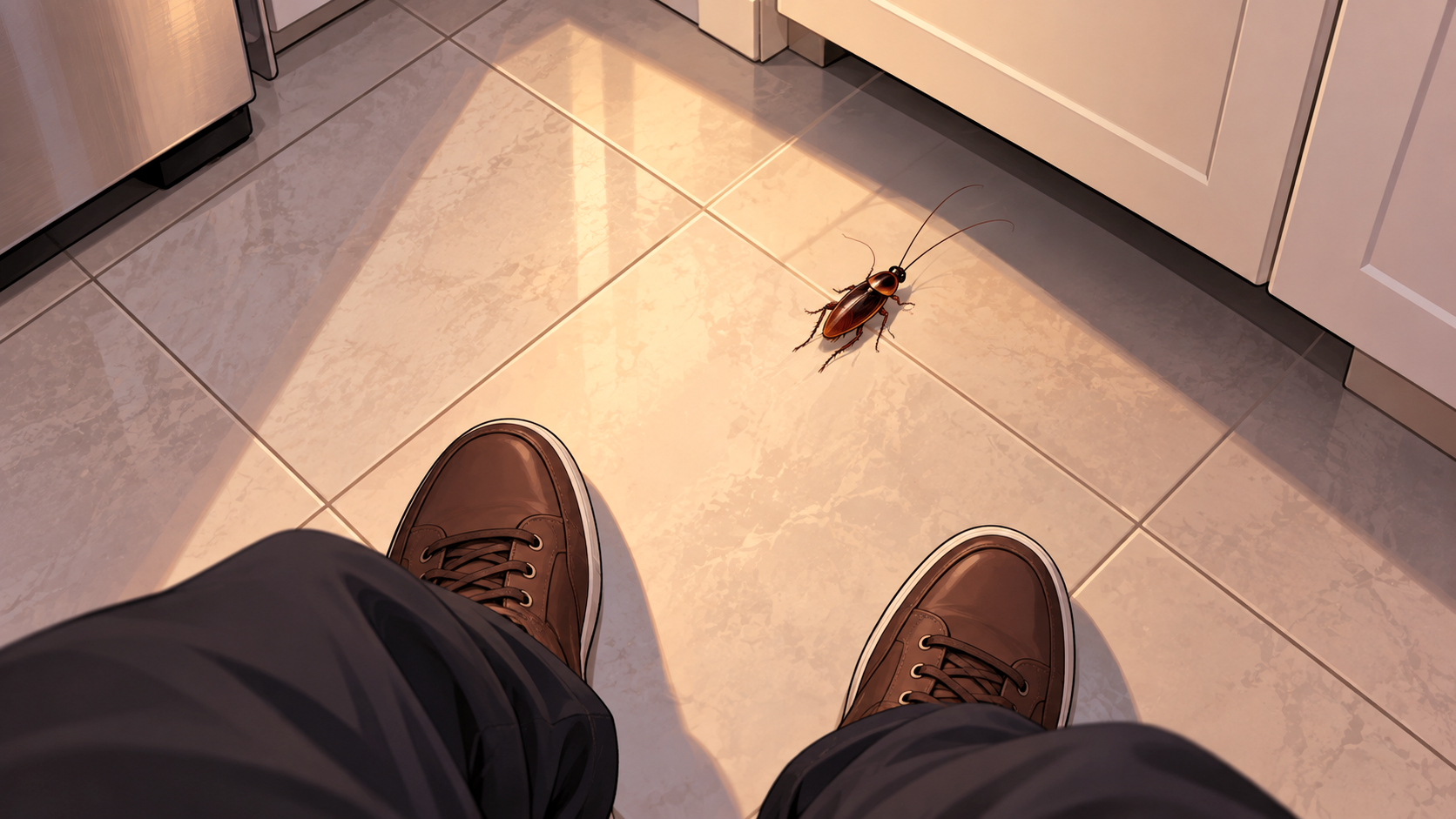
A cockroach rushing directly toward your feet can look surprisingly deliberate, especially when it changes direction as you move. Cockroaches do not normally run toward people to attack or chase them. What appears to be an approach is usually an escape response, an attempt to reach nearby shelter, or a sudden movement that happens to cross a person’s path.
Researchers have actually documented cockroaches turning toward threatening stimuli during escape. Although these movements occur less frequently than turns away from danger, they are part of the insect’s defensive behavior rather than evidence of aggression.
Cockroaches Sometimes Escape in the Wrong Direction
A frightened cockroach does not always run directly away from whatever disturbed it. Its escape response involves a rapid turn followed by forward movement, and the resulting trajectory can occasionally point toward the source of the disturbance.
Scientists studying American cockroaches (Periplaneta americana) found that escape directions were not completely random. Instead, the insects tended to select from several preferred trajectories relative to an approaching threat.
The findings, published in Current Biology, showed that cockroaches use variable escape directions to make their movements less predictable. An insect may turn sharply left or right rather than simply reverse its original direction.
Follow-up research examined escape turns initiated toward a threatening stimulus. Depending on the experimental dataset, these occurred in approximately 3% to 19% of recorded responses. The study of cockroaches escaping both toward and away from threats found that toward-directed turns generally involved relatively small changes in body orientation.
A cockroach may therefore begin moving toward you because its escape response has selected that direction. It is not necessarily recognizing you as a destination, and the movement may end as soon as the insect encounters another obstacle or shelter.
Your Movement Can Trigger an Escape Before You Touch the Cockroach
Cockroaches possess an effective early-warning system for detecting approaching threats.
Two appendages called cerci project from the rear of the abdomen. They contain sensory hairs capable of detecting changes in air movement, including those generated by an approaching object.
When these hairs respond to a disturbance, signals travel through the nervous system to circuits controlling the legs. The insect can initiate a rapid escape before physical contact occurs.
Research published in the Journal of Neurobiology demonstrated that wind-sensitive neurons help determine the direction of cockroach escape movements. Different neurons respond to air arriving from different directions, allowing the insect to adjust its movement.
A hand reaching toward a cockroach, a foot approaching the floor, or an object moving nearby can produce air disturbances that contribute to this response.
However, sensing an approaching threat does not guarantee that the insect correctly identifies the entire human body or chooses the safest direction. Its immediate movement reflects sensory information and nervous-system processing, not a calculated attempt to confront someone.
A Hiding Place May Be Directly Behind You
The layout of a room can make an ordinary escape look like pursuit.
Imagine a cockroach on a kitchen floor, with an open cabinet recess several feet behind your legs. When disturbed, it may rush toward that opening even though reaching it requires crossing the space you occupy.
Cockroaches commonly use narrow gaps and protected surfaces as refuges. A person standing between an insect and an accessible opening can inadvertently become part of its escape route.
This possibility is especially relevant when a cockroach runs toward someone and immediately disappears beneath a cabinet, appliance, or piece of furniture.
The concentrated activity associated with cockroach harborages helps explain why some insects repeatedly head toward the same small area after being disturbed.
Research on cockroach antenna-guided wall following also shows that these insects use tactile information from their antennae to navigate close to surfaces during rapid escapes. A route along a wall, furniture edge, or cabinet base may therefore be more attractive than an unobstructed path across the middle of a room.
A cockroach running past your shoes and disappearing along a baseboard may simply be following the available structural route.
Why a Cockroach May Run Toward You More Than Once
A repeated approach can seem more intentional than a single accidental movement, but several ordinary behaviors can produce it.
If you move to block a cockroach’s path, the insect receives new sensory information and may change direction again. Its revised route can bring it back toward you, particularly in a confined space with limited exits.
An insect moving around chair legs, cabinets, or other obstacles may also cross the same area repeatedly while searching for a suitable opening.
Laboratory experiments have demonstrated that escape direction depends partly on how wind-sensitive nerve cells combine information. In a study published in the Journal of Neuroscience, researchers found that cockroach escape orientation results from coordinated neural activity, rather than one nerve cell simply dictating the direction of movement.
This sensory system does not guarantee a perfectly straight escape away from a person. Changes in the insect’s position, surrounding obstacles, and the direction of the disturbance can all produce another turn.
Repeated approaches should therefore be interpreted in relation to the surroundings. If the insect consistently heads toward the same structural opening, that location is more informative than the fact that it crossed your path several times.
Are Cockroaches Trying to Attack When They Run Toward People?
An approaching cockroach should not ordinarily be interpreted as aggressive.
Most household cockroaches are not predators of humans, and they do not defend territories against people through coordinated attacks. Their rapid responses to approaching objects are primarily associated with avoiding danger.
The original experimental investigation of American cockroach escape behavior demonstrated that air disturbances resembling an approaching predator generally caused the insects to turn away and run.
Occasional movements in the opposite direction do not contradict the defensive purpose of the response. An animal attempting to escape can temporarily move toward danger without intending to attack it.
A cockroach accidentally reaching someone’s foot, trouser leg, or hand is therefore not necessarily attempting physical contact. It may have misdirected its escape, encountered an obstacle, or followed a route that happened to intersect with the person.
Does a Cockroach Know You Are Standing There?
Cockroaches can detect several features of their immediate environment, including movement, contact, air disturbances, and nearby obstacles. However, detecting a human-sized object is different from understanding that a particular person is standing in a specific location.
Their escape circuits respond rapidly to sensory information, sometimes before the insect has fully adjusted its body orientation.
A cockroach approaching from behind may not respond to your stationary legs in the same way it responds to a moving foot. Similarly, an insect rushing along the floor may detect an obstacle only after reaching a position where it needs to turn.
The rapid running ability of cockroaches contributes to how abrupt these encounters appear, but movement speed does not establish the animal’s intentions.
There is no reliable basis for concluding that a cockroach recognizes an individual person and deliberately selects that person as a target simply because it moves in their direction.
What Should You Do When a Cockroach Runs Toward You?
Avoid trying to predict the insect’s next movement by stepping directly into its path. Sudden movements may trigger another escape response, making its direction harder to anticipate.
If the cockroach is moving toward a cabinet or another accessible gap, observe where it goes. Its destination may reveal more about nearby activity than attempting to follow every change in direction.
For an insect that repeatedly emerges from the same area, an appropriately positioned sticky monitoring trap can help establish whether the location is used regularly. The University of California’s cockroach management guidance recommends monitoring traps to identify concentrations of activity.
A cockroach that repeatedly runs along one wall or toward a particular recess may be following a familiar route rather than reacting specifically to whoever happens to be nearby. The distances cockroaches travel while foraging and dispersing also depend on their surroundings and available resources, so a single encounter cannot establish where the insect originally came from.
If you encounter one running toward you, the most useful observation is often what it does next. Whether it changes direction around an obstacle, follows an edge, or disappears into a narrow opening can explain the apparent approach without attributing humanlike intentions to the insect.