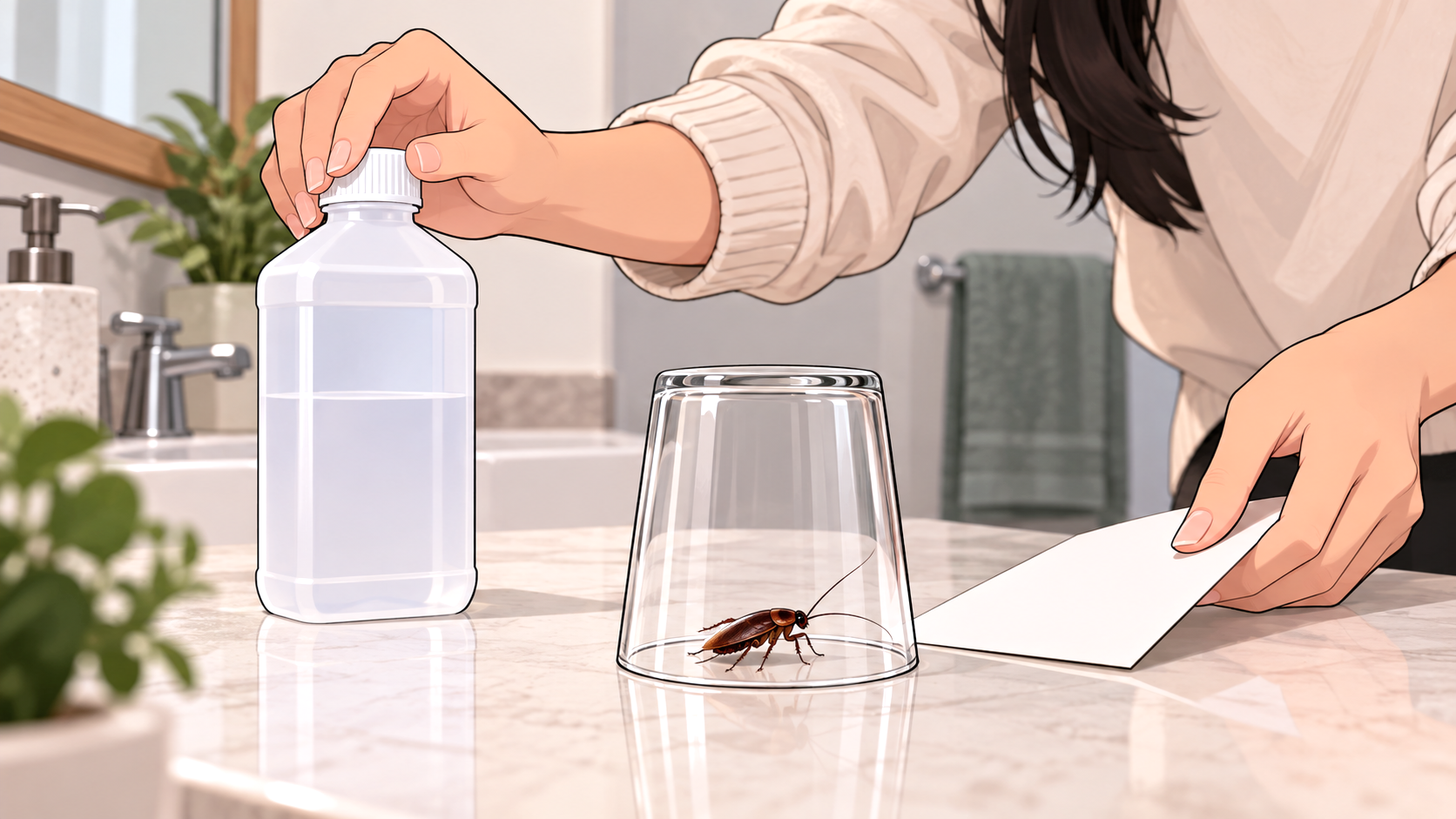
Rubbing alcohol can kill cockroaches when they receive sufficient direct exposure, but spraying a moving cockroach with alcohol does not guarantee its death. The liquid evaporates quickly, contact may be incomplete, and an insect that stops moving may not be permanently incapacitated.
Rubbing alcohol can kill cockroaches, but it is not a reliable or recommended household cockroach treatment. Its flammable vapors create a serious fire hazard, particularly around kitchens, electrical equipment, and ignition sources. There is also insufficient evidence to recommend ordinary rubbing-alcohol sprays as an effective way to control an established infestation.
The distinction between a laboratory experiment involving prolonged immersion and a brief spray from a household bottle is especially important when evaluating claims about alcohol’s effectiveness.
What Happens When Rubbing Alcohol Touches a Cockroach?
Rubbing alcohol typically contains isopropyl alcohol, also called isopropanol, diluted with water. Common household formulations contain 70% or 91% alcohol, although concentrations and additional ingredients vary.
Alcohol can interfere with biological membranes and proteins. With sufficient exposure, these effects can seriously injure or kill insects. However, the precise response of a cockroach depends on the concentration, amount of liquid reaching its body, duration of contact, and species involved.
A 2023 study published in Animals investigated euthanasia techniques involving 70% isopropyl alcohol in four cockroach species. Researchers found that anesthetized cockroaches immersed in alcohol for 15 or 30 minutes subsequently showed irreversible loss of movement. This demonstrates that substantial alcohol exposure can be lethal, but the experiment did not test household spraying or establish that a brief application kills cockroaches immediately.
A cockroach contacted by a small amount of alcohol may continue moving, become temporarily impaired, or die. There is no validated household dose or exposure time that makes a spray-bottle application reliably lethal across cockroach species.
Does 70% or 91% Rubbing Alcohol Work Better?
It is tempting to assume that 91% rubbing alcohol must kill cockroaches faster than 70% alcohol because it contains more isopropanol. Available cockroach research does not support a dependable comparison between these concentrations when applied as household sprays.
The two solutions differ in water content, evaporation behavior, and how long liquid may remain on a surface. Higher alcohol concentration does not automatically translate into better penetration or greater mortality during brief contact.
The CDC’s chemical hazard information for isopropyl alcohol identifies the substance as a highly flammable liquid, regardless of whether it is sold in a common household dilution. Choosing a stronger solution introduces no demonstrated pest-control advantage sufficient to justify spraying it around occupied rooms.
Neither concentration should be treated as an approved cockroach insecticide simply because it is sold for antiseptic or cleaning purposes.
Why Rubbing Alcohol Is Unreliable Against Hidden Cockroaches
Alcohol must reach the insect in an effective amount. Cockroaches concealed behind furniture, inside wall openings, or beneath fixed cabinets are unlikely to receive uniform exposure from liquid sprayed across accessible surfaces.
The alcohol also evaporates rapidly, leaving little opportunity for prolonged contact after the treated surface dries. Unlike an appropriately formulated residual insecticide, ordinary rubbing alcohol is not designed to provide continuing cockroach control after application.
The University of California’s cockroach management recommendations identify targeted baits and other registered treatments as established control methods rather than household alcohol sprays.
Even if several exposed cockroaches die, that result says little about insects remaining elsewhere. The daytime hiding behavior of cockroaches allows most individuals in an established infestation to avoid an application aimed at visible insects.
Alcohol is also not a dependable treatment for cockroach egg cases. Their protective structure and concealed placement create additional barriers to contact. The limitations of treatments against cockroach eggs make physical removal more reliable when a case is accessible.
Rubbing Alcohol Creates a Serious Fire Hazard
Flammability is the strongest reason to avoid using rubbing alcohol as a cockroach spray.
Isopropyl alcohol produces flammable vapor at ordinary indoor temperatures. Spraying it disperses liquid over a wider surface while allowing vapors to accumulate, particularly in poorly ventilated spaces.
The National Institute for Occupational Safety and Health lists a flash point of approximately 53°F (12°C) for pure isopropyl alcohol and classifies it as a highly flammable liquid. Household dilutions also require appropriate flammability precautions.
Ignition sources may include:
- Gas burners and pilot lights.
- Electrical sparks from switches or damaged equipment.
- Space heaters and other heating appliances.
- Cigarettes, candles, and open flames.
- Equipment with hot surfaces or energized components.
The EPA has specifically warned against using rubbing alcohol as an unregistered pesticide, noting that its rapid evaporation and flammability have contributed to residential fires during attempts to control bed bugs. Although that warning concerns a different pest, the chemical hazard applies equally when alcohol is sprayed at cockroaches.
Do not spray alcohol into electrical outlets, ventilation slots, or appliances. The risks involved in removing cockroaches from electronics include damage to internal components and hazards associated with introducing liquids into electrical equipment.
Can Rubbing Alcohol Harm People or Pets?
Inhaling concentrated isopropyl alcohol vapors can irritate the eyes, nose, and throat. Greater exposure may cause headaches, dizziness, or drowsiness. Direct contact can also irritate the eyes and dry or irritate the skin.
The NIOSH Pocket Guide to Chemical Hazards documents these exposure effects and identifies inhalation, ingestion, and skin or eye contact as relevant routes.
Spraying alcohol around pets introduces additional concerns because animals may contact wet surfaces or lick residues before the liquid evaporates. Alcohol ingestion can be particularly dangerous, and household rubbing alcohol should never be used directly on an animal to treat pests.
If alcohol has been spilled, remove people and animals from the affected area as necessary, eliminate ignition sources only when safe to do so, and follow the product’s handling instructions. Significant exposure or accidental ingestion requires prompt medical or veterinary advice.
The health considerations surrounding cockroach sprays also apply to improvised chemical treatments: replacing a registered pesticide with a familiar household liquid does not automatically reduce exposure risks.
Is Rubbing Alcohol Suitable for Kitchen Counters, Furniture, or Bedding?
Rubbing alcohol may be used for certain cleaning applications when the surface manufacturer’s instructions permit it. That does not make spraying it onto cockroaches on those surfaces a suitable pest-control practice.
Alcohol can damage some furniture finishes, plastics, coatings, adhesives, and dyed materials. Applying it heavily to upholstery or bedding also introduces flammable liquid into absorbent materials that may retain moisture longer than a hard surface.
Food-preparation areas present another complication. Spraying alcohol around a cockroach can spread liquid onto utensils, packaged food, and surfaces where cooking equipment may provide ignition sources.
The EPA’s pesticide safety guidance recommends using chemicals only for approved applications and following product instructions. A rubbing-alcohol bottle labeled for antiseptic or cleaning use should not be assumed suitable for insect control.
If a cockroach contaminates a washable surface, ordinary cleaning can address the surface contamination without requiring alcohol to be sprayed at the insect. The food-safety implications of cockroaches contacting food depend on the item affected, not on whether the insect was subsequently exposed to alcohol.
What Should You Use Instead of Rubbing Alcohol?
For an individual exposed cockroach, physical capture or removal avoids introducing flammable liquid into the room. Whether the insect must be killed immediately is a separate consideration from controlling an established population.
When cockroaches repeatedly appear, use monitoring to establish where they remain active and consider an appropriately registered cockroach bait or another labeled treatment. The EPA’s guidance on safer pest control recommends selecting products specifically registered for the intended pest and using them according to their labels.
Rubbing alcohol cannot replace an insecticidal bait simply because both substances may eventually kill a cockroach. Baits are formulated to be encountered or consumed under particular conditions, whereas alcohol has no demonstrated reliable residual or population-control benefit.
A treatment should be evaluated through continued activity rather than the number of insects temporarily immobilized. The signs that cockroaches have actually disappeared include sustained monitoring results and an absence of fresh evidence, not merely the death of insects exposed to one application.
The EPA’s integrated pest management recommendations favor approaches that address the pest while minimizing unnecessary chemical exposure. Given rubbing alcohol’s inconsistent contact performance, lack of useful residual action, and substantial fire risk, it offers little practical advantage over established cockroach-control methods.