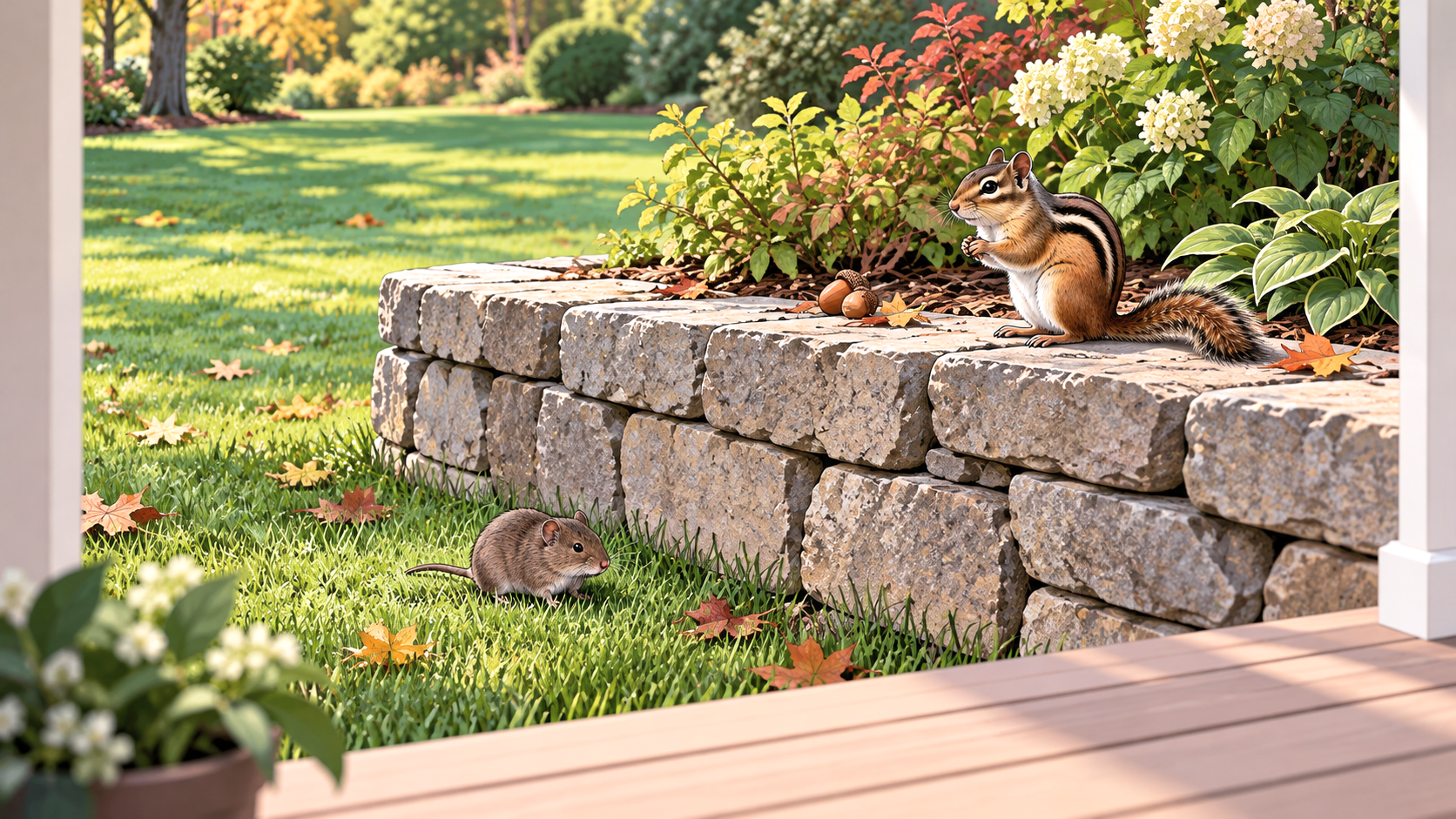
Chipmunks have distinct light and dark stripes running along their backs and faces, while voles have plain or mottled fur without those markings. Chipmunks also have longer, furrier tails, more visible ears, and a slender, squirrel-like appearance. Voles are stockier, with blunt noses, shorter tails, and small ears that often disappear into their fur.
Both animals can live in the same yard, dig burrows, and feed on vegetation. If you haven’t seen the animal, narrow trails through grass provide stronger evidence of vole activity, while an isolated burrow entrance near a log, rock, or foundation may suggest a chipmunk. Neither type of opening identifies its occupant with certainty.
Look for Stripes Along the Back and Face
The most recognizable feature of a chipmunk is its striped coat. The eastern chipmunk (Tamias striatus), widespread across eastern North America, has five dark stripes running lengthwise along its back, separated by lighter bands. Additional dark and pale markings extend across its cheeks and around its eyes.
These distinctive facial and back stripes remain visible even when the animal is partly concealed by vegetation. An eastern chipmunk’s reddish-brown rump also helps distinguish it from other striped ground squirrels.
Voles lack comparable stripes. Their upper fur may be brown, gray, chestnut, or mottled, depending on the species, but it does not form the sharply defined alternating bands characteristic of chipmunks.
The natural coat colors of voles sometimes create a speckled or uneven appearance. Those variations should not be mistaken for genuine stripes, which form continuous markings along the animal’s back.
Chipmunks are not all identical. The least chipmunk (Neotamias minimus), common across parts of western and central North America, is considerably smaller than the eastern chipmunk. Its stripes generally extend farther toward the tail, and its coloration can be relatively pale.
Even with these differences, visible facial and back stripes provide stronger evidence of a chipmunk than size alone.
A Chipmunk’s Tail Is Longer and More Noticeable
When the back is hidden or the stripes cannot be seen clearly, the tail becomes particularly helpful.
A vole usually has a relatively short, thin tail that may barely project beyond its rounded body. Meadow voles have moderately short tails, while woodland voles have especially short ones. The compact proportions and short tails typical of voles give them a mouse-like appearance, although their bodies are generally heavier and their muzzles blunter.
Chipmunks have noticeably longer, well-furred tails. An eastern chipmunk’s tail commonly measures around 8–10 centimeters, with enough hair to give it a fuller outline than a vole’s tail. It is not as bushy as the tail of a tree squirrel, but it remains a prominent feature.
The hairy, somewhat flattened tail of an eastern chipmunk may curve upward as the animal moves or pauses. A chipmunk can also hold its tail behind its body, so an upright tail is not required for identification. Young chipmunks may overlap in size with adult voles, but they retain the striped coat and characteristically longer tail proportions of their species.
Body Size Can Be Misleading
An adult eastern chipmunk generally looks larger and more elongated than a common meadow vole. Its legs are more visible, its head is relatively narrow, and its posture often resembles that of a miniature squirrel.
Voles appear closer to the ground, with short legs and rounded bodies. Their small eyes and partly concealed ears reinforce this compact appearance.
The difference is not dependable when the comparison involves a least chipmunk or an unusually large vole. Least chipmunks can weigh as little as approximately 25 grams, overlapping with several common vole species. The size differences between eastern and least chipmunks are substantial enough that no single body-length cutoff reliably separates chipmunks from voles.
| Feature | Vole | Chipmunk |
|---|---|---|
| Back markings | Plain or mottled, without distinct stripes | Distinct light and dark stripes |
| Facial markings | Generally no contrasting facial stripes | Stripes along the cheeks and around the eyes |
| Body | Rounded and stocky | More slender and squirrel-like |
| Muzzle | Short and blunt | More tapered |
| Ears | Small, often partly hidden | More visible above the fur |
| Tail | Relatively short and thin | Longer, well-furred, often curved upward |
| Legs | Short-looking, close to the ground | More prominent, especially hind legs |
| Cheek pouches | No large external food-carrying cheek pouches | Expandable cheek pouches used to transport food |
The differences between vole species in body size further limit the usefulness of comparing animals by their apparent weight. A clear view of markings, tail proportions, and head shape is far more informative.
Narrow Grass Runways Point Toward Voles
A network of closely clipped paths through grass is one of the strongest signs that voles have been using a property.
Meadow and prairie voles repeatedly travel along sheltered routes, wearing narrow tracks through vegetation. These pathways commonly measure about 1–2 inches wide and may connect small entrances, feeding locations, and concealed resting areas.
The characteristic runway systems created by meadow and prairie voles are especially noticeable when surrounding grass has been flattened or snow has melted. Fresh clippings and droppings along the paths strengthen the evidence that they remain in use.
Chipmunks do not ordinarily create the extensive, closely clipped surface runway networks associated with these voles. They travel between shelter, feeding areas, and burrow entrances, often crossing exposed ground without maintaining a connected system of grass tunnels.
A backyard containing narrow trails running beneath the grass therefore supports a vole identification more strongly than a chipmunk identification.
However, not every vole species uses the surface in the same way. Woodland voles spend more time underground, so a lack of visible trails does not rule them out. Existing tracks can also remain after the animals have stopped using them.
A Clean Burrow Entrance Doesn’t Automatically Mean Chipmunk
Chipmunk holes are frequently discovered beside patios, sheds, foundations, stone walls, woodpiles, and tree roots. An eastern chipmunk entrance is commonly about 2 inches across and may have little or no excavated soil surrounding it.
Chipmunks transport loose earth away from their burrows in their cheek pouches, helping conceal the entrance. Their burrows often have discreet openings without obvious soil mounds, even though the underground systems can contain multiple chambers and passageways.
Voles also make small ground-level openings. Meadow voles frequently connect them with surface runways, while woodland voles construct underground tunnel systems and may leave less obvious aboveground evidence.
An apparently tidy hole could therefore belong to either animal. Its diameter, proximity to a building, and lack of a dirt pile are not enough to establish a chipmunk identification.
The appearance of vole holes and burrow entrances can help explain why some openings resemble those made by other small mammals.
A direct sighting at the entrance is more useful than attempting to identify an animal solely from the hole. A photograph of the occupant should settle many cases immediately.
Chipmunks Move More Like Small Squirrels
A chipmunk running across a driveway or patio often moves in quick bounds, with its hind legs providing noticeable propulsion. It may suddenly stop upright, scan its surroundings, and then run toward a nearby tree, rock pile, or burrow.
Voles usually move with their bodies low to the ground, particularly when crossing exposed spaces. Their short legs and stocky build create a different silhouette, and they commonly disappear beneath grass rather than pausing conspicuously in the open.
The difference is easiest to observe when both animals are moving across an unobstructed surface. A chipmunk’s longer tail may curve upward, while a vole’s short tail usually remains much less noticeable.
Neither movement pattern is exclusive. Voles can make short leaps, and chipmunks sometimes scurry close to the ground rather than bounding. The jumping abilities of voles mean that seeing a small rodent spring forward does not automatically identify it as a chipmunk.
Climbing behavior offers another supporting clue. Chipmunks are capable climbers and may travel over logs, rocks, fences, and low branches. Some voles can also climb vegetation or low obstacles, but they generally appear less agile when moving across elevated surfaces.
An animal with visible stripes climbing a fallen tree trunk is strongly suggestive of a chipmunk. Movement alone, without a reasonable view of the body, is less decisive.
Food-Carrying Cheek Pouches Are a Chipmunk Clue
Chipmunks have expandable cheek pouches that allow them to carry seeds, nuts, and other food to underground storage chambers. A chipmunk collecting food may appear to have unusually swollen cheeks before returning to its burrow.
The food-carrying cheek pouches of eastern chipmunks are a distinctive anatomical feature absent from voles.
Voles do not have comparable large external cheek pouches. They feed heavily on grasses and other vegetation, although their diets also include seeds and additional plant material depending on the species.
The foods consumed by different voles can overlap with chipmunk diets, so finding missing seeds, fruits, or garden produce does not identify the animal responsible.
Observing a small striped rodent filling its cheeks with sunflower seeds is much more informative than discovering scattered seed shells near a hole. Chipmunks may also leave food remains at feeding locations, and other rodents can consume or move the same materials.
An animal’s feeding behavior is strongest evidence when the physical features are visible at the same time.
Where You Live Affects Which Animal Is Likely
Chipmunks and voles occur together across many parts of North America, including wooded residential properties, rural yards, and suburban gardens.
Eastern chipmunks occupy much of eastern North America, especially areas containing deciduous forests, woodland edges, and brushy cover. Least chipmunks have a broader distribution across portions of the western and central continent.
The woodland and suburban habitats occupied by eastern chipmunks overlap with those of several vole species. A property with grassy openings, shrubs, fallen logs, and nearby trees may support both animals within a relatively small area.
Voles include numerous species with different geographical ranges and habitat preferences. Meadow voles favor dense grassy vegetation, while woodland voles are more associated with leaf litter and underground cover.
The habitats preferred by different voles provide geographical context, but the presence of grass or woodland does not automatically identify the occupant.
A striped rodent in western North America may also belong to another chipmunk species rather than the eastern chipmunk. The species name should be matched to the region instead of assuming that every chipmunk is Tamias striatus.
How to Identify an Animal You Only See Briefly
A clear photograph can resolve most vole-versus-chipmunk questions without disturbing the animal. Try to capture the back, face, and complete tail in the same frame, ideally from the side rather than directly above.
When reviewing the image, start by looking for sharply defined stripes. If the stripes are visible along both the back and face, a chipmunk identification is strongly supported. If the coat is uniformly brown or gray, examine the tail, ears, and body proportions before considering a vole.
Where the animal was never seen, the surrounding signs can narrow the possibilities but rarely establish certainty. An interconnected network of clipped grass runways favors voles, whereas a discreet burrow entrance near rocks or a structure may be consistent with chipmunk activity.
If a single hole is the only available evidence, leave the animal unidentified until additional signs appear. The same property can contain chipmunks, voles, mice, and other small mammals, and more than one species may use the surrounding ground.