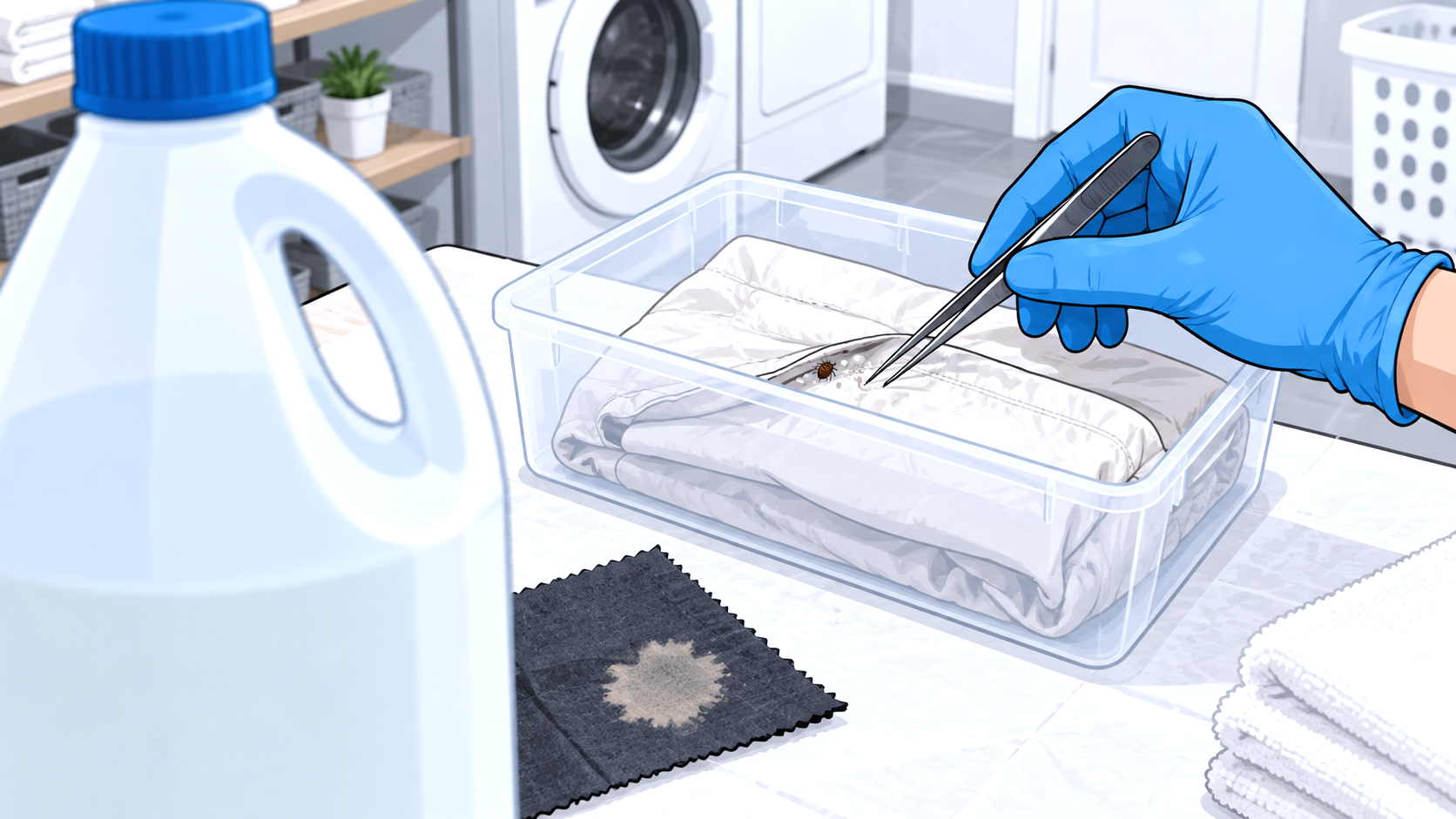
Bleach is a powerful household disinfectant, but that doesn’t make it a proven bed bug treatment. Claims online range from bleach instantly killing adults and eggs to bleach having little effect on eggs, yet authoritative bed bug guidance doesn’t provide the evidence needed to recommend household bleach for either purpose.
We wouldn’t use bleach to get rid of bed bugs or their eggs. Household bleach isn’t a standard bed bug treatment recommended by the EPA, and reliable guidance doesn’t establish a household bleach concentration, application method, or exposure time that will eliminate an infestation. Bleach also introduces unnecessary risks to your skin, eyes, lungs, fabrics, furniture, and other surfaces.
There are established ways to control bed bugs without improvising with a disinfectant that wasn’t intended for this job.
Bleach Is a Disinfectant, Not Automatically an Insecticide
The active ingredient in ordinary chlorine bleach is sodium hypochlorite. The CDC says regular household bleach typically contains 5% to 9% sodium hypochlorite, although the actual concentration depends on the product.
Sodium hypochlorite is well established as an antimicrobial disinfectant. Properly diluted and used according to its label, bleach can kill many disease-causing microorganisms on appropriate surfaces. CDC guidance discusses it specifically in that context: cleaning and disinfecting surfaces to reduce germs.
That doesn’t establish an effective treatment for bed bugs.
An insect is biologically very different from the microorganisms against which household disinfectants are commonly evaluated. More importantly, a bed bug treatment needs evidence showing that a particular product works against bed bugs under specified application conditions. We couldn’t find authoritative guidance establishing household bleach as such a treatment.
There Isn’t Good Evidence for Bleach as a Bed Bug Egg Treatment Either
The egg question produces some of the strongest contradictory claims online.
You’ll find assertions that bleach destroys bed bug eggs on contact and competing claims that the eggs are effectively protected from it. Without reliable experimental evidence establishing what concentration, exposure time, and application conditions were tested, neither claim gives you a dependable treatment method.
Bed bug eggs create an especially important treatment challenge because eliminating visible adults while leaving viable eggs behind doesn’t eliminate the infestation. Those eggs can hatch and continue the population.
We therefore wouldn’t tell you that bleach kills bed bug eggs simply because sodium hypochlorite is chemically aggressive. Nor would we claim that bed bug eggs are completely unaffected by bleach without appropriate evidence. The useful conclusion is narrower: household bleach doesn’t have the verified bed bug treatment instructions needed to rely on it for eggs.
EPA Guidance Points Toward Products Actually Labeled for Bed Bugs
The EPA has registered more than 300 pesticide products for bed bug control and evaluates safety and efficacy data before approving them for that use. The agency says registered pesticides intended for bed bugs must demonstrate that they work against bed bugs in laboratory testing.
Its current overview identifies several major pesticide classes used against bed bugs, including pyrethrins, pyrethroids, desiccants, biochemicals, pyrroles, neonicotinoids, and insect growth regulators. Dichlorvos also has a narrow registered use in pest strips for small enclosures.
The relevant point isn’t simply that sodium hypochlorite doesn’t appear in that list. A chemical being absent from a summary of common pesticide classes doesn’t prove that someone has tested it and found it ineffective.
The stronger standard comes from the EPA’s safety guidance: use a pesticide only when it is approved for bed bugs and follow its label. If a bleach product’s label doesn’t instruct you to use it against bed bugs, its disinfectant claims shouldn’t be repurposed into homemade bed bug treatment directions.
Our overview of chemicals used to kill bed bugs covers the established pesticide options separately.
Bleach Can Damage the Things You’re Trying to Treat
Even before considering whether bleach affects a directly contacted bed bug, its material compatibility creates a major problem for household treatment.
The CDC notes that hypochlorites can corrode metals at sufficiently high concentrations and discolor or bleach fabrics. Chlorine bleach can therefore be a poor choice for many of the places where bed bugs actually hide, including bedding, upholstered furniture, clothing, mattresses, finished furniture, and other materials that may stain, fade, corrode, or otherwise be damaged.
Spraying visible surfaces also doesn’t solve the larger infestation problem. Bed bugs conceal themselves in mattress seams, furniture joints, cracks, bed frames, baseboards, and other narrow harborages. Treating whatever happens to be exposed doesn’t establish that hidden bugs and eggs received an effective treatment.
This limitation applies to plenty of improvised contact treatments, not only bleach. Successful bed bug control has to account for the entire infestation rather than just insects visible at the moment of application.
Mixing Bleach With Other Cleaners Can Be Dangerous
This is the strongest reason not to experiment with household cleaners during a bed bug infestation.
The CDC warns never to mix household bleach with other cleaners or disinfectants. Sodium hypochlorite can react with ammonia to release chloramine gases. Mixing bleach with acidic products can instead release chlorine gas.
That distinction matters because ammonia isn’t the only dangerous combination. Vinegar and some toilet-bowl cleaners are acidic, so combining them with bleach can also create hazardous fumes.
Exposure can irritate or injure the eyes and respiratory tract and may cause coughing, chest tightness, wheezing, shortness of breath, or more serious lung injury depending on the exposure. The CDC also recommends good ventilation whenever bleach is used indoors.
Never combine cleaning chemicals in an attempt to create a stronger homemade bed bug treatment.
Bleach Still Has Its Normal Cleaning Uses
Rejecting bleach as a bed bug treatment doesn’t mean bleach has no legitimate household use.
If a bleach product is appropriate for disinfecting a particular hard surface, you can still use it for that purpose according to its label. Cleaning or disinfecting a surface and treating a bed bug infestation are simply two different jobs.
For example, you might clean a suitable surface during ordinary household sanitation without expecting that cleaning step to eliminate bugs hidden elsewhere in the room. The bleach should be diluted or used exactly as its product instructions require, with appropriate ventilation and precautions.
There is no reason to make the solution stronger because bed bugs are present. Doing so increases exposure and material-damage risks without providing a verified bed bug treatment protocol.
Use Methods With Evidence Behind Them Instead
Bed bug control works better when several proven measures are combined rather than when one household chemical is sprayed throughout a room.
Depending on the infestation and the items involved, control can include inspection, vacuuming, laundering and dryer heat for appropriate belongings, mattress and box-spring encasements, interceptors, steam used correctly, and pesticides specifically registered and labeled for bed bugs. Professional treatment may be appropriate when the infestation is established, widespread, or persists despite careful DIY control.
If a pesticide is part of the plan, use a product specifically labeled for the locations and surfaces you intend to treat. Our article on whether bed bug sprays actually work explains why performance varies substantially even among products designed for bed bugs.
Bleach doesn’t offer a useful shortcut around those established methods.
Questions About Bleach and Bed Bugs
Will bleach kill a bed bug if you spray it directly?
We wouldn’t rely on that claim without a validated household treatment protocol showing the concentration and exposure conditions required. Even if direct contact injured or killed an exposed insect, that wouldn’t establish bleach as an effective infestation treatment because hidden bugs and eggs may never be contacted.
Does bleach kill bed bug eggs?
There isn’t enough reliable evidence to recommend household bleach for killing bed bug eggs. Claims online conflict, and authoritative bed bug guidance doesn’t provide a bleach concentration, contact time, or application procedure that reliably eliminates eggs.
Can you spray bleach on a mattress for bed bugs?
We wouldn’t. Bleach can discolor and damage fabrics and may expose you to irritating fumes. More importantly, spraying the exposed mattress surface isn’t a proven method for eliminating bed bugs concealed in seams, the bed frame, box spring, furniture, and surrounding harborages.
Can you mix bleach with vinegar to make it stronger against bed bugs?
No. Never mix bleach with vinegar or other acidic cleaners. The reaction can release toxic chlorine gas. Bleach also shouldn’t be mixed with ammonia, which can produce hazardous chloramine gases.
Can you use bleach for ordinary cleaning during a bed bug infestation?
Yes, when the product is appropriate for the surface and you’re using it for its labeled cleaning or disinfecting purpose. That should be kept separate from the bed bug treatment itself. Follow the bleach label, ventilate the area, and never mix it with other household cleaners.