Getting rid of bed bugs in a car starts with careful inspection, vacuuming, and treating removable belongings separately. What you shouldn’t rely on is a particular dashboard or cabin temperature as proof that parking the vehicle in the sun has eliminated every bed bug and egg.
Heat can kill bed bugs, but successful heat treatment depends on both temperature and exposure time at the insects’ actual hiding places. A hot dashboard doesn’t tell you how warm it is deep inside a seat, beneath carpeting, or within another insulated crevice.
Inspect and Vacuum the Places Bed Bugs Can Hide
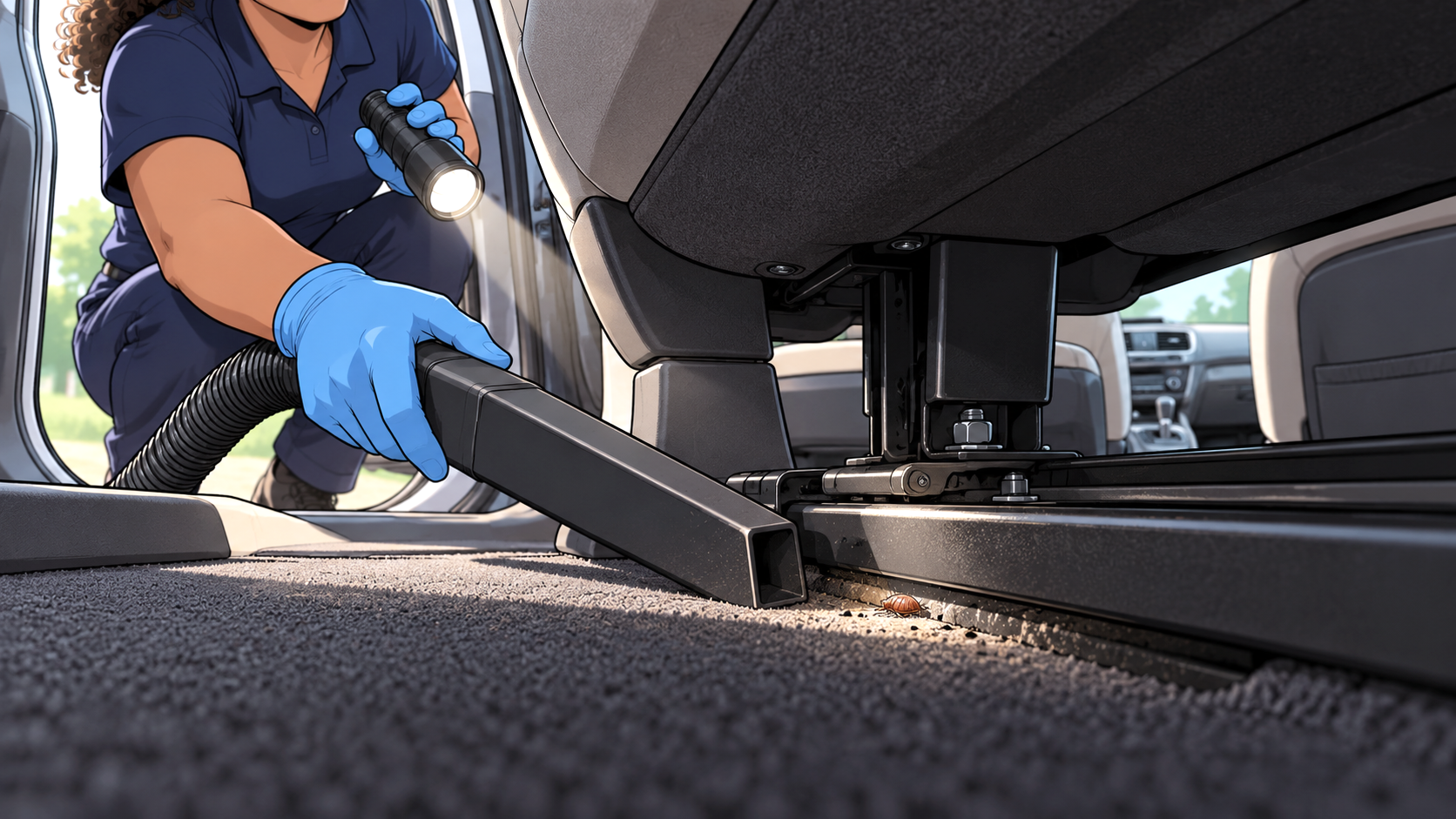
Start by removing loose belongings so you can inspect the interior properly. Check seat seams, folds, piping, gaps between seat cushions, seat rails, floor mats, carpeting edges, the trunk or cargo area, and cracks around interior trim.
Vacuum accessible bugs and debris using a crevice attachment. Pay particular attention to seams and narrow gaps rather than quickly vacuuming the open surfaces.
The EPA recommends thorough vacuuming as part of bed bug control and advises sealing the vacuum bag afterward and disposing of it in outdoor trash. If you’re using a bagless machine, empty and clean it carefully so bugs aren’t carried elsewhere.
Vacuuming can reduce bed bug numbers, but it won’t reliably reach every bug or egg hidden inside inaccessible parts of a vehicle.
Treat Removable Fabric Items Separately
Blankets, clothing, removable seat covers, and other dryer-safe fabrics are easier to treat outside the vehicle.
The EPA recommends placing suitable items in a household dryer on high heat for 30 minutes and notes that washing alone might not eliminate bed bugs. Always check the item’s care instructions before exposing it to high heat.
Once treated, keep clean items separated from anything that may still contain bed bugs until the vehicle has been dealt with.
Dryer heat is a much more controllable treatment than depending on whatever temperature a parked vehicle happens to reach that day.
Don’t Rely on a Specific Hot-Car Temperature
A parked car can become extremely hot in direct sunlight, but there isn’t a single cabin-temperature reading that guarantees every bed bug hidden throughout the vehicle has received a lethal exposure.
The EPA does mention placing suitable bagged items in a hot, closed car in the sun as a possible nonchemical approach. However, it specifically warns that success depends on climate and other factors and that DIY heat treatments may not work.
The problem is heat penetration. University of Minnesota guidance for professional thermal treatment stresses that lethal conditions must reach the inside of the infested item, not merely the surrounding air. Upholstery, cushions, carpeting, and other materials can insulate insects from heat.
Research demonstrates how large that difference can be. In one experiment, mattresses wrapped in black plastic and placed in summer sun reached 85°C (185°F) on their sun-exposed surfaces, yet protected areas remained far cooler. A very hot surface therefore doesn’t prove that hidden bed bugs received the same exposure.
For that reason, heat from a hot car shouldn’t be treated as a guaranteed bed bug treatment.
Be Careful With Steam Inside a Vehicle
Steam can kill bed bugs when it delivers sufficient heat directly to them. The EPA recommends steam of at least 130°F (about 54°C) for appropriate surfaces and warns against forceful airflow that could scatter bugs.
A vehicle introduces additional complications. Upholstery, foam, electronics, adhesives, trim, and other materials may not tolerate moisture or high temperatures, and reaching deeply hidden insects is harder than treating an exposed seam.
If steam is suitable for your vehicle’s materials, concentrate on accessible seams and crevices rather than assuming surface steaming heats an entire seat internally. Steam treatment has important limitations even on surfaces where it can be used safely.
Don’t Spray Just Any Pesticide Inside a Car
A pesticide registered for bed bugs isn’t automatically approved for vehicle interiors. The product label determines where it can legally and safely be applied.
The EPA requires pesticides to be used according to their labels. Don’t apply a household bed bug spray to seats, carpeting, dashboards, or other vehicle surfaces unless the label permits that specific type of application.
The same caution applies to total-release foggers. EPA says foggers shouldn’t be used as the sole method of bed bug control, and using a pesticide in a vehicle without label authorization can create unnecessary exposure without solving the infestation.
Consider Professional Treatment for an Established Vehicle Infestation
A single bed bug found in a car doesn’t necessarily mean the vehicle contains an established breeding population. Bed bugs are effective hitchhikers and can be transported in luggage, clothing, bags, and other belongings.
If repeated inspections find live bugs, eggs, shed skins, or other evidence that bed bugs are established inside the vehicle, professional treatment is more appropriate than experimenting with heaters or pesticides.
Vehicle treatment is possible. A peer-reviewed Virginia Tech study successfully eliminated all tested life stages from minivans using professionally controlled sulfuryl fluoride fumigation. That was a specialized professional procedure with controlled dosing and aeration, not something to reproduce yourself.
Questions About Treating Bed Bugs in a Car
Will parking a car in the sun kill bed bugs?
A closed car can become hot enough to harm or kill bed bugs, but cabin temperature alone doesn’t prove that lethal conditions reached every hiding place for long enough. Don’t use a particular dashboard reading as confirmation that the vehicle is bed bug-free.
Can I use a bed bug fogger inside my car?
Don’t use one unless its pesticide label specifically permits the intended application. EPA also advises against relying on foggers as the sole method of bed bug control.
Will professional detailing get rid of bed bugs?
Ordinary detailing isn’t the same as pest treatment. Vacuuming and cleaning may physically remove some bugs, but a clean-looking interior doesn’t establish that hidden bugs or eggs have been eliminated.
Do I need to treat the entire car if I find one bed bug?
Inspect the entire vehicle, particularly nearby seams, carpeting, seat rails, belongings, and concealed areas. One hitchhiking bug doesn’t prove an established infestation, but limiting the inspection to the exact place where it was found could miss additional bugs.
One thought on “How to Get Rid of Bed Bugs in Your Car”