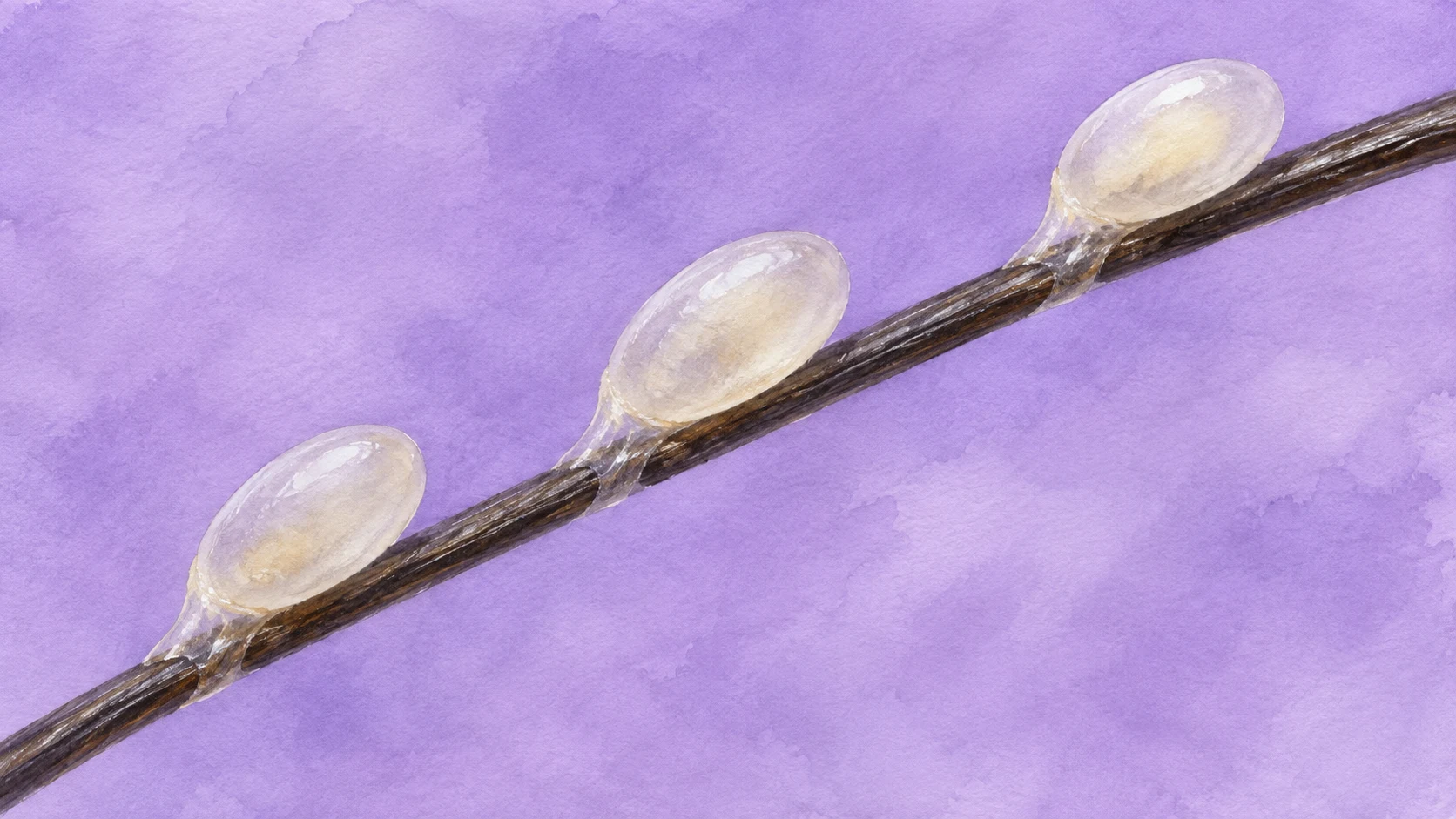
Head lice eggs, commonly called nits, look like tiny oval or teardrop-shaped specks firmly attached to individual strands of hair. They are usually yellowish, tan, brownish, or whitish, and measure approximately 0.8 millimeters long and 0.3 millimeters wide. Unlike loose flakes or ordinary hair debris, genuine lice eggs are cemented to the hair shaft and do not simply fall away when the hair moves.
A nit may resemble a miniature seed, a tiny bead, or a small knot in a piece of thread. Its exact appearance depends on whether the egg still contains developing material or is an empty shell. The typical oval shape and yellow-to-white coloration of head lice eggs are useful visual characteristics, but their attachment to the hair is often more distinctive than their color.
What Is the Difference Between a Head Lice Egg and a Nit?
The words egg and nit are often used interchangeably, but there is a useful distinction between them. A head lice egg is the structure laid by a female louse, containing the developing insect. After the insect emerges, the empty eggshell can remain attached to the hair and is also called a nit.
Some medical and entomological references reserve the word nit for an empty eggshell. Others use it for both an unhatched egg and an empty shell. Both conventions appear in public-health information, so the term alone does not establish whether the structure contains anything.
The difference between an egg and its remaining shell becomes easier to understand when looking at their physical appearance. An egg containing developing material may look yellowish, tan, or brown, while an empty casing often appears paler, whitish, or more transparent.
Both structures can remain firmly attached to hair because the adhesive material that originally secured the egg does not disappear when its contents are gone. As a result, two similar-looking specks on neighboring hairs may represent different physical states.
What Shape Are Head Lice Eggs?
Head lice eggs are elongated ovals, sometimes described as teardrop-shaped or flask-shaped. They are not perfectly spherical. One end is generally broader and rounded, while the opposite end has a specialized opening covered by a cap.
Their smooth, compact outline is most apparent under magnification. Without magnification, the entire egg may look like a small oval dot attached to the side of a hair. The subtle difference between its two ends is usually too small to recognize.
The egg has a protective outer shell called the chorion. At one end is a cap known as the operculum, which closes the opening through which the developing louse eventually emerges. This cap is a genuine anatomical feature rather than a separate particle stuck to the egg.
The operculum and the rest of the shell are visible in sufficiently detailed microscope images, but they should not be expected to stand out during an ordinary examination of hair. The fine structure of head lice eggs is much easier to appreciate in enlarged specimen photographs.
An empty shell may have an open or altered end where the cap was displaced. However, a person examining a tiny speck without adequate magnification generally cannot assess that detail reliably.
How Big Are Head Lice Eggs and Nits?
A typical head lice egg measures approximately 0.8 millimeters in length and 0.3 millimeters in width. That makes it substantially smaller than an adult louse and small enough to be mistaken for an ordinary speck on a strand of hair.
For comparison, one millimeter is the distance between two adjacent millimeter markings on a metric ruler. A head lice egg is shorter than that distance, while its width is only a fraction of a millimeter.
The measurements of approximately 0.8 by 0.3 millimeters explain why eggs are sometimes compared with tiny knots in thread. The comparison is approximate, but it conveys the scale more effectively than an enlarged photograph without a reference object.
An egg is also much longer than the diameter of a typical human hair. However, its narrow width and position against the hair shaft can make it difficult to separate visually from the strand to which it is attached.
Under magnification, the egg may appear large and prominent. At its actual size, it often resembles a tiny grain or bead, with little of its anatomy visible.
What Colors Can Head Lice Eggs and Nits Be?
Head lice eggs can appear yellow, tan, brownish, cream-colored, or whitish. Some have a slightly translucent appearance, while others look more opaque. Their color is influenced by the contents of the egg, the shell, the surrounding hair, and the lighting.
Eggs containing developing material often appear darker than empty casings. Tan, yellowish-brown, or brown coloration may be visible, particularly in magnified photographs. Empty shells frequently look white, pale yellow, or nearly transparent.
The visible differences between eggs and empty casings are especially apparent when the structures are photographed side by side. An egg with contents may look like a tiny colored seed, while an empty shell can resemble a clear or whitish bead.
These differences are not absolute. Lighting can make a translucent shell look bright white, and a pale egg may be difficult to distinguish from an empty casing. Color alone cannot reliably establish the contents of every individual structure.
The color of the surrounding hair also affects contrast. A pale nit may stand out against dark hair but blend into blond or gray hair. Brownish eggs may be less conspicuous on similarly colored strands.
How Are Head Lice Eggs Attached to Hair?
Female head lice deposit their eggs directly onto individual hair shafts, securing them with a specialized adhesive secretion. The adhesive hardens around the hair and the lower portion of the egg, forming a strong attachment that helps keep the structure in place.
The egg does not merely rest against the hair like a piece of dust. It is bonded to the strand, with part of the attachment forming a sleeve or collar around the hair shaft. This is why a genuine nit often appears fixed at one position rather than hanging loosely.
The cement-like attachment of head lice eggs is one of their most recognizable physical characteristics. The adhesive is produced during egg laying and helps prevent the egg from being dislodged by ordinary hair movement.
The egg usually sits alongside the hair rather than encircling the entire strand as a large ring. Under magnification, the attachment area can be seen where the base of the egg meets the hair shaft.
Hair continues growing after the egg is deposited, carrying the attached structure farther from the scalp. The egg does not actively crawl along the hair, and its position changes with the strand’s growth rather than through independent movement.
Where on the Hair Are Head Lice Eggs Usually Found?
Head lice eggs are generally deposited close to the scalp, often within a few millimeters of the skin. This places them in the warm, relatively stable environment surrounding the hair roots.
The eggs are attached to hair shafts rather than embedded in the scalp itself. They may appear to be touching the skin because of their small size and proximity to the hair roots, but the actual attachment is to the hair.
Common locations include hair behind the ears and near the nape of the neck. These areas frequently provide suitable conditions for egg deposition and are among the places where attached nits may be noticed.
The usual position of nits near the scalp helps explain why they are often concealed beneath the outer layers of hair. A nit attached near the base of a strand may be invisible until the surrounding hair is separated.
Nits can also be found farther along the hair shaft. As hair grows, an attached shell moves away from the scalp with it. Distance therefore changes the physical location of a nit without changing the fact that it remains attached to the same strand.
The places head lice and their eggs are commonly found include several areas of the scalp, but the exact distribution varies between individuals.
What Do Empty Head Lice Egg Cases Look Like?
An empty head lice egg case usually resembles a tiny whitish, pale yellow, or translucent oval attached to a strand of hair. It retains much of the original egg’s outline, even though the developing insect is no longer inside.
The shell may appear slightly collapsed or open at one end, but these details are not always visible. Many empty casings retain a recognizable oval shape and can remain attached long after their contents have disappeared.
The adhesive at the base of the shell is particularly persistent. The egg’s contents can leave without the entire structure separating from the hair. This explains why an empty nit may remain in place even though it no longer contains a developing insect.
An empty casing often looks brighter than an egg containing material, especially against dark hair. However, this is a general appearance difference rather than a definitive test for every specimen.
The visual differences between live, dead, and empty lice eggs require more careful interpretation than simply assigning a status based on whether a speck looks white or brown.
How Can You Tell a Nit From Ordinary Hair Debris?
The most useful distinction is how the object is attached to the hair. A genuine nit is cemented to an individual hair shaft, while ordinary particles such as dust, lint, and loose scalp flakes are not bonded in the same way.
Hair debris can accumulate near the scalp and resemble tiny eggs, especially when viewed without magnification. Product residue may form small whitish or translucent particles, while flakes of skin can appear pale yellow or white.
A genuine nit generally has a more consistent oval shape and a fixed attachment point. Loose debris may have irregular edges, an uneven surface, or no obvious connection to a particular hair shaft.
The distinction becomes less straightforward with certain hair conditions and cosmetic residues. Some materials can cling to hair strongly enough to resemble attached eggs. For this reason, resistance to movement is a useful clue, not absolute proof.
The difference between firmly attached nits and loose hair particles is especially useful when a person notices several tiny white specks but cannot see their outlines clearly.
A more detailed comparison of head lice nits and dandruff addresses the differences between those two specific findings, while the broader range of objects mistaken for head lice includes other materials that may collect in hair.
What Does a Nit Look Like Under Magnification?
Magnification reveals features that are difficult or impossible to appreciate with the naked eye. The egg’s elongated outline becomes clearer, its connection to the hair shaft can be examined, and the shell’s surface may appear smooth or slightly textured depending on the image quality.
A sufficiently detailed microscope photograph can show the cap at one end and the adhesive attachment at the opposite end. In some images, the egg’s contents are visible through the shell, while empty casings appear more transparent.
The hair shaft provides a useful scale reference. The egg is attached along the strand, with its long axis generally aligned with the hair. The adhesive surrounding the attachment point can make the base look slightly thicker than the rest of the shell.
Magnified images can also exaggerate the apparent size of nits. A structure less than one millimeter long may fill an entire photograph, making its features appear far more prominent than they would during a normal scalp examination.
The limits of seeing lice-related structures with the naked eye are important when comparing ordinary observations with highly enlarged photographs. A nit that looks unmistakable under a microscope may resemble an unremarkable speck on a person’s head.
The Most Useful Visual Features of Head Lice Eggs and Nits
Several physical characteristics can be considered together when interpreting an unfamiliar speck attached to hair. No single characteristic is perfectly reliable, but the combination provides a more useful description than color alone.
|
Feature |
Typical head lice egg or nit appearance |
|---|---|
|
Shape |
Small, elongated oval or teardrop |
|
Length |
Approximately 0.8 mm |
|
Width |
Approximately 0.3 mm |
|
Color |
Yellowish, tan, brownish, white, or translucent |
|
Attachment |
Firmly cemented to an individual hair shaft |
|
Position |
Commonly close to the scalp, although attached shells can occur farther along the hair |
|
Surface |
Relatively smooth, with finer details visible under magnification |
|
Empty casing |
Often pale or translucent, sometimes with a visible opening at one end |
The attachment point is particularly informative because it describes how a nit physically relates to the hair. A small oval structure firmly bonded to a single strand is more consistent with a nit than an irregular particle resting loosely among several hairs.
Even when the appearance is consistent with a nit, its color, shape, and position do not establish whether an infestation is currently active. That is a separate question requiring evidence beyond the physical description of an egg case.
Common Questions About the Appearance of Head Lice Eggs
Are head lice eggs white or brown?
They can be either. Eggs containing developing material may appear yellowish, tan, or brown, while empty casings are often whitish or translucent. Color varies and cannot reliably establish the contents of every egg.
Do head lice eggs look like tiny seeds?
Yes. Their elongated oval shape can resemble a miniature seed or a small knot in thread. However, they are much smaller than most familiar seeds, measuring approximately 0.8 millimeters long.
Are nits attached to the scalp or the hair?
Nits are attached to individual hair shafts, usually close to the scalp. They are not embedded in the scalp itself, even when they appear to be positioned directly against the skin.
Can empty nits stay attached to hair?
Yes. The adhesive securing the original egg can remain in place after the insect has emerged. Empty shells may therefore persist on hair strands.
Do all nits look exactly the same?
No. Their color, apparent transparency, position, and visible contents can differ. Lighting and hair color can also change how clearly an individual nit can be seen.
Can a nit look like a tiny piece of dandruff?
Yes. Both can appear as small pale specks in hair. Genuine nits have a characteristic oval shape and firm attachment to a hair shaft, whereas ordinary loose flakes are not cemented to the strand.
3 thoughts on “What Do Head Lice Eggs and Nits Look Like?”