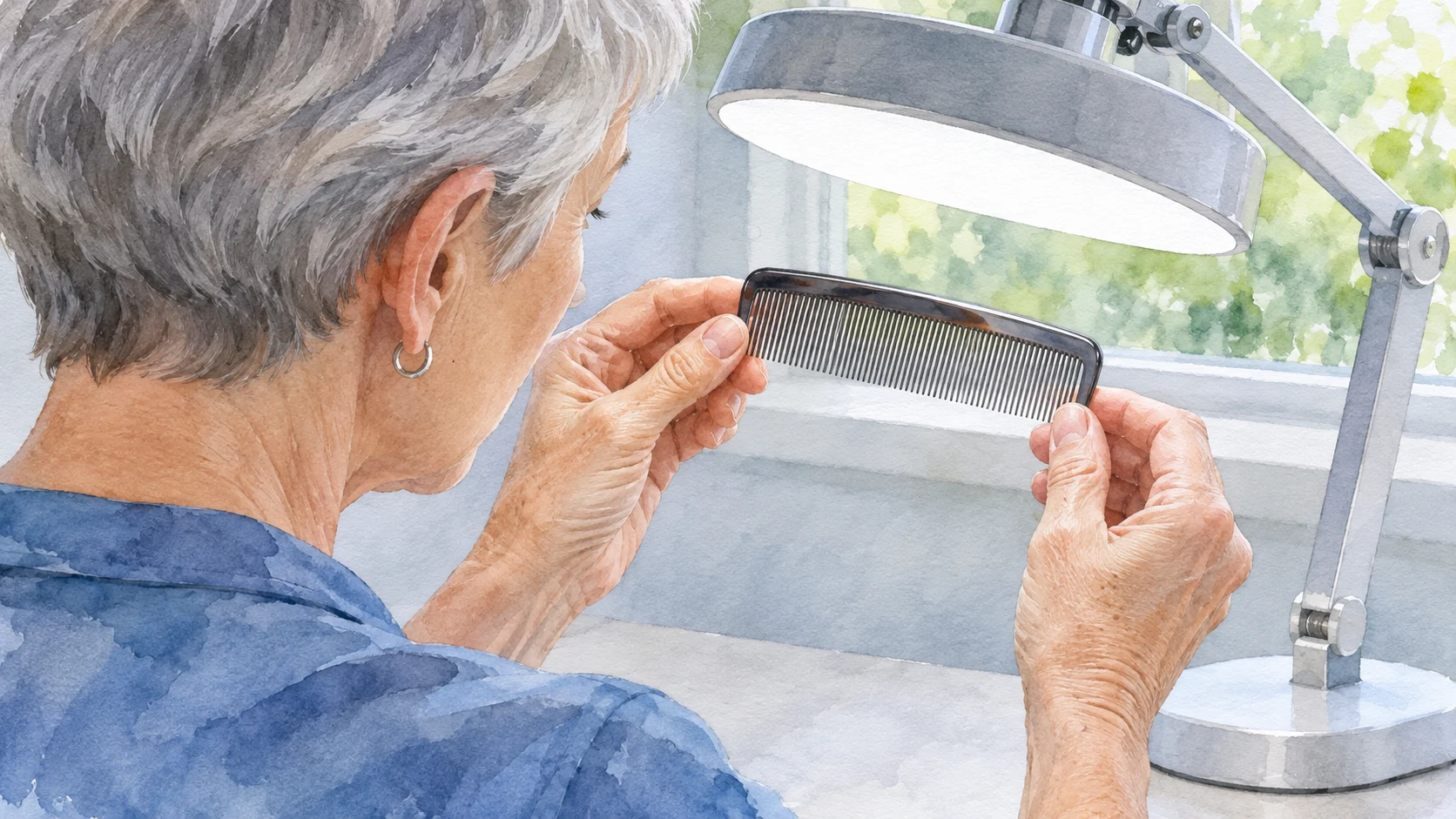
Head lice are visible to the naked eye, including adults and young lice called nymphs. You do not need a microscope to see them. However, spotting a living head louse among hundreds of hair strands can be surprisingly difficult, especially when the insect is young, moving quickly, or close to the scalp.
Adult head lice are generally easier to notice than newly hatched nymphs. Their grayish, tan, or brownish bodies may stand out against the surrounding hair, but their small size and tendency to avoid light make them easy to overlook. Bright, even lighting and a fine-toothed lice comb can make living insects easier to find.
The visibility of head lice and their eggs is well established, but being large enough to see does not mean an insect will be easy to locate. A person can have head lice without noticing a single crawling insect during a casual glance at their hair.
What Do Head Lice Look Like Without Magnification?
To the naked eye, an adult head louse usually appears as a tiny, elongated insect moving among hair strands. Depending on the lighting and its coloration, it may resemble a small gray, tan, or brown speck until its legs and movement become noticeable.
Its body is relatively narrow, with six legs adapted for gripping individual hairs. Those legs may be difficult to distinguish without magnification, particularly when the insect is surrounded by strands.
When a louse is visible against a light background, its outline may become clearer. The head and abdomen can sometimes be distinguished, although the finer anatomical details are generally beyond what an unaided observer can see.
The physical appearance of adult head lice includes features that are easier to appreciate in enlarged photographs than during an ordinary scalp observation.
A living louse is also not necessarily seen from above. It may be partly hidden behind a strand, positioned against the scalp, or viewed at an angle that conceals much of its body.
These factors explain why someone might recognize a head louse immediately when it is isolated on a plain surface but struggle to see the same insect among dense hair.
Are Baby Head Lice Visible to the Naked Eye?
Young head lice, called nymphs, are also visible without magnification, although they are considerably harder to notice than adults.
A newly hatched nymph resembles a smaller version of an adult head louse. Its body may appear pale or somewhat translucent, making it difficult to distinguish from the surrounding scalp or light-colored hair.
As a nymph grows, its body becomes easier to recognize. Its legs, elongated outline, and crawling movement become more apparent, but it remains a small insect that can disappear among strands.
The appearance of baby head lice changes as they develop, and the youngest stages present the greatest visual challenge.
A nymph may be visible as a moving dot before its body structure becomes recognizable. This can create uncertainty because movement alone does not reveal every anatomical feature needed to identify an insect.
The difficulty of seeing young lice without magnification is recognized in public-health guidance. Nymphs are small enough that a magnifying lens may be helpful, even though they are not microscopic.
A person who fails to notice a nymph during a brief observation should not assume that no young lice are present.
Why Are Head Lice So Hard to See in Hair?
The difficulty comes from the combination of the insects’ small bodies, their movement, and the environment in which they live.
Scalp hair creates numerous narrow spaces where lice can remain partly concealed. A louse may cling close to the skin, move behind a strand, or change direction before an observer can focus on it.
Head lice also tend to avoid light. When exposed during an examination, they may crawl away from the illuminated area or move deeper among the surrounding hairs.
The rapid movement and light-avoidance behavior of head lice contribute to the difficulty of finding them during visual inspection.
Hair density can make the task harder. Thick or tightly arranged hair may obstruct the view of the scalp, while long strands can shift across the area being observed.
The number of lice present also affects the chance of seeing one. A light infestation may contain relatively few living insects, leaving large areas of the scalp without a visible louse at any particular moment.
The difficulty is therefore not necessarily poor eyesight. Even someone who knows what head lice look like may fail to spot one when it is concealed or moving.
Does Hair Color Affect How Easily You Can See Head Lice?
Yes. Hair color can affect the contrast between a louse and its surroundings, although it does not provide a dependable way to predict whether lice will be visible.
Head lice can appear grayish, tan, pale brown, or darker. A pale louse may be difficult to notice against blond or gray hair, while a darker specimen may be more conspicuous.
Against dark hair, a pale insect may stand out when it is exposed. However, the scalp, shadows, and overlapping strands can still conceal it.
The natural color variations of head lice mean that their appearance is not identical from one insect to another.
Lighting can also change the apparent contrast. A louse that looks dark against a brightly illuminated scalp may appear pale or indistinct when viewed against a darker strand.
Hair color is only one factor. A well-lit area with clearly separated strands may reveal a louse more readily than a poorly lit area, regardless of the person’s natural hair color.
What Kind of Lighting Makes Head Lice Easier to See?
Bright, even lighting is helpful because it makes the scalp and individual hair strands easier to distinguish. Natural daylight or a well-positioned indoor light can provide a clearer view than dim room lighting.
The light should illuminate the area being observed without producing excessive glare. Strong reflections from shiny hair or a wet scalp may make tiny insects harder to distinguish.
A movable lamp can be useful when shadows fall across the scalp. Adjusting the direction of the light may reveal an insect that was previously hidden behind a strand.
However, brighter light does not always make the insects themselves easier to follow. Because head lice tend to avoid illumination, exposing them may cause them to crawl away.
The use of bright light when looking for head lice is recommended alongside a fine-toothed comb rather than as a substitute for other observation methods.
Good lighting improves visibility, but it cannot guarantee that a moving louse will remain exposed long enough to be recognized.
Can You See Head Lice Moving on the Scalp?
Yes. A living head louse may be seen crawling along a hair shaft or moving close to the scalp. Its movement can be one of the first clues that a tiny speck is actually an insect.
Head lice crawl using their legs and gripping claws. They do not jump or fly, so their movement is generally confined to surfaces they can grasp.
A louse may travel along a strand, move from one hair to another, or disappear beneath overlapping hair. The movement can be quick enough that an observer loses sight of it almost immediately.
The crawling behavior of head lice is distinct from the jumping behavior of fleas. However, not every moving particle is a head louse, and an insect that remains still is not necessarily dead.
A strand shifting against another strand can make an attached particle appear to move independently. Conversely, a living louse may remain motionless briefly while gripping hair.
A recognizable insect body provides stronger evidence than movement alone. When the object is too small to examine clearly, a lice comb can help bring it into a position where its features are easier to observe.
Can You See Head Lice Eggs More Easily Than Living Lice?
Sometimes. Head lice eggs, commonly called nits, are attached to individual hair shafts and do not crawl away when exposed. This makes them easier to notice in some situations than living lice.
Nits may appear as tiny pale, yellowish, or brownish structures fixed near the hair roots. Their lack of movement gives an observer more time to examine them.
The appearance and attachment of head lice eggs help distinguish them from loose particles, although visual identification can still be difficult.
A nit may remain attached after the egg has hatched or become nonviable. Finding one therefore does not necessarily establish that living lice are currently present.
The difference between living, dead, and empty lice eggs is important when interpreting a visible structure on a hair shaft.
Nits are often confused with dandruff and hair-product residue. Their attachment provides a useful clue, but identifying an egg-like object is not equivalent to seeing a living head louse.
Does Wet Hair Make Head Lice Easier to See?
Wet hair can make lice easier to locate in some circumstances, particularly when combined with a fine-toothed lice comb.
Moisture can reduce the insects’ ability to move quickly through the hair. It may also make strands easier to organize, allowing small areas to be viewed with less interference from surrounding hair.
However, wet hair can also clump together or reflect light, making an insect difficult to see directly. The benefit comes partly from making the lice less mobile and helping a comb collect them.
The use of wet hair and fine-toothed combing to locate lice is supported by pediatric guidance.
A comb can bring a living louse out of dense hair and onto a contrasting surface, where its body and movement may be easier to recognize.
This is particularly helpful when the insect is too small or too well concealed to identify while it remains on the scalp.
Is a Fine-Toothed Lice Comb Better Than Looking With Your Eyes Alone?
A fine-toothed lice comb can improve the chances of finding living head lice because its closely spaced teeth help capture insects that might otherwise remain hidden.
Ordinary visual inspection depends on an insect being exposed at the moment someone looks. A lice comb can physically bring lice out from among the strands.
This does not mean that every particle collected by a comb is a louse. Hair debris, flakes, and other material may also be caught, so the collected object still needs to be recognized correctly.
The usefulness of fine-toothed combs for finding living lice is especially relevant when no insects are visible during an initial observation.
A white tissue or another plain, contrasting surface can make a collected insect easier to see. Its outline, legs, and movement may become clearer once it is no longer concealed by surrounding hair.
The article on checking your own head for lice covers the complete self-examination process. The important point here is that a comb can reveal insects that are already present but difficult to see.
What If You Cannot See Any Head Lice?
Not seeing a louse during a casual look does not establish that none are present. A light infestation may involve few living insects, and those insects may be hidden or moving away from exposed areas.
The absence of itching is also not conclusive. Some people have head lice without experiencing noticeable discomfort, especially early in an infestation.
The possibility of having head lice without itching explains why symptoms cannot replace direct observation.
There is also a difference between failing to see an insect and repeatedly finding no living lice using an appropriate examination method. A brief glance provides limited information, while careful observation with suitable lighting and a lice comb offers stronger evidence.
If uncertainty remains, a healthcare professional can help identify a suspected specimen. Unnecessary lice treatments should not be started solely because the scalp itches or an unidentified speck has been noticed.
The signs of a head lice infestation involve more than the visibility of a single particle, and a living louse remains the most persuasive evidence of active infestation.
What You Can Realistically Expect to See
| What you are looking at | Visible without magnification? | Main difficulty |
|---|---|---|
| Adult head louse | Yes | Small body, fast crawling, and concealment among hair |
| Older nymph | Yes | Smaller and less conspicuous than an adult |
| Newly hatched nymph | Yes, but difficult | Tiny, sometimes pale or translucent body |
| Attached nit | Yes | Can resemble dandruff or other hair debris |
| Legs and fine body details | Sometimes, but usually indistinct | Limited detail at normal viewing distance |
| A louse collected by a fine-toothed comb | Often easier to see | Still requires correct recognition of the insect |
The table illustrates an important difference between visibility and recognition. An object may be large enough for the human eye to detect but too small, obscured, or poorly illuminated for its identity to be obvious.
Head lice are not microscopic parasites. Adults, nymphs, and eggs can all be seen without specialized equipment. Their size, movement, and position among hair strands simply make them harder to find than many people expect.
One thought on “Can You See Head Lice With the Naked Eye?”