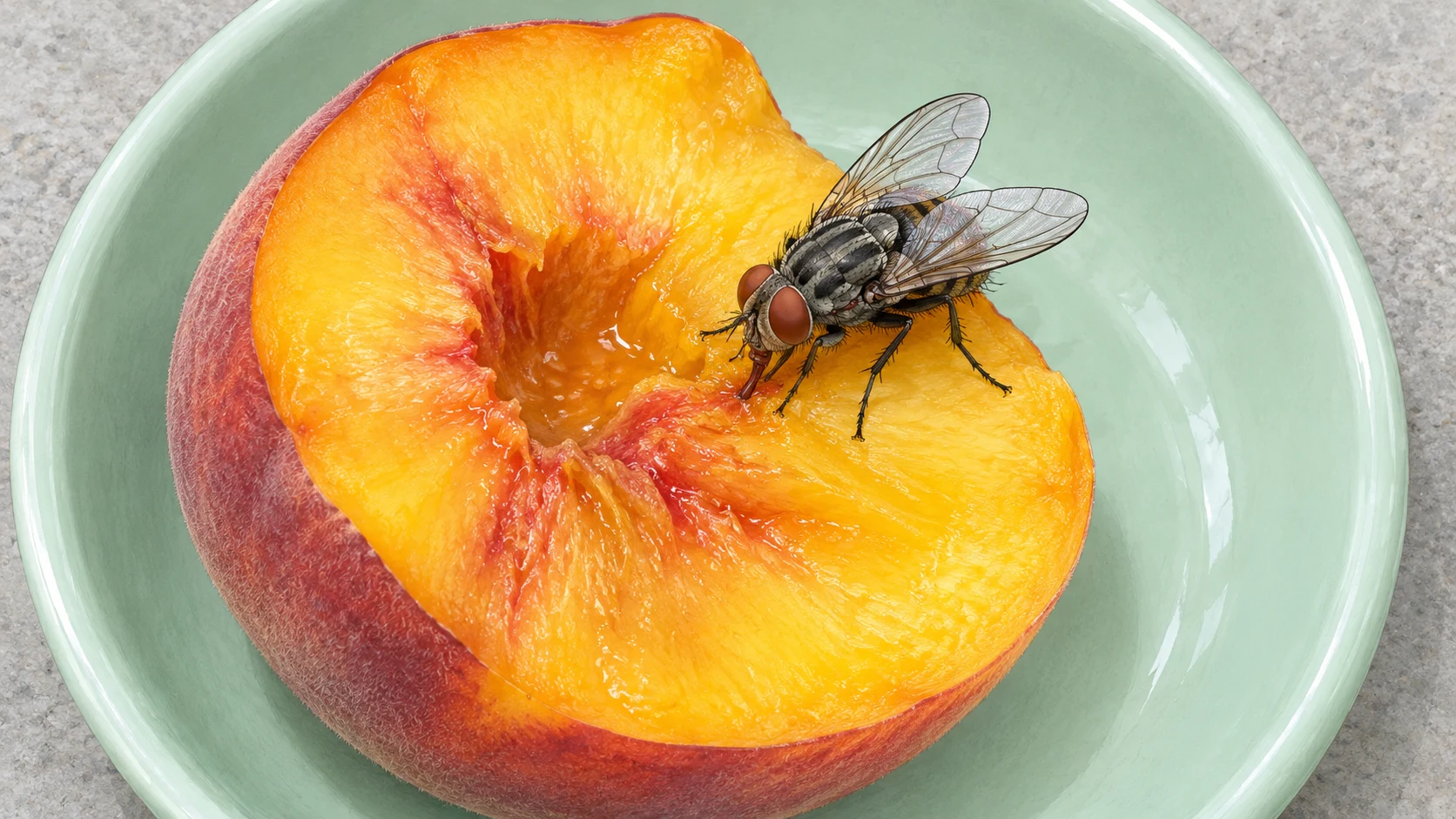
A house fly can land on a slice of watermelon, move across a piece of bread, and later feed on something far less appealing, such as animal waste. Unlike insects that depend on a narrow range of foods, house flies can obtain nutrients from many different materials.
The common house fly, Musca domestica, is an opportunistic feeder. Adults consume sugary liquids, fruit juices, milk, dissolved food particles, and nutrient-rich fluids associated with decomposing organic matter. They also feed on human food, animal feed, and certain waste materials when those substances provide accessible nutrients.
However, house flies cannot chew and swallow solid food the way humans do. Their mouthparts are specialized for taking up liquids, so solid materials must first become sufficiently moist or dissolved for the fly to ingest them.
House flies eat a remarkably broad range of foods, but they must consume those foods in liquid or dissolved form. This feeding limitation helps explain why moist foods, exposed meals, and food residues are commonly visited by adult flies.
What Foods Do Adult House Flies Eat?
Adult house flies feed on materials containing accessible carbohydrates, proteins, and other nutrients.
Their diet is not restricted to rotten food or garbage. Fresh human food can also provide suitable nourishment, particularly when it contains moisture or soluble nutrients.
Common foods and materials consumed by adult house flies include:
Fruit juices and moisture from ripe or damaged fruit.
Sugar dissolved in liquids.
Milk and other accessible dairy liquids.
Moist or softened food scraps.
Nutrient-rich liquids associated with meat and other animal products.
Liquids and dissolved nutrients in animal feed.
Organic waste containing accessible moisture and nutrients.
Fluids associated with manure and other decomposing material.
These categories are supported by research on house fly feeding and observations in homes, farms, and other environments.
The University of Maryland Extension’s guidance on indoor flies identifies human food and animal excrement among the materials used by adult house flies.
Similarly, Utah State University Extension describes adult feeding on human food products, manure, and decaying organic matter.
The range of available foods is broad because house flies can exploit nutrients from both plant and animal sources.
However, a fly landing on a particular material does not automatically mean it is feeding. It may be walking, resting, or examining the surface.
Why House Flies Need Liquid Food
The structure of a house fly’s mouth determines how it eats.
Adult house flies possess sponging mouthparts, which are adapted to collect liquids rather than bite off solid pieces of food.
The lower portion of the feeding apparatus ends in two fleshy lobes called the labella.
These lobes contain fine channels known as pseudotracheae, which help collect liquid food and direct it toward the fly’s food canal.
The North Carolina State University explanation of insect mouthparts describes how these specialized structures allow house flies and related insects to absorb liquid food.
This anatomy places a practical limit on what an adult house fly can swallow.
A fly cannot remove a large chunk from a sandwich or chew a piece of meat into smaller fragments.
Instead, it takes up nutrients that are already dissolved or have been made sufficiently liquid.
That is why the physical condition of a food can be just as important as its ingredients.
A wet food surface may offer immediately accessible nutrients, while a dry piece of the same food may be harder for the insect to consume.
Can House Flies Eat Solid Food?
Yes, but only after the food becomes sufficiently liquid for their mouthparts to take it up.
House flies cannot ingest large solid particles directly.
A solid food may nevertheless contain moisture on its surface or substances that can dissolve when exposed to liquid.
The fly can then consume the resulting solution.
The University of California Integrated Pest Management Program explains that house flies use saliva to help liquefy solid food before feeding.
The physical process of softening food is part of their normal feeding biology.
A dry sugar crystal, for example, is not swallowed whole. The fly must obtain the sugar in dissolved form.
Likewise, a piece of bread may provide accessible nutrients if moisture allows some of its components to become available in liquid form.
This does not mean that every dry food is equally useful to house flies.
The composition of the food, its moisture content, and the availability of soluble nutrients all affect whether an adult can obtain nourishment from it.
Do House Flies Chew Their Food?
No. Adult house flies do not possess the chewing mouthparts used by insects such as grasshoppers.
Their mouthparts are designed primarily for sponging and absorbing liquids.
Although small structures on the mouthparts can help manipulate food surfaces, this is not equivalent to chewing solid pieces.
The distinction explains why a house fly can feed from a solid-looking food without removing a visible bite.
The fly is taking up dissolved material rather than consuming a recognizable chunk.
Do House Flies Eat Sugar?
Yes. Sugar is an important carbohydrate source for adult house flies.
Sugars provide energy that supports movement, flight, and other physiological activities.
House flies can consume sugar when it is dissolved in a liquid or made accessible through moisture.
Laboratory researchers commonly use sugar solutions when studying adult feeding and survival.
A 2022 study of sex-specific feeding behavior in house flies examined how males and females consumed foods with different nutritional compositions.
The researchers offered sugar, milk, egg-yolk preparations, and water.
Both sexes consumed nutritional resources, but the feeding patterns differed.
Male flies showed a stronger preference for the carbohydrate-rich sugar solution in that experimental setting.
The result supports the importance of carbohydrates in the adult diet without establishing that sugar is the only food males need.
House flies obtain nutrients from a range of materials, and feeding behavior can change with physiological requirements.
Do House Flies Eat Fruit?
Yes. Adult house flies can consume accessible liquids and dissolved nutrients from fruit.
Ripe or damaged fruit may contain exposed juices that are readily available to their sponging mouthparts.
Fruit can supply sugars and other dissolved compounds.
However, house flies do not need to bite through intact fruit skin to obtain food.
They may feed where moisture is already exposed, such as on a cut surface or damaged portion.
A fly walking across an intact apple is not necessarily consuming the apple.
Similarly, the presence of flies around a fruit bowl does not establish that every insect present is a common house fly.
Fruit flies and other small fly species may also occur around fruit.
For adult Musca domestica, the relevant dietary feature is the availability of liquid or dissolved nutrients.
The University of Michigan’s Animal Diversity Web account includes fruit among the food materials consumed by house flies.
Do House Flies Eat Meat?
House flies can feed on accessible liquids and soluble nutrients associated with meat and other animal products.
However, they do not chew pieces of meat or consume intact muscle tissue in the way an animal with biting mouthparts would.
A moist meat surface may provide accessible material.
Juices released from cooked or raw meat can also contain nutrients that a fly can take up.
The presence of a house fly on meat should not be interpreted as evidence that it is removing solid pieces.
Its feeding remains limited by the same sponging mouthparts used on other foods.
Meat also illustrates why the broad term food can be misleading.
A house fly may obtain nourishment from a moist animal product without being a specialized meat-eating insect.
Its adult diet is considerably more varied.
Do House Flies Drink Milk?
Yes. Milk is a documented food for adult house flies.
It contains water, carbohydrates, proteins, and other nutrients in a form that can be consumed through their mouthparts.
Milk has also been used in controlled feeding experiments.
In the 2022 study of sex-specific feeding behavior, female house flies showed a preference for the milk treatment over the other tested foods.
The researchers interpreted this result in relation to the nutritional requirements of adult females.
A later study of adult house fly feeding and egg production on potential dairy-farm foods examined how different food resources influenced survival and reproduction.
The study provides additional evidence that adult house flies can use a variety of nutritional resources rather than depending on one particular food.
Milk is therefore more than a surface on which house flies happen to land. It can serve as a genuine source of nourishment.
However, the results of laboratory feeding experiments should not be converted into a universal ranking of foods that every house fly prefers.
Do House Flies Eat Bread, Rice, and Other Starchy Foods?
House flies can obtain nutrients from starchy foods when those nutrients become accessible in liquid or dissolved form.
Bread, cooked rice, pasta, and similar foods are not automatically unsuitable simply because they are solid.
Moisture can change how readily a fly can feed from their surfaces.
For example, a soft piece of bread containing moisture may offer different feeding opportunities from a completely dry crumb.
Cooked rice with moisture on its surface differs from hard, uncooked grains.
However, house flies do not chew or swallow intact grains of rice.
The presence of starch does not override the physical limitations of their mouthparts.
Whether a fly can obtain meaningful nourishment depends on the food’s condition and the availability of soluble material.
It is therefore more accurate to say that house flies can feed on accessible nutrients from some starchy foods than to claim that they eat every form of bread, rice, or grain equally well.
Do House Flies Eat Vegetables?
Yes. Adult house flies can feed on liquids and dissolved nutrients associated with vegetables.
Cut, damaged, cooked, or decomposing vegetables may expose moisture and nutrients that the insects can consume.
A freshly cut tomato, for example, presents a very different surface from a hard, dry vegetable.
The fly’s ability to feed depends on the material available at the surface.
However, a house fly does not need to consume a vegetable for it to land on one.
Walking across a food item and actively feeding are different behaviors.
House flies are generalist feeders, but the presence of an insect on a vegetable should not be interpreted as proof that it has eaten a measurable amount.
Do House Flies Eat Animal Feed?
Yes. Adult house flies can consume accessible nutrients from animal feed.
This is particularly relevant around farms and animal-housing facilities, where feed may be present in dry, damp, spilled, or partially decomposed forms.
A dry feed pellet may not offer the same feeding opportunity as feed mixed with moisture.
The availability of dissolved nutrients determines what an adult can ingest.
The Texas A&M AgriLife Extension guide to fly management in dairies describes adult house flies feeding on animal feed, excrement, and decaying organic matter.
The guide also distinguishes adult feeding from the environmental conditions that support developing fly populations.
For adult diet, the relevant observation is that feed materials can supply nourishment when their nutrients are physically accessible.
Do House Flies Eat Manure and Animal Waste?
Yes. Adult house flies can feed on accessible nutrients in manure and other animal waste.
Although these materials are unpleasant to humans, they can contain moisture, dissolved organic compounds, and nutrients that insects can use.
House flies are not restricted to clean food.
Their feeding range includes materials associated with livestock and other animals.
However, it is important to distinguish feeding from simply walking across waste.
An adult may contact a contaminated surface without necessarily consuming it.
The 2021 scientific review of house fly biology describes the species’ broad feeding habits and the role of liquid food consumption in its biology.
The ability to use both human food and waste materials is one reason house flies are significant from a hygiene perspective.
A fly can contact unsanitary material and subsequently land on food intended for people.
The potential for contamination does not depend on the insect consuming a large quantity of either material.
Do House Flies Eat Rotten Food?
Yes. Decomposing food can provide accessible nutrients for adult house flies.
As organic material breaks down, its physical structure and chemical composition change.
Some substances become softer or more readily available in liquid form.
This can make portions of the material suitable for a fly with sponging mouthparts.
However, house flies do not require food to be rotten before they can eat it.
Fresh fruit juice, milk, and other suitable liquids can provide nourishment.
Rotten food is therefore one part of their diet rather than its defining feature.
A house fly may consume nutrients from fresh food on one occasion and decomposing material on another.
Its ability to exploit both types of material is characteristic of a generalist feeder.
Do Male and Female House Flies Eat the Same Things?
Male and female house flies share the same basic feeding anatomy, but their nutritional requirements can differ.
Both sexes need energy to support movement and normal physiological functions.
Females also require nutrients associated with egg production.
Protein availability is particularly relevant to reproduction.
The 2022 study of sex-specific feeding behavior found that females preferred the milk treatment, while males showed a stronger preference for the sugar treatment.
The researchers also observed that some individuals consumed more than one type of food during the experiment.
These findings demonstrate that adult house fly feeding is not identical across all individuals.
However, the results should not be interpreted as a rigid rule that females eat only protein-rich foods and males eat only sugar.
Both sexes can consume a range of suitable materials.
Age, reproductive condition, and the availability of food can influence what an individual consumes.
Why House Flies Eat Different Foods at Different Times
A house fly’s dietary needs are not necessarily constant throughout adulthood.
An individual may require energy for activity while also needing other nutrients to support physiological processes.
Reproductive condition can influence feeding behavior, particularly in females.
The availability and nutritional composition of food also affect what the insect consumes.
Laboratory research has shown that house flies can feed on multiple food types when given the opportunity.
The 2022 feeding study found that approximately one-third of tested females and about one-tenth of males consumed more than one offered food during the observation period.
Those percentages describe the particular experiment, not a universal daily feeding pattern.
They nevertheless demonstrate that a house fly’s diet can include multiple nutritional resources rather than one preferred substance.
A fly feeding from a sugary liquid at one moment may obtain other nutrients elsewhere.
Why Household Food Is Suitable for House Flies
Many foods commonly found in homes already contain moisture and dissolved nutrients.
A bowl of fruit, an uncovered drink, a plate containing sauce, or a damp food scrap may provide substances that an adult house fly can consume.
Even when a food appears solid, moisture on its surface may make some nutrients accessible.
House flies do not distinguish between food intended for people and other suitable organic materials.
Their feeding anatomy allows them to exploit whatever accessible nutrients are available.
However, the ability to consume a food is not the same as being attracted to it from a distance.
A food may be nutritionally suitable without necessarily being the strongest stimulus for an approaching fly.
Likewise, a fly landing on a meal may not immediately begin feeding.
The diet question concerns what the insect can consume, while its approach and landing behavior involve additional sensory processes.
Can House Flies Eat Food That Looks Completely Dry?
Some apparently dry foods may still provide accessible nutrients, but truly dry, insoluble material is difficult for an adult house fly to consume directly.
A food’s appearance does not always reveal how much moisture is available at its surface.
For example, a food may contain small areas of moisture or soluble material that are not obvious to someone looking at it.
A fly can exploit such material without visibly removing a piece.
However, it cannot simply swallow large dry particles.
The physical limitations of its mouthparts remain the same regardless of the food’s nutritional value.
A dry food that contains abundant carbohydrates or proteins may be less immediately accessible than a moist food containing smaller amounts of those nutrients.
This explains why dietary suitability involves both nutritional composition and physical form.
Do House Flies Need Protein or Just Sugar?
Adult house flies benefit from more than carbohydrates alone.
Sugar provides an important energy source, but other nutrients contribute to survival and reproduction.
Protein is particularly important for egg production in females.
Research on adult house fly feeding has demonstrated that the composition of available food influences reproductive outcomes.
The 2025 study of foods available on dairy farms examined adult longevity, feeding behavior, and egg production under different dietary conditions.
Its findings reinforce the importance of evaluating nutritional quality rather than assuming that all food sources are equivalent.
A sugar-rich liquid may provide energy without supplying every nutrient needed for reproduction.
A more nutritionally varied food source may support different physiological requirements.
This does not mean every individual house fly must consume a perfectly balanced meal.
It means that adult nutrition involves several nutrients, and access to sugar alone does not describe the entire diet.
Does a House Fly Eat Every Time It Lands on Food?
No. Landing on food does not necessarily mean feeding has occurred.
A house fly may walk across a surface, pause, or examine it without ingesting anything.
Feeding requires the insect to take up accessible liquid or dissolved material through its mouthparts.
A fly may also contact a surface that contains little usable nourishment.
The distinction is important because an observer may see a house fly on a plate and assume it has been eating continuously.
That conclusion is not supported by the landing alone.
However, food safety should not depend on proving that the insect consumed something.
House flies can contact contaminated environments, and their feet and body surfaces may carry microorganisms.
The University of California Integrated Pest Management Program identifies their feeding and movement between materials as relevant to potential contamination.
Keeping food covered and preventing fly contact are sensible precautions regardless of whether visible feeding occurs.
Questions About What House Flies Eat
Do house flies eat human food?
Yes. Adult house flies can consume accessible liquids and dissolved nutrients from many human foods, including fruit, milk, sugary liquids, and moist food scraps.
Can house flies eat solid food?
They can obtain nutrients from solid foods only when those nutrients are available in liquid or dissolved form. Their sponging mouthparts cannot chew and swallow large solid particles.
Do house flies eat both sugar and protein?
Yes. Carbohydrates provide energy, while protein and other nutrients support additional physiological functions. Protein is particularly important for egg production in female house flies.
Do house flies eat fresh food or only rotten food?
They can eat both. Fresh foods containing accessible liquids can provide nourishment, while decomposing organic material may also supply suitable nutrients.
A House Fly’s Diet Is Broader Than Its Mouthparts Suggest
Adult house flies can obtain nourishment from fresh food, fruit juices, sugary liquids, milk, animal feed, and nutrient-rich organic waste.
Their feeding range is broad, but their mouthparts impose an important limitation: food must be liquid or sufficiently dissolved before it can be ingested.
The nutritional needs of adult flies also vary. Carbohydrates provide energy, while proteins and other nutrients contribute to physiological processes, including reproduction.
This combination of flexible feeding habits and specialized mouthparts explains why a house fly can make use of such different materials.
House flies do not need one particular food to survive. They need access to nutrients in a form their sponging mouthparts can consume.
One thought on “What Do House Flies Eat?”