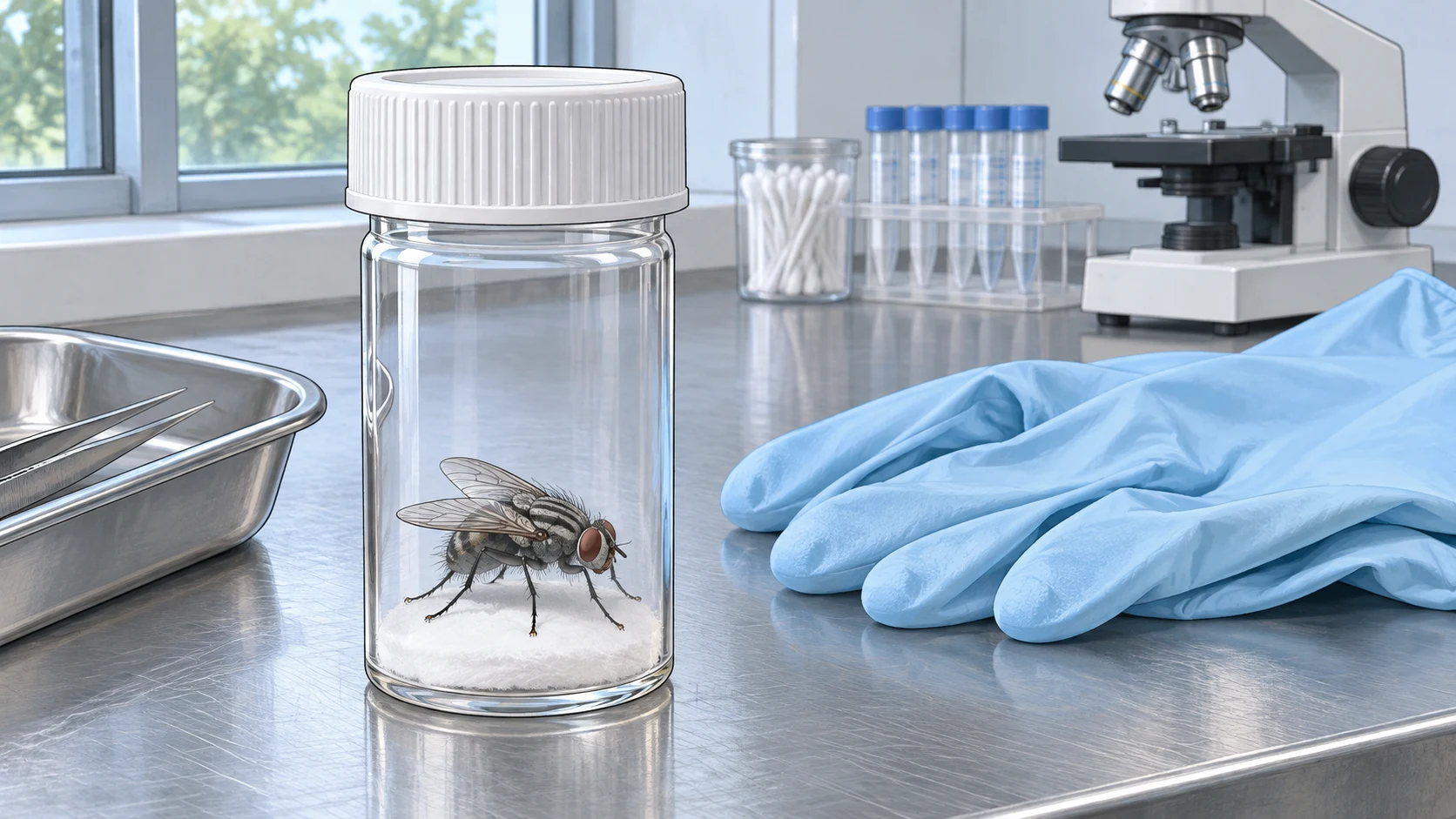
The common house fly (Musca domestica) has been implicated in rare cases of human myiasis. However, it is not one of the principal flies responsible for this condition, and finding maggots in or near the human body does not establish that house flies caused them.
Myiasis occurs when fly larvae infest a living person or animal and feed on tissue, bodily fluids or ingested material for at least part of their development. Some fly species are specialized parasites, while others normally develop in decaying organic matter and become involved only under unusual circumstances. House flies belong to the second group. Medical literature includes reports involving their larvae, but those cases require careful interpretation. Establishing that Musca domestica was responsible depends on identifying the larvae and determining whether an actual infestation occurred.
Can the Common House Fly Really Cause Myiasis?
The common house fly is classified among flies capable of facultative myiasis. This means its larvae normally develop outside a living host but may occasionally become associated with living tissue or other suitable material in exceptional circumstances.
The distinction is important because the house fly is not a specialized human parasite. Its normal reproductive behavior does not depend on depositing eggs in human skin, and its larvae do not ordinarily develop inside people.
Nevertheless, the species has appeared in documented human cases. A major medical review of myiasis and the flies responsible identifies Musca domestica among species reported in intestinal, wound and body-cavity myiasis.
These reports establish that house fly involvement is possible. They do not establish that it is frequent, that ordinary exposure to house flies commonly causes myiasis, or that every case attributed to a house fly was confirmed with the same level of evidence.
A house fly entering a room, landing on someone or touching intact skin is not itself a myiasis event.
Why House Fly Myiasis Is Unusual
House fly larvae normally feed and develop in moist, decomposing organic material. They are not adapted to invade healthy human tissue in the way certain obligately parasitic fly larvae are.
Myiasis-causing flies differ considerably in their relationship with hosts. Some species require a living host for larval development. Others use a host only when particular conditions make it possible.
House flies are generally considered facultative or accidental participants rather than obligate parasites.
This helps explain why their involvement in human myiasis is exceptional. A house fly may encounter exposed biological material, but contact alone does not mean its eggs will hatch, its larvae will survive or an infestation will become established.
Veterinary references also include Musca domestica among flies capable of facultative myiasis in animals. Such classifications describe biological capability, not the likelihood of disease following ordinary household encounters.
What Types of Myiasis Have Been Reported With House Flies?
Published literature has associated Musca domestica with several forms of myiasis. The strength and interpretation of the evidence vary, particularly where larvae may have entered the body accidentally or contaminated a specimen after collection.
Intestinal Myiasis
Intestinal myiasis reports involving house flies generally concern accidental ingestion of eggs or larvae, followed by their presence in the gastrointestinal tract or passage in stool.
A published report described two cases attributed to Musca domestica. The authors noted that intestinal myiasis is usually accidental and that larvae may pass through the digestive system without producing symptoms, although symptoms have been reported.
An important limitation is that passing larvae through the intestine does not necessarily mean they were growing or reproducing there.
Medical literature distinguishes actual infestation from spurious passage, in which ingested larvae pass through the digestive tract without establishing themselves. Some publications use the term pseudomyiasis for such accidental occurrences.
There is also the possibility of contamination after a stool sample has been passed. If flies gain access to an exposed sample, larvae found later may not have originated inside the patient.
For these reasons, an isolated observation of larvae in stool cannot reliably establish intestinal house fly myiasis.
The separate article on accidentally eating house fly eggs or maggots addresses the ingestion event itself rather than the medical classification of myiasis.
Wound Myiasis
House flies have also been implicated in unusual cases involving wounds.
One published case involved larvae from three fly species recovered from scalp lesions. Laboratory rearing produced 153 adult flies, including a single Musca domestica, alongside substantially larger numbers of two other species.
The documented mixed-species myiasis case provides evidence that house flies can participate in a human infestation. However, it would be misleading to describe the case as a typical house fly infestation or imply that the house fly was solely responsible.
Mixed-species cases demonstrate another identification challenge: different fly species can occupy the same affected area.
A clinician cannot determine which species are involved simply by seeing larvae in a wound. Laboratory examination may be necessary, and the presence of one species does not exclude others.
Other Reported Body-Cavity Involvement
Medical reviews also mention uncommon reports involving house fly larvae in body cavities or the urogenital system.
These reports require particular caution because some involve accidental contamination rather than established infestation. The location where larvae were discovered does not always establish where they developed.
A review of laboratory identification and misleading parasite findings describes how contamination of urine and stool specimens can lead to apparent myiasis. It also notes that house flies and lesser house flies have appeared in reports involving urogenital specimens.
Such findings should not be interpreted as proof that house flies routinely colonize human organs.
How Does House Fly Myiasis Differ From Myiasis Caused by Other Flies?
The word myiasis covers conditions involving different species with very different biological capabilities.
Some fly larvae are obligate parasites that require a living host. Others develop primarily in decomposing material and become involved with living hosts only opportunistically.
| Fly or group | Relationship with myiasis | Important distinction |
|---|---|---|
| Common house fly (Musca domestica) | Rarely reported in facultative or accidental cases | Not a specialized human parasite |
| Human bot fly (Dermatobia hominis) | Obligate parasitic development | Larvae develop beneath the skin |
| New World screwworm (Cochliomyia hominivorax) | Obligate parasitic development | Larvae can invade living tissue and cause extensive injury |
| Certain blow flies | Some species cause facultative wound myiasis | Species and wound conditions determine their involvement |
| Certain flesh flies | Some species are associated with myiasis | Not every flesh fly species has the same medical significance |
The differences are documented in clinical identification guidance for myiasis-causing flies.
It is therefore inaccurate to treat every maggot found in a human wound as a house fly larva or to apply the behavior of screwworms and bot flies to ordinary house flies.
Adult appearance can also be misleading. House flies and blow flies are different groups, and their larvae cannot be identified reliably from the casual description of a small white maggot.
Why Confirming the Fly Species Matters
A report of myiasis attributed to Musca domestica is only as reliable as the evidence identifying the insect.
Many fly larvae are pale, legless and superficially similar. Their general shape is not enough to distinguish the common house fly from medically important blow flies, flesh flies or other species.
Specialists may examine the larvae’s posterior spiracles, anterior spiracles, mouth hooks, internal skeletal structures and surface features. These characteristics can help narrow the identification to a genus or species.
In some investigations, larvae are reared to adulthood, allowing additional identification features to be examined. Molecular methods may also assist where suitable specimens and reference information are available.
The laboratory approach to identifying myiasis larvae emphasizes anatomical structures that are not reliably visible in ordinary photographs.
The distinction between house fly maggots and other fly larvae is particularly important when someone is trying to interpret a medical report.
A photograph showing maggots in a wound does not establish that they belong to Musca domestica. Even an adult house fly observed nearby does not prove that its larvae are responsible.
Why Some Reported Cases Are Difficult to Interpret
Not every published account involving larvae found in a person provides equally strong evidence of established myiasis.
Several questions affect interpretation: Were larvae collected directly from the affected tissue? Were they alive when recovered? Was the species confirmed by a specialist? Could contamination have occurred after the specimen was collected? Did the clinical findings support an infestation rather than incidental passage?
These questions are especially relevant to intestinal and urinary reports.
A larva discovered in stool might have been swallowed accidentally, passed through the digestive tract or entered the sample after it was produced. Those explanations have different medical implications, even if the insect species is correctly identified.
Likewise, larvae found in a wound may include more than one species. A mixed infestation should not automatically be attributed to whichever fly is most familiar to the observer.
A case report can establish that an unusual event occurred, but it cannot by itself determine how frequently that event happens across the population.
This is why isolated case reports should not be converted into claims that ordinary house flies regularly invade human tissue.
Does Finding House Fly Eggs on Skin Mean Myiasis Will Develop?
No. Finding suspected fly eggs on skin does not establish that larvae will hatch or develop in the body.
The common house fly normally deposits eggs in suitable organic material, not intact human skin. Even if an adult fly has contacted a person, that contact does not establish that eggs were deposited.
There is a further identification problem: tiny pale particles on skin may not be insect eggs at all. Even confirmed fly eggs cannot necessarily be assigned to the common house fly by appearance alone.
The question of whether house flies lay eggs on human skin concerns the insect’s egg-laying behavior. Myiasis requires additional evidence of larval involvement with a living host.
Someone who notices a fly resting on their skin should not assume that an infestation has begun.
When Does Suspected Myiasis Require Medical Evaluation?
Suspected myiasis should be assessed by a healthcare professional, particularly when larvae are observed in a wound, near sensitive body structures or in a specimen associated with persistent symptoms.
Medical evaluation is necessary because the responsible organism, the affected location and the extent of tissue involvement cannot be established from a general description.
Some forms of myiasis require prompt treatment, especially when living tissue may be affected. Delaying assessment while attempting to identify larvae online can allow an underlying wound or other medical problem to worsen.
The clinical overview of myiasis identifies open or untreated wounds as an important risk factor and explains that different fly species can produce different forms of infestation.
If larvae are observed in a wound, do not apply household insecticides, solvents or other pest-control chemicals to the affected tissue. Do not attempt invasive removal or assume that a home remedy will eliminate every larva.
A clinician can determine whether removal, wound care, laboratory identification or additional treatment is necessary.
When larvae are discovered in stool or another specimen, medical evaluation may also help distinguish actual infection from accidental passage or contamination.
What Information Helps a Healthcare Professional Evaluate a Suspected Case?
A clear account of what was observed can be useful, particularly when the suspected fly species has not been confirmed.
Relevant information includes the location where larvae were discovered, whether they were collected directly from the body or from a container, when they were first noticed and whether an adult insect was actually observed.
Recent travel and exposure history may also matter because the distribution of medically important fly species differs geographically.
If a specimen is available, ask the healthcare professional or laboratory how it should be collected and preserved. Incorrect storage or contamination can interfere with identification.
Do not assume that a specimen should be placed in alcohol, frozen or kept alive without instructions. The appropriate handling method depends on the laboratory examination planned.
The appearance of the larvae alone is not enough to make a medical diagnosis, and a home identification attempt should not delay care.
Does an Adult House Fly Pose the Same Myiasis Risk as a Maggot?
No. Myiasis involves fly larvae, not adult flies living inside human tissue.
Adult house flies may contact people, enter buildings and visit exposed material, but these ordinary activities are not themselves myiasis.
The common house fly also lacks the piercing mouthparts needed to bite human skin. Its inability to bite is a separate biological characteristic from the exceptional reports involving its larvae.
The explanation of why house flies do not bite humans helps distinguish ordinary adult contact from the larval involvement required for myiasis.
Accidentally swallowing an adult house fly is also not equivalent to developing myiasis. The usual effects of swallowing an adult house fly concern passage through the digestive tract and possible immediate complications, not an established larval infestation.
These distinctions prevent ordinary encounters with adult flies from being mistaken for evidence of a rare medical condition.
Common Questions About House Flies and Myiasis
Are house flies a common cause of human myiasis?
No. The common house fly has been implicated in rare reports, but it is not among the principal specialized parasites responsible for human myiasis. Some reported cases involve accidental larval passage or circumstances that require careful interpretation.
Can house fly larvae develop in a human wound?
Exceptional reports have associated Musca domestica with wound myiasis, including a documented mixed-species infestation. This does not mean house fly larvae normally develop in human wounds or that every maggot found in a wound belongs to this species.
Can house flies cause intestinal myiasis?
There are published reports attributed to Musca domestica. However, accidental ingestion and passage of larvae must be distinguished from an established intestinal infestation. Finding larvae in stool does not establish that they grew inside the body.
Can a doctor identify myiasis from a photograph of maggots?
A photograph may support an initial assessment, but reliable species identification often requires examination of the actual larvae. Medical diagnosis also depends on the circumstances in which they were found and the person’s clinical condition.
House Fly Myiasis Is Possible but Exceptional
The common house fly has been implicated in rare human myiasis reports, including intestinal and wound cases. Its larvae normally develop in decaying organic material, and the species is not a specialized human parasite.
The evidence requires careful interpretation. Some reports involve accidental passage of larvae, while others document involvement in wounds or mixed-species infestations. Identifying the fly species and establishing that a genuine infestation occurred are separate requirements.
Finding maggots does not automatically mean house flies caused them. Suspected myiasis requires medical evaluation rather than assumptions based on an adult fly seen nearby or the appearance of larvae in a photograph.
One thought on “Can House Flies Cause Myiasis?”