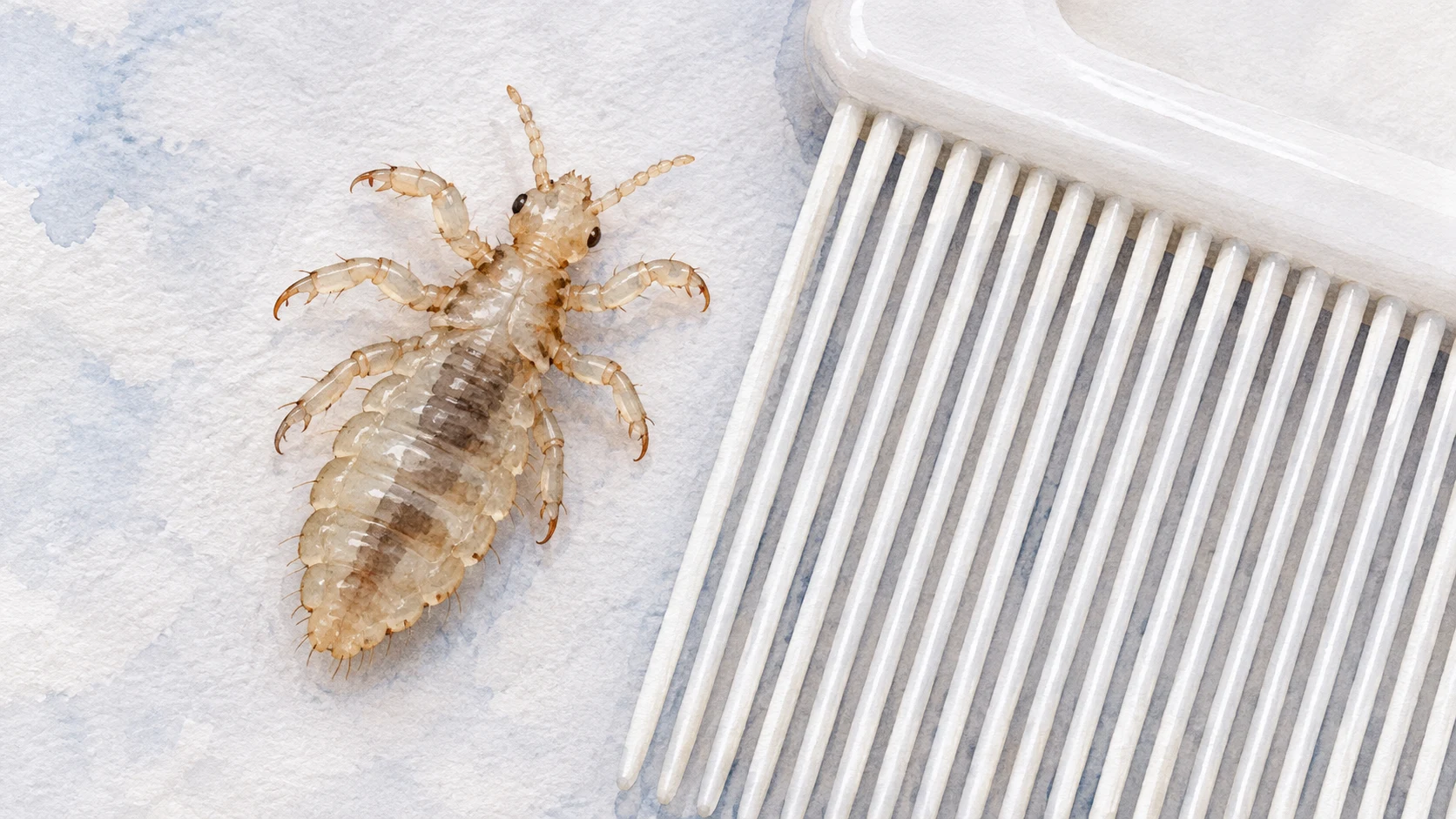
Adult head lice are approximately 2 to 3 millimeters long, about the size of a sesame seed. Young head lice, called nymphs, are considerably smaller. A newly hatched nymph is roughly the size of a pinhead, around 1 to 1.5 millimeters long. Both stages are small enough to be overlooked in human hair, although they can be seen without a microscope.
These measurements describe the insects themselves, not the amount of space they occupy when moving through hair. A louse that is clearly visible on a white surface may be much harder to notice against the scalp. The difference between its actual size and its apparent size helps explain why people sometimes underestimate how small head lice really are.
How Big Is an Adult Head Louse?
A fully grown head louse generally measures 2 to 3 millimeters from the front of its head to the end of its abdomen. That is approximately 0.08 to 0.12 inches, making it shorter than one-eighth of an inch in most cases.
The commonly cited adult head lice measurements are estimates rather than an exact size shared by every individual. Some entomological references describe adults reaching approximately 3.5 millimeters, reflecting natural variation and differences in the specimens being measured.
A length of 3 millimeters may sound extremely small, but it is large enough for an insect to be visible without special equipment. The difficulty is recognizing something so small while it is surrounded by dozens of overlapping hairs.
Adult lice are also not all identical in size. Females are generally larger than males, although the difference is usually too subtle to judge reliably without magnification. The physical appearance of adult head lice provides additional context for recognizing an insect at this scale without relying on length alone.
Is an Adult Head Louse Really the Size of a Sesame Seed?
Yes. A sesame seed is one of the most useful familiar objects for understanding adult head louse size. Many sesame seeds measure approximately 3 millimeters in length, putting them in the same general size range as a mature louse.
The comparison refers to length rather than an exact match in overall dimensions. Sesame seeds vary in size, and an insect does not occupy precisely the same amount of space as a seed of equal length.
A sesame seed placed on a fingertip provides a reasonable impression of how much space an adult louse occupies. It also demonstrates why an insect that seems prominent in an enlarged photograph can look surprisingly insignificant at its actual size.
How Big Are Baby Head Lice?
Baby head lice, or nymphs, are smaller than adults. A newly hatched nymph is approximately 1 to 1.5 millimeters long, although its size increases as it develops. The familiar comparison is the head of a small pin.
The size of a young head louse is often described as approximately 1.5 millimeters. This figure is useful for understanding its scale, but it should not be interpreted as the precise measurement of every nymph.
Nymphs grow before reaching adulthood, so the term baby head louse covers insects of different sizes. A recently hatched nymph can be much smaller than one approaching maturity. Consequently, finding a louse smaller than 2 millimeters does not automatically mean it has only just hatched.
A young head louse’s appearance as it develops changes along with its size. For someone examining hair, the important measurement-related point is that young lice can be considerably less conspicuous than adults.
Are All Nymphs the Same Size?
No. Head lice pass through three nymphal stages before becoming adults. They grow as they progress through these stages, so their measurements are not constant throughout development.
A very young nymph may be close to 1 millimeter long, while an older nymph can approach adult size. There is no single measurement that accurately describes every young louse.
The three successive nymphal stages explain why two immature lice found on the same head can differ noticeably in length. One may be barely visible, while another may already be large enough to resemble a small adult.
This size variation also means that a photograph labeled simply “nymph” may not represent the smallest lice someone could encounter. The developmental stage matters when interpreting the scale of an image.
Head Lice Size Compared With Familiar Objects
Millimeter measurements are easier to understand when compared with objects people already recognize. A sesame seed gives a useful approximation for an adult, while a small pinhead provides a reference for a young nymph.
The following comparisons are approximate. Familiar objects vary in size, and some are more useful for understanding length than others.
| Object or reference | Approximate size | Comparison with head lice |
|---|---|---|
| Newly hatched head louse | About 1–1.5 mm | Roughly the size of a small pinhead |
| Adult head louse | About 2–3 mm | Similar in length to a sesame seed |
| Sesame seed | Often around 3 mm long | Useful adult-size reference |
| Typical human scalp hair | Often around 0.05–0.10 mm in diameter | Much thinner than the length of a louse |
| 1 millimeter mark on a ruler | Exactly 1 mm | Useful for visualizing the smallest nymphs |
These comparisons should not be used as exact identification tests. A sesame seed and a louse can have similar lengths without looking identical, while a pinhead’s diameter varies depending on the type of pin.
A ruler with millimeter markings provides a more consistent reference. Looking at the distance between two adjacent millimeter marks makes it easier to appreciate how little space a newly hatched louse occupies.
How Big Are Head Lice Compared With a Strand of Hair?
A typical human hair shaft is far thinner than the length of a head louse. Scalp hair commonly measures around 50 to 100 micrometers in diameter, equivalent to approximately 0.05 to 0.10 millimeters, although actual hair thickness varies considerably.
An adult louse measuring 3 millimeters long is therefore about 30 to 60 times as long as the diameter of a hair within that example range. A 1.5-millimeter nymph would be approximately 15 to 30 times as long.
These figures compare two different dimensions: the insect’s length and the hair’s thickness. They do not mean that the insect is 30 to 60 times wider than a strand of hair.
The comparison helps explain why a head louse can be visible as an individual insect even though the hair shafts around it appear extremely fine. Its body extends across a much greater distance than the diameter of a single hair, but surrounding strands can still obstruct the view.
Hair thickness also varies among individuals and even among hairs on the same head. There is no universal hair diameter that produces one exact lice-to-hair size ratio.
Can You See Head Lice Without a Magnifying Glass?
Yes. Both adult head lice and nymphs can be visible to the naked eye. Adults are generally easier to notice because they are larger, while newly hatched nymphs may be difficult to distinguish from the surrounding hair and scalp.
The difficulty of finding living head lice is not caused by size alone. Lice crawl through hair, move relatively quickly, and tend to avoid light. Their position and movement can make a small insect disappear from view before its size becomes obvious.
An adult louse on a light-colored surface may be easy to notice, while the same insect can be much harder to find on a person’s head. Thick or closely overlapping hair can conceal it, and limited lighting reduces the contrast between the insect and its surroundings.
Young nymphs present an even greater challenge because they occupy less space. A nymph around 1 millimeter long may appear as little more than a moving point when seen without magnification.
The distinction between an insect being theoretically visible and being easy to locate is important. The limits of seeing head lice with the naked eye depend on lighting, contrast, movement, and the observer’s vision, not merely the insect’s measured length.
Why Do Head Lice Look So Large in Photographs?
Close-up photographs can make head lice appear many times larger than their actual dimensions. A louse that measures only 3 millimeters may occupy most of a computer screen or phone display when the original photograph has been enlarged.
The apparent size of an insect in a photograph depends on magnification, cropping, camera distance, and display size. A photograph showing a louse beside a hair shaft provides some visual context, but it still may not reveal the insect’s actual length unless a calibrated scale is included.
This is particularly noticeable in microscope photographs. Details that are almost impossible to see with the naked eye can become prominent, creating the impression of a much larger insect.
A photograph without a ruler or scale bar cannot establish the insect’s exact size. Even two images displayed at identical dimensions may represent specimens photographed at very different magnifications.
For a realistic size comparison, images that include a millimeter scale are more useful than isolated close-ups. They allow the viewer to distinguish the actual dimensions of the insect from the enlargement used to photograph it.
Does the Size of a Head Louse Tell You How Old It Is?
Size can provide a broad indication of developmental stage, but it cannot reliably establish the exact age of an individual head louse.
An adult generally falls within the larger size range, while a newly hatched nymph is much smaller. Between those stages, the insect grows through successive molts. Individuals at different points in development can therefore overlap in size.
A louse measuring approximately 2 millimeters could be a small adult or an older nymph. Its length alone does not establish which stage it has reached.
Adult size also varies naturally, so finding a relatively small adult does not necessarily mean it recently matured. Likewise, a larger specimen is not automatically older than every smaller one.
The head lice life cycle explains how the insects progress from immature stages to adulthood. Length is one piece of information about development, not a dependable method for calculating an individual louse’s age.
Does Finding a Very Small Louse Mean an Infestation Is New?
Not necessarily. A small louse may be a nymph, but its presence does not reveal when the infestation began.
An established infestation can contain lice at different developmental stages. Adults and younger lice may be present at the same time, so finding a tiny specimen does not mean the insects only recently arrived on the head.
Conversely, a newly introduced adult louse may already be fully grown. Its larger size would not prove that it had been living on that person’s scalp for a long period.
The evidence of an active head lice infestation depends on finding living lice rather than estimating how long they have been present from their dimensions. Size is useful for understanding what may be visible, but it is not a reliable infestation clock.
How Small Can Head Lice Be Before They Become Difficult to Notice?
A newly hatched nymph, at roughly 1 to 1.5 millimeters long, is near the smallest size someone would encounter among living, crawling head lice. Such an insect can be visible without magnification, but detecting it among human hair is often difficult.
There is no universal size threshold below which a louse becomes invisible. Visibility depends on eyesight, lighting, contrast, distance, and whether the insect is stationary or moving.
A small nymph against a contrasting background may be easier to see than a larger adult concealed among hair. Similarly, an enlarged photograph can make the smallest developmental stage appear unmistakable even though the actual insect would be challenging to notice.
When checking a child, the practical examination of scalp hair needs to account for the possibility of both adult-sized lice and much smaller nymphs. A quick glance that reveals no sesame-seed-sized insects cannot rule out their presence.
The most useful size expectation is therefore a range rather than a single familiar object. Living head lice may be as small as a pinhead or approximately as long as a sesame seed, depending on their developmental stage.
Common Questions About Head Lice Size
How many millimeters long is a head louse?
An adult head louse is usually around 2 to 3 millimeters long. Some references report adults reaching approximately 3.5 millimeters. Young nymphs are smaller, with newly hatched individuals measuring roughly 1 to 1.5 millimeters.
Are head lice smaller than sesame seeds?
Young head lice are generally smaller than sesame seeds. Adults are approximately the same length as a sesame seed, although both seeds and individual lice vary in size.
Can a head louse be only 1 millimeter long?
Yes. A newly hatched nymph can be approximately 1 millimeter long. Lice become larger as they develop, so a specimen of this size is much smaller than a typical adult.
Are adult head lice bigger than baby head lice?
Yes. Adult head lice are generally larger than nymphs. However, older nymphs can approach adult dimensions, making exact developmental stage difficult to determine from size alone.
Can head lice be too small to see?
Living head lice are not microscopic, but very small nymphs can be difficult to notice without magnification. Their size, movement, and position among the hair can make them easy to overlook.
5 thoughts on “How Big Are Head Lice?”