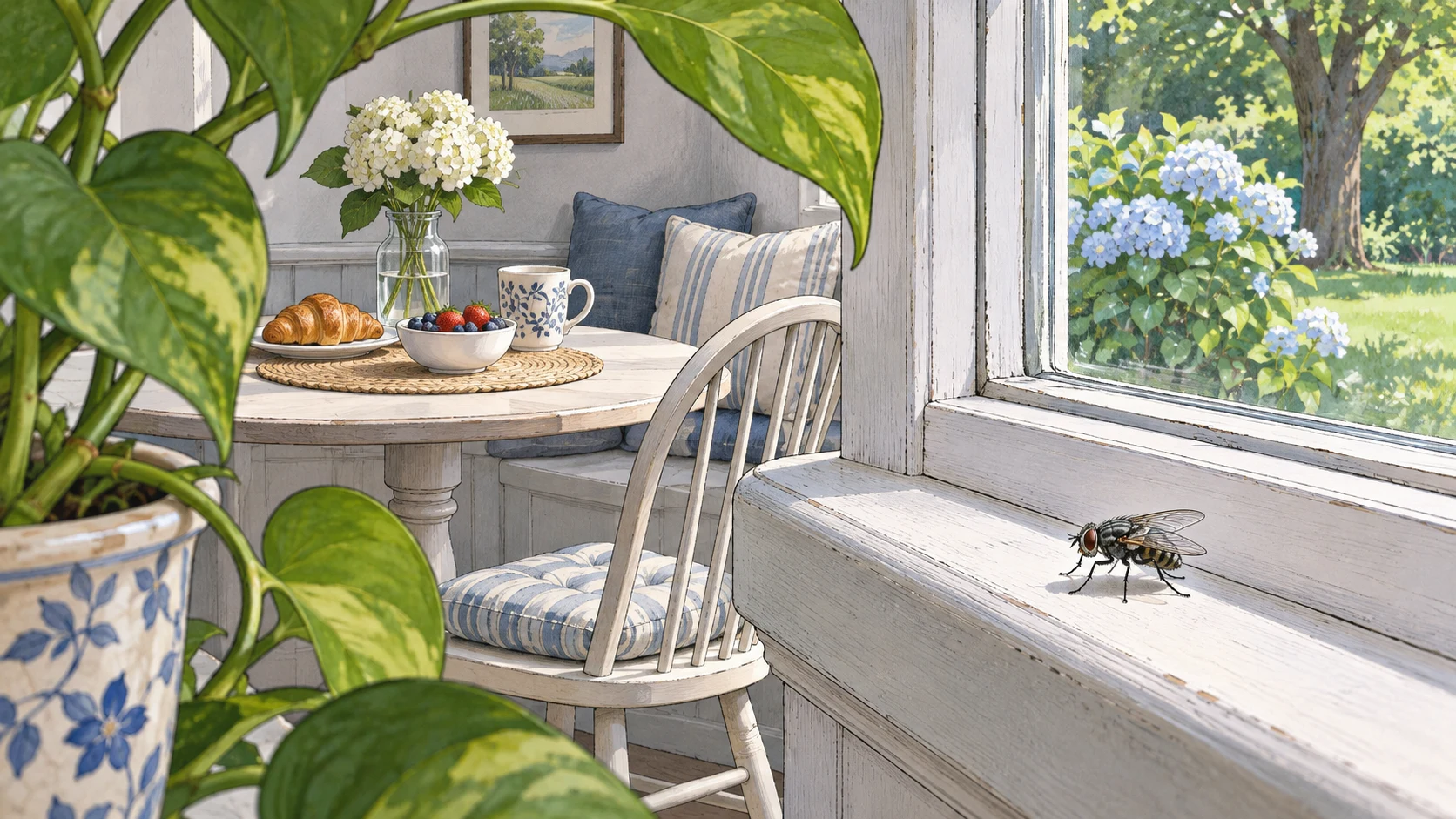
Seeing one house fly every day does not necessarily mean you have an infestation. You may be seeing the same adult that has remained inside your home, or a different fly may be entering through the same opening each day. Both explanations are possible, and repeated sightings alone cannot establish which one is happening.
House flies (Musca domestica) can live for several weeks under favorable conditions. During that time, an adult may remain inside a building, rest in sheltered places, and become visible at different times of the day.
Could It Be the Same House Fly Returning Every Day?
The fly you see today could be the same individual you noticed yesterday. Adult house flies can survive for weeks, giving a single insect plenty of time to remain inside a building and appear repeatedly.
A house fly does not need to be newly emerged to remain active around your home. It can move between resting places, windows, walls, and areas where food is available.
Adult house fly lifespan and survival under different conditions help explain why one insect could remain alive long enough to be noticed on multiple days.
However, ordinary household observations cannot reliably establish an individual fly’s identity. House flies do not have obvious individual markings that homeowners can use to track one insect from day to day.
The fact that a fly disappears after you see it does not establish that it has left the building. It may simply have settled somewhere out of sight.
Why Does the Fly Keep Appearing at the Same Time?
House flies are primarily active during daylight. Their flight activity changes throughout the day in response to environmental conditions, including temperature and light intensity.
A fly may become noticeable when sunlight reaches a particular room or when the surrounding area becomes warmer. It may also be resting somewhere nearby until conditions encourage it to fly again.
Research examining daily flight activity in house flies found that activity varied with time of day, environmental conditions, and the sex of the insects. The observations came from two dairy facilities, so they should not be treated as an exact timetable for flies inside residential homes.
A fly that appears around the same time each morning may simply be following its normal daily activity pattern. The timing does not prove that a new adult is entering the house every morning.
House flies also use resting locations where they remain relatively inactive, particularly as daylight declines. This can make an insect seem to disappear for several hours before becoming visible again.
Why Does One House Fly Keep Appearing Near the Same Window?
Windows provide attractive resting and gathering locations for house flies. Their light and surrounding surfaces can make insects particularly noticeable in these areas.
A fly that repeatedly appears near the same window may be using the area as a resting place or responding to the light coming through the glass.
A window can also become an apparent meeting point for different flies entering through the same nearby opening. Seeing an insect there each day does not establish that it is the same individual.
The reasons house flies gather around windows help explain why these locations can attract repeated attention from homeowners.
Light may also influence how often you notice an insect. A fly resting quietly against a darker wall can be difficult to see, but it becomes obvious when it moves across a bright window.
Could a Different House Fly Be Entering Every Day?
Repeated sightings can result from separate flies entering through the same route.
An exterior door that opens frequently, a damaged window screen, or a poorly fitted opening can provide opportunities for adult flies to enter. A house may receive a new visitor each day without supporting any indoor reproduction.
House flies commonly develop outdoors in manure, garbage, and decaying organic material before entering nearby buildings. Typical house fly entry routes and the role of damaged screens and open windows explain why indoor adults often originate outside.
The same entrance may be used repeatedly because it remains available whenever the door or window is open. You could therefore see a similar-looking adult in the same room every day without encountering the same insect.
An apparently closed home can also have openings around its windows, doors, or other building components. House fly entry into closed houses is relevant when flies keep appearing despite ordinary doors and windows being shut.
Does Seeing One House Fly Every Day Mean There Is an Infestation?
One adult fly appearing each day is not sufficient evidence to establish an infestation.
A single visitor may have entered accidentally, remained inside for several days, or emerged from a nearby source. The number of adults you see provides limited information about the presence of immature insects.
Stronger evidence includes maggots developing in suitable organic material, pupae, or repeated adult emergence associated with a breeding substrate.
Signs of a house fly infestation provide a broader picture of the evidence that separates occasional visitors from ongoing fly development.
There is no universal daily sighting threshold that confirms an infestation. The surrounding evidence matters more than simply counting one adult per day.
A house can have a recurring entry problem without an indoor breeding population. Conversely, a concealed breeding site can produce adults even when the number of visible flies remains relatively small.
Could the House Fly Be Breeding Somewhere Inside?
Indoor breeding is possible when a female house fly finds suitable moist, decomposing organic material in which to lay eggs.
Wet garbage and neglected organic waste can provide conditions for larval development. Adults emerging from such material may then appear in living spaces even though the original breeding site is elsewhere in the building.
However, house flies generally develop outdoors, and indoor reproduction is relatively uncommon in ordinary homes.
The conditions that permit house flies to breed inside a house help explain why one adult sighting should not automatically be interpreted as evidence of indoor reproduction.
Maggots or pupae associated with suitable indoor waste would make local development a more plausible explanation. Without those signs, repeated adult entry remains a reasonable possibility.
Could It Actually Be a Cluster Fly?
A fly that appears around the house repeatedly may not belong to the common house fly species.
Cluster flies are frequently mistaken for house flies. They are generally darker, somewhat larger, and have golden hairs on their bodies. Their flight is also noticeably slower.
Unlike house flies, cluster flies develop through larvae that parasitize earthworms. Adults can shelter inside buildings and become active again when indoor temperatures rise.
The house fly versus cluster fly comparison helps separate these two insects when an apparently persistent visitor behaves unusually.
A particularly sluggish fly repeatedly appearing around a window deserves a closer look. It may be an insect emerging from a sheltered resting location rather than a house fly entering from outside each day.
Metallic blue or green flies suggest another possibility, since blow flies have different breeding habits from ordinary house flies.
How to Monitor a House Fly That Appears Every Day
A short record of sightings can help distinguish a recurring entry pattern from an insect that remains inside the building.
For several days, record the time and location where the fly appears. Note whether an exterior door was recently open, whether the fly is usually near a window, and whether its movement is fast or sluggish.
A photograph can help you compare the insect’s appearance across different sightings. Look for the gray body and four dark thoracic stripes characteristic of an adult house fly.
A useful monitoring record might look like this:
| Observation | What to record |
|---|---|
| Time | Morning, afternoon or evening |
| Location | Window, kitchen, ceiling or another area |
| Recent access | Exterior doors or windows recently opened |
| Behavior | Active flight or slow movement |
| Appearance | Gray house fly, metallic fly or possible cluster fly |
| Other evidence | Maggots, pupae or additional adults |
The purpose is not to prove that you have identified the same individual. It is to recognize whether sightings follow a repeatable pattern.
For example, finding a fly near the same window shortly after the exterior door has been opened repeatedly suggests a possible entry pattern. Finding a sluggish insect in the same part of the house without any apparent outdoor access may justify reconsidering its identity.
When Should You Be More Concerned About a Daily Fly?
An isolated adult appearing each day is generally less concerning than a pattern accompanied by evidence of breeding or increasing activity.
Pay closer attention when you notice maggots, pupal cases, or flies emerging from an inaccessible part of the building. These observations suggest a different problem from an occasional adult entering through a door.
If the same pattern continues and you cannot explain it through ordinary entry, a qualified pest professional can assess the building and determine whether a concealed source needs attention.
One fly per day does not tell you whether it is the same individual, a succession of new visitors, or an adult emerging from a nearby developmental site. A record of its appearance, timing, location, and accompanying evidence provides a much more useful basis for deciding what is happening.