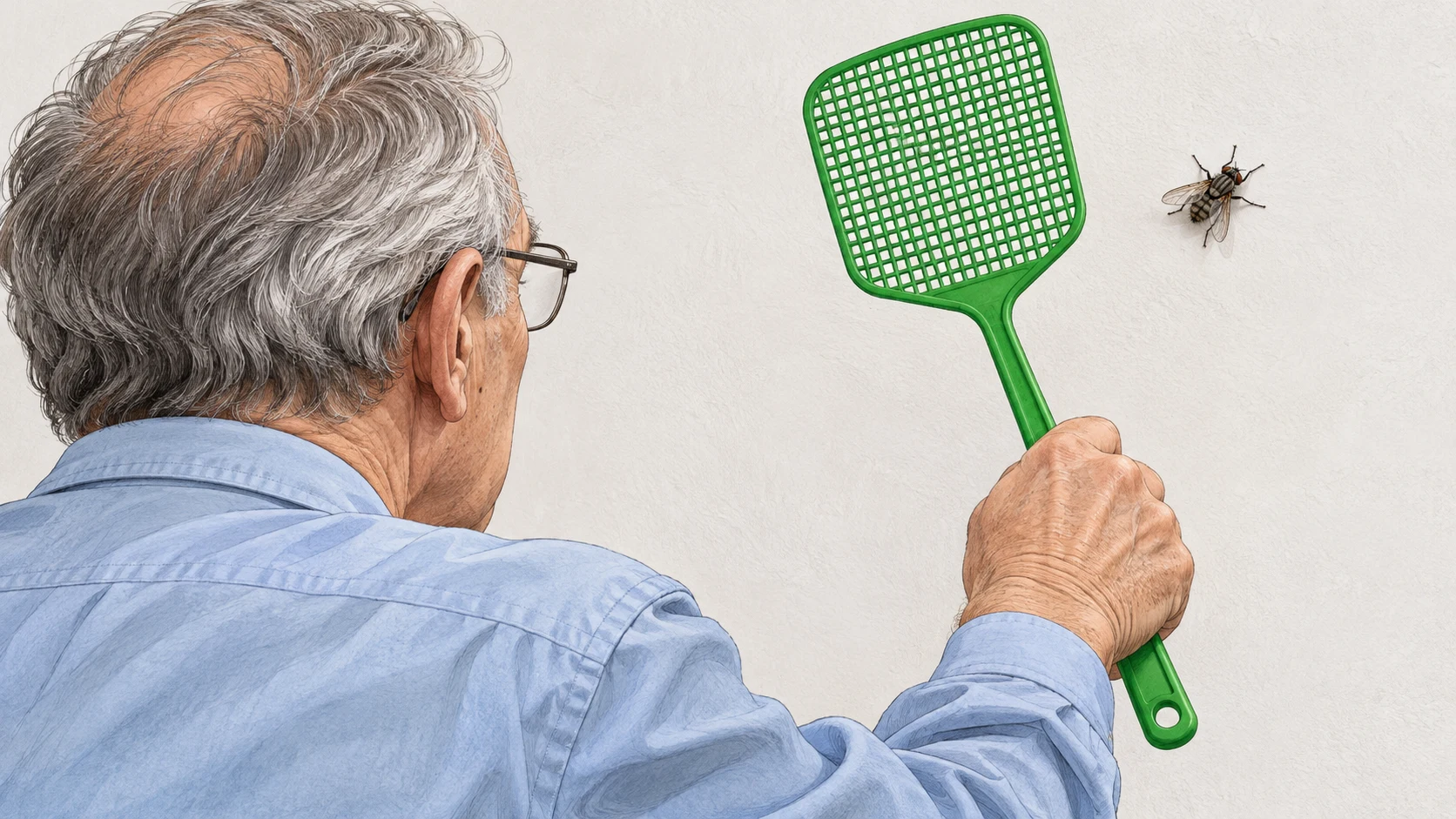
A fly swatter kills a house fly through direct physical impact. The best opportunity is when the insect lands on an accessible, solid surface, allowing you to use a controlled swing without damaging nearby objects. Afterward, remove the dead fly and clean the affected surface.
Swatting works well for one or a few adult flies. It becomes less practical when insects are continually appearing or resting in places that are difficult to reach.
Choose the Right Fly Swatter
A conventional fly swatter usually has a flat, flexible head attached to a handle. The head provides a broad striking surface, while small openings allow air to pass through during a swing.
A lightweight plastic or mesh-headed swatter is suitable for ordinary household use. Check that the head is firmly attached and that its edges are not cracked or sharp. A loose head can detach during a swing, while a damaged one may scratch painted surfaces.
The handle should be long enough to reach an insect on a nearby wall or window without forcing you to stretch. An excessively long handle can be harder to control in a furnished room.
The common house fly (Musca domestica) is generally about 1/4 inch long and gray, with four dark stripes on its upper thorax. These identifying markings and other adult characteristics help you distinguish a house fly from insects that may require a different approach.
A cluster fly, for example, is generally larger and slower-moving. Checking the physical differences between house flies and cluster flies can prevent you from confusing a seasonal look-alike with an ordinary house fly.
How to Swat a House Fly Without Damaging the Surroundings
The surface where the fly lands matters as much as the swatter itself. A clear section of wall or an unobstructed window frame makes a better target than a crowded kitchen counter.
Use the following technique:
1. Wait for the fly to land. Watch where it settles and make sure the surrounding area is clear. A stationary target is easier to approach than a fly moving around the room.
2. Hold the swatter securely. Grip the handle firmly enough to control the head without tightening your hand so much that the movement becomes awkward.
3. Position the striking face. Keep the broad face of the swatter directed toward the fly. On a flat wall or window surface, aim to make contact without twisting the head sideways.
4. Use a short, controlled swing. Move the swatter through the target area with enough force to make contact. Avoid an exaggerated arm swing that could hit furniture, breakable objects, or nearby people.
5. Check the result. Look at the landing area before moving the swatter away. A fly that has only been stunned may recover, so confirm that it is dead before clearing the surface.
A flexible head can make contact across a broader area than a narrow, rigid edge. Still, striking forcefully against glass, delicate screens, or painted trim can cause damage. Choose a safer surface when the fly moves somewhere difficult to reach.
Use a Suitable Surface for the Strike
A hard, reasonably flat surface gives the swatter a predictable area of contact. However, the location of the fly should determine whether you attempt a strike at all.
|
Where the fly lands |
Swatting suitability |
|---|---|
|
Flat painted wall |
Good, provided the finish is washable |
|
Window glass |
Suitable with a controlled swing and a clean swatter |
|
Solid wooden surface |
Suitable if the surface is not delicate |
|
Curtains or upholstery |
Poor choice because of staining and possible damage |
|
Food preparation counter |
Avoid swatting directly over food or utensils |
|
Near electronic equipment |
Avoid swinging where the swatter could strike cables or equipment |
We particularly recommend keeping swatting away from food preparation areas. A fly can leave fragments behind when struck, and those particles may reach nearby food or utensils. Guidance on avoiding contamination during indoor fly control specifically cautions against using swatters near food preparation.
For flies resting above your comfortable reach, do not climb onto unstable furniture or swing near ceiling fixtures. A different removal method is safer. Vacuum capture of flies resting on indoor surfaces provides an alternative when a swatter would be difficult to control.
Remove the Dead Fly and Clean the Surface
After a successful strike, pick up the fly using a disposable tissue or paper towel. Avoid handling it directly, particularly when it has been crushed against a surface.
Place the remains in a waste container and wash your hands afterward. If the fly was struck on a washable wall, tabletop, or window frame, clean away any visible residue with an appropriate household cleaner.
The cleaning step deserves particular attention when the fly is crushed. House flies visit contaminated organic material and can carry microorganisms on their bodies. House fly contact with food and food-contact surfaces explains why avoiding contamination matters even when only one adult is present.
Never swat a fly directly over uncovered food and assume removing the dead insect makes the food safe. Discard food that has been contaminated by insect remains, rather than trying to pick visible fragments out of it.
Wash a reusable swatter with soap and water when it becomes dirty. Allow it to dry before storing it, and keep it away from utensils and food-preparation equipment.
Why Swatting Does Not Stop More House Flies From Appearing
A fly swatter deals with the adult insect you strike. It does not reach eggs, maggots, or pupae developing in garbage, manure, and other suitable organic material.
House flies pass through four developmental stages, from egg to larva, pupa, and adult. The house fly’s complete development cycle explains why killing individual adults cannot prevent new flies from emerging from an existing breeding site.
Swatting is therefore most useful for occasional adult flies. When new insects keep appearing, repeated strikes will not resolve the underlying source. It is also a poor substitute for identifying the insects when several different fly species are present.
For a single adult resting on a reachable surface, a conventional fly swatter remains a simple, inexpensive option. Use a controlled strike, choose a surface that can be cleaned, and remove the remains promptly.
| Where the fly lands | Swatting suitability |
|---|---|
| Flat painted wall | Good, provided the finish is washable |
| Window glass | Suitable with a controlled swing and a clean swatter |
| Solid wooden surface | Suitable if the surface is not delicate |
| Curtains or upholstery | Poor choice because of staining and possible damage |
| Food preparation counter | Avoid swatting directly over food or utensils |
| Near electronic equipment | Avoid swinging where the swatter could strike cables or equipment |