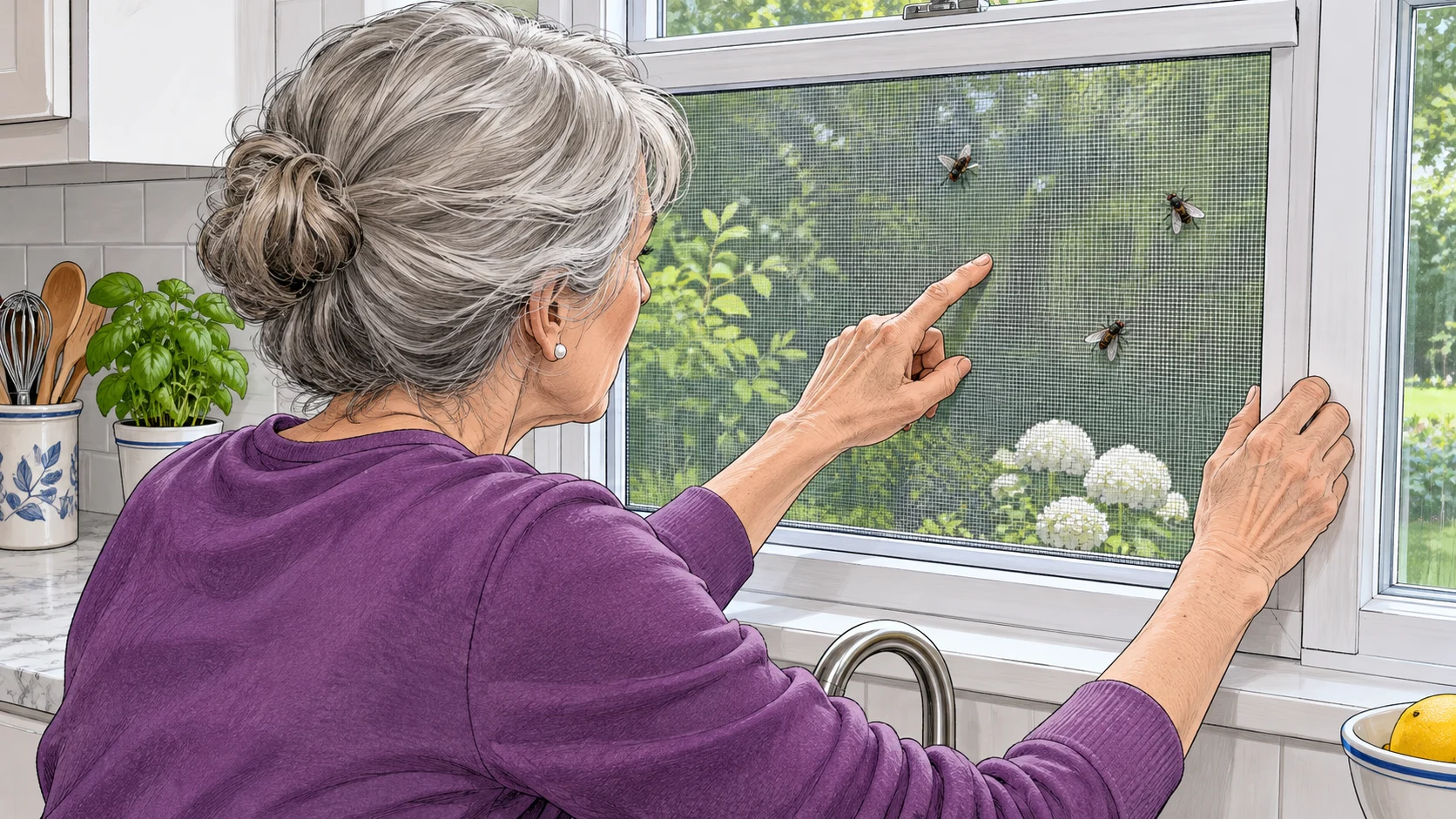
To get rid of house flies, identify the species, remove the moist organic material where larvae develop, close the routes adults use to enter, and use correctly placed traps to catch remaining flies while monitoring whether new adults continue appearing. Spraying alone rarely resolves a persistent problem because the breeding source may remain untouched. House fly control is most effective when you deal with the reason the insects keep appearing. A few adults can be removed quickly, but repeated sightings usually require a closer look at the property and its surroundings.
Start by Confirming That the Flies Are House Flies
Before choosing a control method, establish which insects are actually present. The common house fly (Musca domestica) is generally gray, approximately 1/4 inch long, and has four dark stripes running along its thorax, the upper body section behind the head.
Several other flies can look similar. Little house flies, face flies, blow flies, and flesh flies may also enter homes, but their breeding materials and behavior differ.
The physical features used to identify common house flies provide a useful starting point. Metallic blue or green coloring, unusually small body size, or a different flight pattern may point toward another species.
This matters because the wrong identification can send you looking for the wrong breeding material. For example, a metallic blow fly may indicate decomposing animal remains, while a tiny fruit fly is more likely associated with fermenting food.
Keep a dead specimen or capture an individual in a small container when identification is difficult. A clear photograph can also help, although a specialist may need a physical specimen to confirm the species.
Find the Breeding Material Before Killing More Adults
The repeated appearance of house flies usually deserves an inspection of the places where moist organic material accumulates. Female house flies lay eggs in suitable waste, and the larvae feed in that same material as they develop.
Common breeding sources include:
- Fresh animal manure and accumulated pet waste.
- Wet garbage, leaking refuse bags, and dirty outdoor bins.
- Exposed food scraps and decomposing vegetables.
- Damp grass clippings and accumulated lawn debris.
- Compost containing exposed, wet food waste.
- Animal remains and other decomposing organic material.
The exact material matters because a pile of dry leaves is not equivalent to a wet accumulation of decaying food or manure. Concentrate on material that remains moist and provides food for developing larvae.
House fly egg-laying sites and suitable breeding materials help explain why removing the correct organic material has a greater effect than repeatedly killing adult insects.
Start with the areas where adult activity is greatest, but do not assume the breeding site is directly underneath them. Flies often move toward windows and lights, so they may gather in a room some distance from where they developed. Cornell’s guidance on identifying fly breeding sources explains why both insect identification and the surrounding conditions matter when tracing an infestation.
Remove sources that can sustain new generations
Once you find suitable breeding material, remove it rather than treating only the adults around it. Put infested waste into securely tied bags and dispose of it through an appropriate waste service. Clean organic residue from the affected container or surface.
Garbage containers deserve particular attention because liquid and food scraps can collect beneath liners and around lids. Cleaning house fly breeding material from trash cans addresses the residue that may remain after the garbage bag has been removed.
Pet areas require regular collection of droppings. Keep collected waste sealed until disposal, especially when it is damp or accumulating in a covered container. Pet-waste storage and fly attraction explain why leaving accessible feces around a property can maintain fly activity.
The National Pesticide Information Center’s house fly breeding-source guidance also identifies garbage, manure, compost, and animal feces as materials that can support fly development.
Stop More Flies From Entering the House
Even after removing the breeding material, adult flies from surrounding properties can continue entering the building. House flies commonly use open doors, damaged screens, and poorly fitted windows to get inside.
Check the condition of:
- Window and door screens, including their edges and frames.
- Weatherstripping around frequently used entrances.
- Gaps beneath exterior doors.
- Openings around vents and other exterior penetrations.
Repair damaged screens and make sure doors close properly. Keep exterior doors closed when they are not being used, particularly when outdoor fly activity is high.
How house flies enter apparently closed houses explains why apparently small openings can still provide access. Proper screening and exclusion reduce the number of new adults reaching indoor spaces.
House fly exclusion and sanitation measures are part of the same integrated approach. Screening alone cannot solve a problem when flies are breeding in accessible organic waste nearby.
Use Traps to Reduce the Adults That Remain
Once breeding material and entry routes have been addressed, trapping can help reduce the remaining adult population. Traps also provide useful information about whether fly activity is declining.
Different traps serve different purposes. Sticky ribbons capture flies that land on their adhesive surfaces and can help with a small number of adults in an enclosed area. Indoor ultraviolet light traps can provide supplemental control when properly positioned, while baited outdoor traps are designed to attract flies away from occupied spaces.
Trap selection should match the species and location. A fruit-fly vinegar trap, for example, is not a substitute for a house-fly trap. Likewise, a strongly scented outdoor bait should not be placed beside a doorway or patio because its attractant may draw flies toward people and buildings.
Comparing indoor house fly trap types helps explain the differences in their capture methods and limitations.
Sticky traps and light traps are supplemental measures. They cannot eliminate an active breeding site or prevent flies from entering through an open door. House fly trap performance and placement also depend on the type of trap and the number of flies present.
A fly swatter is adequate for an occasional adult. Avoid swatting flies over exposed food or food-preparation surfaces, since insect fragments can contaminate the area. Electric bug zappers should also be kept away from food-preparation areas because they can scatter insect fragments.
The broader guidance on selecting and positioning fly traps explains why indoor and outdoor devices have different placement requirements.
Monitor Whether the Number of Flies Is Actually Declining
After removing breeding material and improving exclusion, keep track of the adults you continue seeing. A reduction in sightings is encouraging, but occasional flies may still enter from outdoors.
Use the same observation points over successive checks. Note where you see adults, whether larvae appear in previously affected material, and whether a trap continues catching similar numbers.
A simple record can look like this:
|
Observation |
What it may indicate |
|---|---|
|
Fewer adults and declining trap catches |
Fly activity may be decreasing |
|
Repeated larvae in waste |
A breeding source remains accessible |
|
Adults gathering near doors and windows |
Outdoor entry may still be occurring |
|
Flies returning around one waste location |
Inspect that source for remaining organic material |
|
Metallic or unusually small flies |
Recheck the species identification |
Trap catches are not a direct measurement of the entire fly population. Changes in trap location, lighting, airflow, and competing attractants can affect the numbers caught. Keep the monitoring arrangement consistent before drawing conclusions.
House fly monitoring and follow-up checks provide a way to judge whether adult activity is declining or whether another inspection is needed.
Purdue’s house fly control recommendations emphasize sanitation and exclusion because insecticides alone cannot be expected to rid a property of flies. House flies can complete a generation in as little as 7 to 10 days under suitable conditions, so continuing larval development can quickly undermine adult trapping.
Avoid Making Sprays the Main Solution
Aerosol sprays and foggers can kill exposed adult flies, but they do not remove the organic material where larvae develop. New adults can continue emerging while breeding sources remain accessible.
Indoor house fly control and the limitations of insecticides explain why identifying the species and eliminating its breeding site are more effective than relying on chemical applications alone.
We would prioritize source removal, exclusion, and targeted trapping before considering pesticides. In most residential situations, these measures provide the main control without requiring routine chemical treatment.
When a pesticide is considered, choose one specifically labeled for the intended fly and indoor application site. Follow its instructions for application, ventilation, protective equipment, children, pets, and reentry. Never spray exposed food, dishes, or food-preparation surfaces unless the label expressly permits that use.
Persistent activity may require professional help, particularly when larvae repeatedly appear or a suspected breeding source is hidden inside an inaccessible part of the property. Correct species identification should come before selecting a treatment.
How to Tell Whether Your House Fly Problem Is Under Control
A successful control program should produce fewer adult sightings and fewer flies appearing on consistently positioned monitoring traps. You may still encounter an occasional adult that enters from outdoors, but repeated increases or newly appearing larvae suggest that something remains unresolved.
Keep checking the original waste locations after cleanup. Also watch for adults gathering around entrances, which may indicate that outdoor populations are still entering.
The strongest results come from addressing the source and entry routes together. Trapping then handles the remaining adults, while consistent monitoring shows whether the problem is actually declining.
One thought on “How to Get Rid of House Flies”