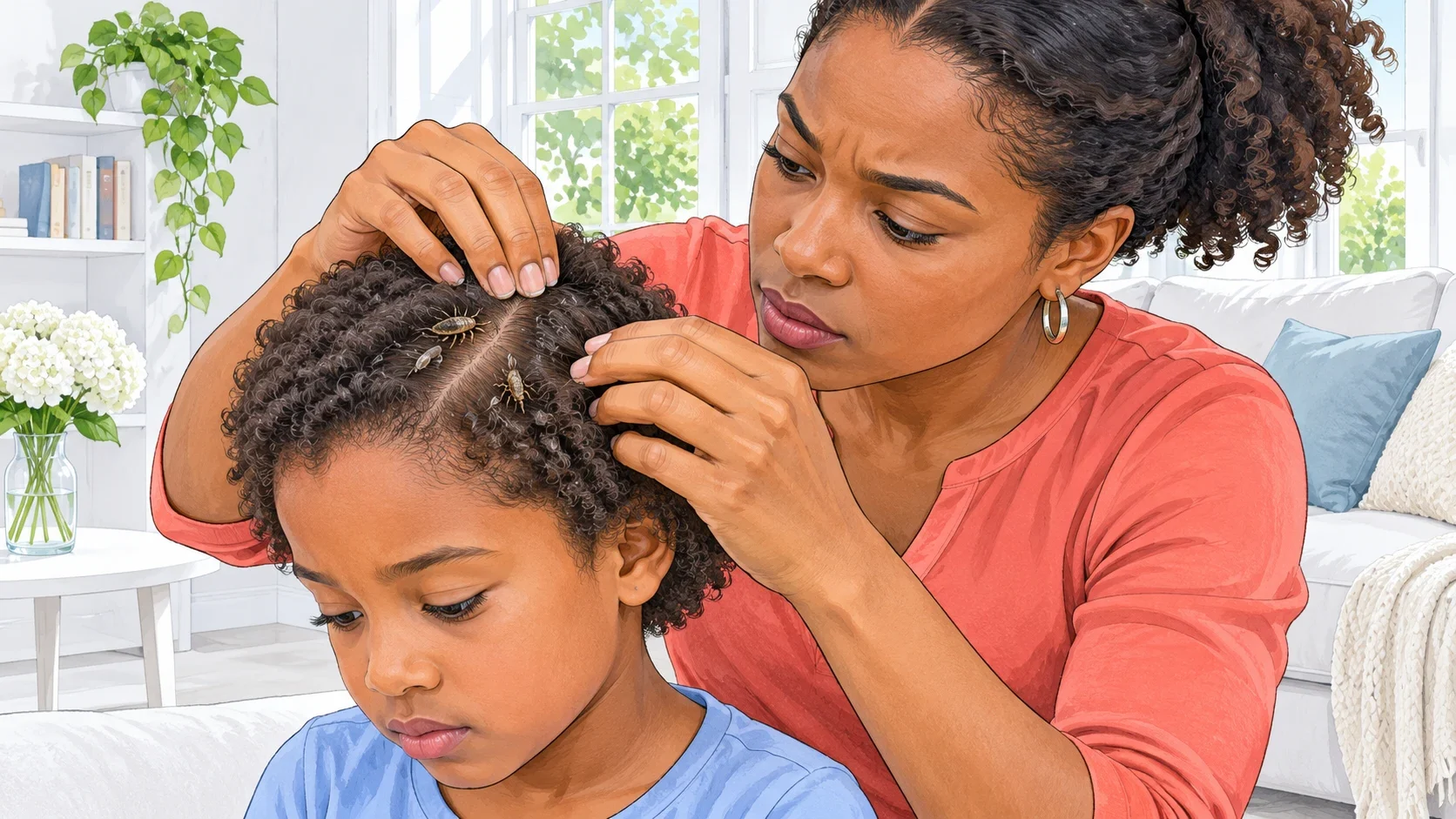
You have dealt with the head lice, checked your child’s hair, and thought the problem was over. Then you find another louse. After the second or third episode, it is natural to wonder whether your child keeps picking them up at school, someone at home is passing them back, or the lice never disappeared in the first place.
Repeated head lice usually come down to two possibilities: the original infestation persisted, or your child acquired lice again through contact with another person. A third possibility is that something mistaken for lice has made it appear that the infestation keeps returning.
Those possibilities require different responses. Buying another treatment every time your child scratches may not solve the underlying problem. We recommend starting with a confirmed live louse, a careful look at the previous treatment timeline, and an examination of the people who regularly have close contact with your child.
Are the Lice Coming Back, or Did They Never Go Away?
A new discovery does not necessarily mean a new infestation. Head lice can remain after treatment when some live insects survive or eggs hatch before the necessary follow-up has been completed.
The distinction is particularly important when lice are found within days of treatment. If your child had live lice on Monday, received treatment that evening, and still has crawling lice several days later, there is no reason to assume another child at school caused the problem. The original infestation may not have been fully cleared.
If careful checks showed no live lice after the appropriate treatment course and another live louse appears weeks later, a new exposure becomes more plausible. However, even a gap of several weeks cannot prove where the lice came from, particularly if nobody checked the hair during that interval.
The clinical guidance on persistent head lice after treatment identifies several explanations, including misdiagnosis, incomplete treatment, incorrect application, and reinfestation. It does not treat every recurrence as evidence that a child has caught lice from someone else.
A useful starting point is to establish how to tell whether head lice are gone before deciding that a later discovery represents a completely new episode.
What the Timing of a Recurrence Can Tell You
The date you discover lice is helpful, but it is not a precise record of when your child acquired them. Small lice can be difficult to spot, and itching may not develop immediately.
|
What you notice |
What to investigate first |
| Live lice shortly after treatment | Whether the original infestation was completely cleared and the product was used correctly |
| Small crawling lice several days later | Whether eggs survived and hatched, and whether the prescribed or labeled follow-up was completed |
| Live lice after a documented lice-free period | New head-to-head exposure among close contacts, while recognizing that an earlier infestation may have been missed |
| Only itching or attached nits | Whether there is any active infestation at all |
| Several household members repeatedly have lice | Whether infestations were detected and addressed among close contacts at the same time |
These are investigative clues, not diagnostic rules. The head lice life cycle helps explain why newly hatched lice can appear after a treatment that killed crawling insects but did not eliminate every viable egg.
Keep a simple record of when live lice were found, when treatment occurred, and what subsequent checks showed. This can reveal whether your family has experienced several distinct infestations or one prolonged episode that was never clearly resolved.
Your Child May Be Getting Lice From Someone Close to Them
Head lice spread mainly through direct head-to-head or hair-to-hair contact. They crawl between people; they cannot jump or fly.
Children often bring their heads together while playing, hugging, taking photographs, watching a tablet, reading a book, or resting beside one another. A child who frequently spends time in these positions with someone who has live lice may encounter them repeatedly.
The usual ways children acquire head lice explain why ordinary social contact is more relevant than the cleanliness of a classroom or home. Head lice can affect children with clean hair, freshly washed bedding, and attentive parents.
Consider your child’s close-contact network rather than assuming the source must be the school. That network might include siblings, cousins, neighborhood friends, regular playmates, and children at daycare or after-school activities.
A child may also spend time with the same close friend in several settings. If both children attend school together and have frequent playdates, discovering lice after a school day does not establish that the exposure occurred in the classroom.
The goal is to identify people who may need a careful head check, not to determine who is responsible.
Could Someone in Your Household Be Passing Lice Back?
A household can experience repeated lice discoveries when more than one person has an active infestation and those cases are not recognized together.
Imagine that one child has obvious lice and receives treatment. A sibling has a small infestation but no itching, so nobody checks their hair. The children continue to cuddle on the couch, share a bed occasionally, or play with their heads close together. Even after the first child’s infestation has cleared, contact with the untreated sibling can introduce live lice again.
Parents and other caregivers can also acquire head lice. Being an adult does not make someone immune, although exposure patterns differ.
For this reason, checking a child carefully for head lice should be accompanied by appropriate checks of other household members and close contacts. The CDC’s guidance for examining household members recommends checking others when lice are found and treating people who meet its criteria for an active infestation.
There is no benefit in automatically treating everyone with lice medication simply because one child has lice. An uninfested person does not need preventive pesticide exposure. Check first, then follow the appropriate treatment advice for anyone who is actually infested.
A shared household infestation can also be difficult to recognize when head lice cause no itching. Someone who feels completely comfortable may still have crawling lice.
Why Your Child Might Keep Getting Lice After Treatment
When lice remain after treatment, the next step is to review what happened rather than immediately assume your child was exposed again.
Some treatments kill crawling lice more effectively than eggs. Depending on the product, a follow-up application may be necessary at a specified interval. If that step was missed, newly hatched lice can make the infestation appear to have returned.
Application problems can also leave live lice behind. A product may not have covered the hair adequately, or it may have been rinsed or used differently from its instructions. Some products have specific restrictions involving conditioner or hair washing. These details vary by formulation, so one treatment’s directions should not be substituted for another’s.
The CDC’s explanation of why head lice treatment may fail includes misdiagnosis, incorrect use, incomplete treatment, and reacquisition. Resistance is another possible explanation, but it cannot be established simply because lice are still present.
If live lice persist after an appropriately completed treatment course, consult a healthcare professional rather than repeatedly applying the same product or combining several treatments. This article focuses on identifying why lice seem to return, not selecting medications or providing a complete treatment regimen.
The age and appearance of the lice can offer clues, but they cannot reliably tell a parent whether a particular louse survived treatment or arrived from another person. Newly hatched lice are smaller than adults, and baby head lice have a different appearance. Their size alone does not establish how they reached your child’s hair.
Check for Live Lice Before Assuming Another Infestation
One of the most frustrating parts of repeated head lice is that itching can continue even when the infestation has cleared. The scalp may remain irritated after treatment, and scratching does not prove that live lice are present.
Old nits can also remain attached to hair shafts. Parents sometimes find these during a later inspection and assume that a new infestation has started. An empty eggshell or a nonviable egg is not the same as a crawling louse.
The most reliable sign of an active infestation is finding a live nymph or adult louse. The CDC’s head lice identification guidance also explains that nits located farther from the scalp are usually hatched or dead and that dandruff and other particles can be mistaken for eggs.
Use good lighting and a fine-toothed lice comb to examine the hair, particularly behind the ears and near the nape of the neck. If you find a moving insect, inspect it carefully rather than relying on the appearance of a tiny speck.
Our guide to distinguishing live, dead, and empty lice eggs covers why the appearance of attached nits can be misleading.
If you repeatedly find suspicious material but cannot confirm live lice, ask a healthcare professional or someone experienced in identifying head lice to examine it. Repeatedly treating a child for dandruff, hair casts, or another harmless finding creates an unnecessary burden.
Is School Really Where Your Child Keeps Catching Lice?
School is an obvious suspect because children spend so much time there. Yet a classroom contains many children who may never have direct hair-to-hair contact with one another.
A child who sits across a table from someone with lice is not automatically exposed. Children who frequently lean their heads together during play may have more opportunities for transmission, whether they are at school, a birthday party, or a relative’s house.
There is also a timing problem. Finding lice on a Friday does not prove that your child acquired them at school that week. An infestation may have been present before it was noticed.
Rather than asking which classroom is responsible, consider where your child has had repeated close head contact. If the same children regularly play together, their families may benefit from checking for live lice around the same time.
Understanding how head lice spread at school or daycare can help you judge the likely opportunities for exposure without treating every classmate as a possible source.
If you confirm lice, a discreet message to the school or daycare can help staff follow their procedures. The decision about telling school or daycare about head lice is separate from trying to identify who introduced them.
Avoid accusing another family or asking a child to name classmates who scratch their heads. Scratching is not a reliable way to identify an infestation, and a child with lice may have no symptoms.
Are Bedding, Couches, or Stuffed Animals Causing the Repeated Lice?
Parents sometimes respond to every recurrence by washing all the bedding, replacing pillows, spraying furniture, and cleaning the entire house. This can consume hours without addressing the most likely route of transmission.
Head lice depend on feeding from a human scalp and generally survive poorly after becoming separated from a person. Transmission through objects is possible, but direct hair-to-hair contact is the principal route.
Routine attention to recently used head-contact items is reasonable. However, the 2025 California head lice treatment checklist specifically advises that excessive household cleaning is unnecessary and that bleach, fumigation, and pesticide spraying are not appropriate responses.
If your child repeatedly has live lice, investigate untreated close contacts and the earlier treatment course before blaming the sofa or carpeting. There is little reason to assume a room is maintaining an infestation independently of people.
The risk from head lice on pillows and bedding is a separate issue from repeated transmission through close personal contact.
Never apply household insecticides or foggers to a child’s room as a substitute for addressing head lice on people.
What to Recheck When Head Lice Keep Appearing
We would investigate a recurring case in a particular order. Start with the evidence of active lice, then review the earlier episode, and finally examine the people and activities that could explain a fresh exposure.
Recurrence Investigation Checklist
For parents and caregivers:
- Confirm that you have found a live, crawling head louse rather than itching or old nits.
- Write down the dates of the last confirmed infestation, treatment, and subsequent checks.
- Review whether the previous treatment course was completed exactly as directed.
- Check household members and other close contacts for evidence of active lice.
- Consider repeated hair-to-hair contact during playdates, sleepovers, daycare, and family activities.
- Ask a healthcare professional for help if live lice persist despite correctly completed treatment.
It is useful to record what you actually saw rather than writing only “lice came back.” A note such as “two live crawling lice found during combing” provides more information than “scalp itchy again.”
If another household member has live lice, that is relevant to the investigation. If nobody else has lice and your child has had no identifiable close contact with an infested person, you may not be able to determine the source. That uncertainty is normal.
Do not use the absence of a known contact as proof that the original treatment failed, or the presence of a classmate with lice as proof that your child was reinfested. Both conclusions require more evidence.
When Repeated Head Lice Need Professional Advice
An occasional new exposure is possible, but persistent live lice after a correctly completed treatment course deserve a closer look.
A pediatrician, dermatologist, or other qualified healthcare professional can help confirm the diagnosis and review whether the previous treatment was appropriate. They can also consider whether another treatment approach is needed without exposing your child to repeated, unnecessary applications.
Seek medical advice sooner if the scalp develops spreading redness, swelling, drainage, significant pain, or other signs of possible infection. Scratching and treatment-related irritation can complicate the picture, and not every scalp problem is caused by lice.
If several treatments have been attempted without a confirmed lice-free interval, bring a written timeline to the appointment. Include the products used, their application dates, and when live lice were subsequently found. This is more useful than relying on a general description of how often the problem has returned.
Can a Child Keep Getting Head Lice Even When the Family Is Careful?
A family can follow reasonable precautions and still experience another exposure. Children naturally play close together, and it is not realistic to monitor every moment of contact.
Repeated lice do not prove poor hygiene, inadequate parenting, or a dirty home. They also do not mean your child is somehow more attractive to lice than other children. Exposure opportunities and whether previous infestations were completely cleared are more useful explanations.
The best response is a focused investigation rather than escalating cleaning or repeatedly using treatment products without confirmation.
Start by finding out whether live lice are present. Review the previous treatment timeline, check household members and close contacts, and consider whether your child has been exposed again after a genuinely lice-free period. If live lice continue despite appropriate treatment, seek professional guidance.
You may never discover exactly where a particular louse came from. You can still identify the likely reason the problem keeps appearing and avoid spending time and money on measures that do not address it.
Common Questions About Repeated Head Lice
Can my child get head lice again immediately after treatment?
A child can acquire lice again through close contact with someone who has an active infestation, even after successful treatment. However, live lice found soon after treatment may have survived the original episode. The timing alone cannot distinguish the two.
Why does only one of my children keep getting lice?
Siblings can have different contact patterns. One child may regularly play with their head close to other children’s hair, while another rarely does. Differences in when infestations are detected can also make one child appear to have more episodes. There is no reliable basis for assuming that one child’s hair is inherently a preferred target.
Can my child still have lice if nobody else in the family does?
Yes. Your child may have acquired lice outside the household, or another person’s small infestation may have gone unnoticed. Checking close contacts is worthwhile, but not finding lice on anyone else does not rule out an active infestation in your child.
Does finding nits again mean the lice have returned?
Not necessarily. Nits and empty eggshells can remain attached after treatment. A live crawling louse is stronger evidence of an active infestation. If the finding is uncertain, obtain help identifying it before repeating treatment.