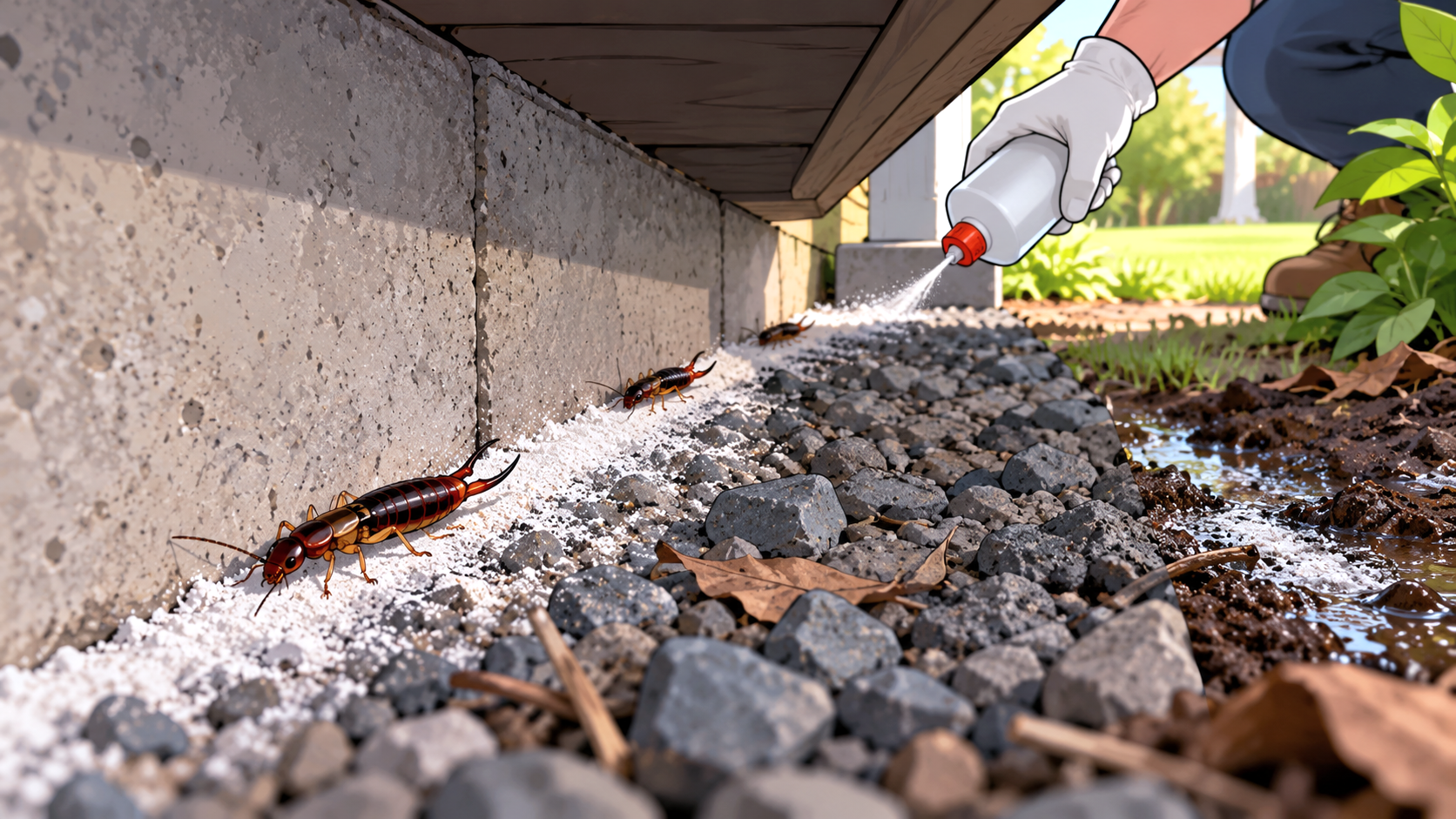
Diatomaceous earth looks almost too simple to be an insect killer. It is a fine mineral dust, not a conventional liquid insecticide, and an earwig can crawl across it without immediately dropping dead. That delay is one reason people sometimes assume the treatment has failed. Yes, diatomaceous earth can kill earwigs. It works physically by damaging and absorbing material from the protective outer layer of an insect’s exoskeleton. The insect then loses water and dies from dehydration. However, the dust needs contact with the insect, and moisture can substantially reduce how well it works.
That last limitation matters particularly with earwigs because the places where they congregate are often the same places where diatomaceous earth performs poorly.
How Diatomaceous Earth Actually Kills Earwigs
Diatomaceous earth is made from fossilized remains of microscopic aquatic organisms called diatoms. Those remains are largely silica. Some diatomaceous earth products containing silicon dioxide are registered as pesticides for controlling insects.
Unlike a poison that needs to be swallowed or absorbed as a toxic chemical, diatomaceous earth works through the insect’s exterior. The particles absorb oils and fats from the insect’s cuticle, while their abrasive properties contribute to damage of that protective surface. Once the cuticle can no longer prevent water loss effectively, the insect dries out.
That mechanism applies to earwigs as well. Canadian pest-control guidance specifically includes diatomaceous earth as an earwig-control option, explaining that insects crawling over the powder can become dehydrated and die.
However, this is not an instant knockdown treatment. An earwig walking through the dust may continue moving afterward. That makes DE quite different from a treatment someone might choose specifically because they want to kill a visible earwig immediately.
The Earwig Has to Encounter the Dust
The biggest practical weakness of diatomaceous earth is easy to overlook. It cannot kill an earwig that never contacts it.
Earwigs are nocturnal and spend daylight hours concealed in dark, tight and often damp refuges. They can hide beneath boards, debris, mulch and other protected objects before emerging at night. That behavior means randomly scattering DE across a large garden or room is not a particularly thoughtful way to use it.
Placement matters more than sheer quantity. A pesticide product containing diatomaceous earth should only be applied to locations and pests permitted by its current label. When earwigs are the target, the useful treatment area is one where they are actually likely to travel and where the product’s label permits application.
This is also why we would not judge the treatment by whether every earwig disappears immediately. DE is a contact-dependent dust. It does not pull hidden earwigs out of their refuges, and it does not correct the conditions attracting earwigs to an area in the first place.
Moisture Is Where Diatomaceous Earth Runs Into Trouble
This is the part of DE treatment that matters most for earwigs.
Diatomaceous earth works best when it remains dry. Rain, irrigation and other moisture can interfere with a dry dust treatment. Garden guidance also notes that DE may need reapplication after exposure to rain, watering or dew.
Earwigs, meanwhile, commonly shelter in damp locations. They are frequently found beneath mulch, plant debris, stones, boards and similar protected places. A treatment that depends on remaining dry therefore has an obvious disadvantage in some of the exact microhabitats where earwigs concentrate.
We think this is the most useful way to decide whether DE makes sense. Do not ask only whether the substance can kill an earwig. Ask whether you have a suitable, label-approved location where the dust can remain in the condition required to work.
A dry protected route can be a much better candidate than exposed soil that receives irrigation every evening. Likewise, spreading DE before rainfall and expecting the same performance afterward misses one of the basic limitations of the material.
More Diatomaceous Earth Is Not Better
A visible pile of white powder can make a treatment look more serious, but pest-control dusts are not something to apply by intuition.
The amount and method of application come from the specific pesticide label. Different diatomaceous earth products can have different permitted uses and instructions. Therefore, we would not use a homemade rule such as creating a particular width of powder around a plant or dumping a thick ring around the foundation.
There is another reason to avoid excessive application. Diatomaceous earth is a dust that people can inhale. Exposure can also occur through the eyes or skin, and inhaling the dust can irritate the nose and nasal passages.
Use the product exactly as its pesticide label directs. Keep unnecessary people and animals away during application as required by that label, and avoid creating airborne clouds of dust. Fans, vents and high-traffic areas can disturb loose material and increase the chance of exposure.
The goal is controlled insect contact, not covering every visible surface with powder.
Do Not Confuse Food-Grade DE With a Pest-Control Product
The words “food grade” can create a misleading sense that a product is automatically the better choice for pest control around a home.
Food-grade diatomaceous earth has legitimate non-pesticide uses, but that does not make an unlabeled food-grade product a substitute for a pesticide registered and labeled for insect control. Products marketed for pesticide use come with directions describing where and how they can be applied, along with precautions intended to limit exposure.
With an unlabeled food-grade product, those pest-control directions and risk evaluations are absent. The risks and effectiveness of using non-pesticide food-grade products for pest control have not been evaluated in the same way.
For that reason, we would choose a pesticide product whose label covers the intended pest and application site rather than buying food-grade DE simply because the word “food” sounds reassuring.
This distinction matters even more when people plan to use the dust indoors, around vegetable gardens, near pets or in other locations where exposure or application restrictions need careful attention.
Is Diatomaceous Earth a Good Way to Get Rid of Earwigs in the Garden?
It can play a role, but it would not be our first choice for every garden.
Earwig habitat and DE’s preferred working conditions do not always cooperate. Irrigated soil, damp mulch and rainy weather can make maintaining an effective dry dust treatment difficult. Meanwhile, established earwig-management methods give homeowners other ways to target concentrated populations.
For example, earwigs readily enter refuge traps made from rolled newspaper, cardboard and similar materials. Oil traps can also capture them. Our guide to DIY earwig traps explains those approaches separately.
Habitat management can matter even more. Removing unnecessary hiding places and correcting excess moisture can reduce the conditions supporting large concentrations. Where earwigs are damaging plants, nighttime inspection helps confirm that earwigs are actually responsible before you start treating them.
That confirmation is worth doing. Earwigs can also consume aphids and other small organisms, so their mere presence in a garden is not automatically a reason to kill them. Our guide to whether earwigs are good or bad for the garden goes deeper into when their presence becomes a real plant problem.
Diatomaceous Earth Indoors Needs More Caution Than People Assume
An indoor earwig can make DE seem appealing because it does not look like a conventional pesticide spray. However, loose dust inside a living space creates an exposure issue that should not be dismissed just because the material has a natural origin.
Air movement and everyday activity can disturb dust. Applications near fans, air vents, swinging doors and heavily traveled areas can increase the likelihood that particles become airborne. Children and pets can also contact floor-level treatment areas that adults barely notice.
A pesticide label determines whether a particular DE product can be used indoors and where it can be placed. Follow those directions rather than spreading loose powder along every baseboard.
More importantly, repeated indoor earwigs usually call for a different strategy. European earwigs do not reproduce indoors, so persistent sightings point back toward continued entry from outside rather than a self-sustaining indoor population. Sealing openings and reducing favorable exterior shelter therefore addresses something DE cannot: the supply of new earwigs entering the building.
Our guide to keeping earwigs out of the house covers that exclusion strategy in detail.
Where DE Fits Into an Earwig Control Plan
Diatomaceous earth makes the most sense as one targeted tool rather than the entire control plan.
First determine where earwigs are concentrating and whether they are causing a problem that warrants treatment. Then deal with unnecessary damp shelter where practical. Traps can reduce concentrated populations, while exclusion is more relevant when the problem is repeated indoor entry. Our broader guide to getting rid of earwigs puts those methods together.
DE can then supplement that work where an appropriately labeled product can be placed correctly and remain effective.
That is a less exciting answer than drawing a white circle around the problem and waiting for every earwig to vanish, but it is a much better use of the material. Diatomaceous earth really can kill earwigs. Its usefulness depends on contact, correct application and conditions that allow the dust to do its job.
Other Questions About Diatomaceous Earth and Earwigs
Does diatomaceous earth repel earwigs?
Diatomaceous earth should be treated as an insect-killing dust according to the claims and directions on the particular pesticide label, not assumed to create an invisible repellent barrier. Its established insecticidal action depends on contact with the insect’s exterior.
Can I put diatomaceous earth directly on vegetable plants?
Only use a pesticide product on an edible plant when its current label permits that application, and follow all crop-specific directions and restrictions on that label. Do not assume that a product can go onto vegetables simply because diatomaceous earth occurs naturally.
Will diatomaceous earth still work after it rains?
Do not assume an exposed DE application remains effective after rain. Moisture interferes with the dry-dust conditions that make diatomaceous earth useful against insects. Follow the particular product’s label for reapplication instructions rather than automatically adding more powder.
Can I mix diatomaceous earth with water and spray it for earwigs?
Some registered diatomaceous earth products come in formulations or have application directions that differ from ordinary dry dust. Whether a particular product can be mixed with water depends entirely on its label. Do not create a homemade wet application from a product whose directions do not permit it.
Can earwigs become resistant to diatomaceous earth?
Diatomaceous earth acts through physical damage and absorption at the insect’s protective exterior rather than the toxic biochemical action associated with many conventional insecticides. That physical mode of action is one reason desiccant dusts occupy a different role from conventional chemical treatments.
2 thoughts on “Does Diatomaceous Earth Kill Earwigs?”