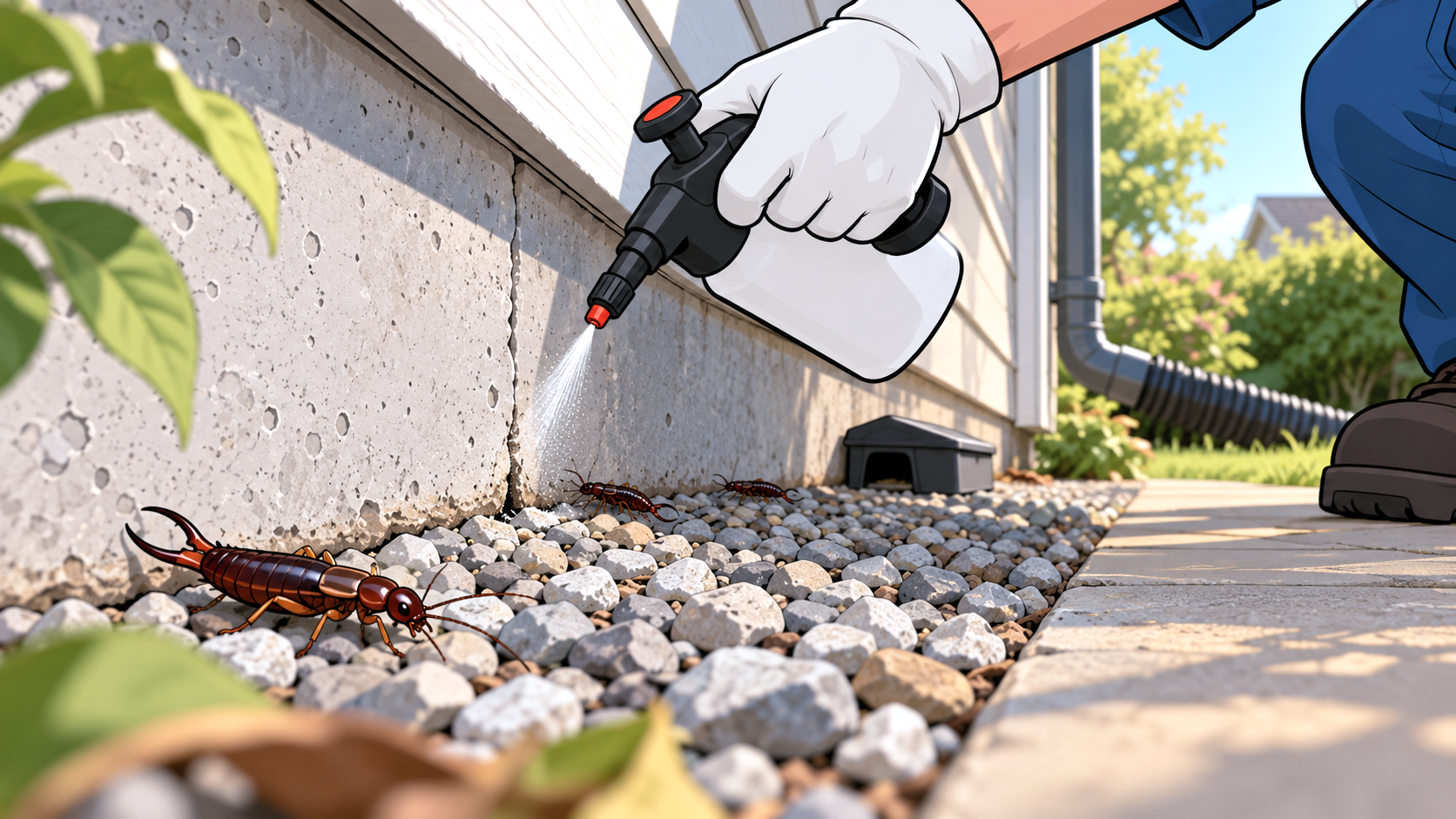
The best earwig killer depends heavily on where the earwigs are causing trouble. A product that makes sense along an indoor baseboard is not automatically the product we would spray over vegetables, and a professional concentrate is unnecessary for someone dealing with three earwigs around a basement door.
After comparing current labels, active ingredients, permitted treatment sites, ease of use, and current pricing, Ortho Home Defense Insect Killer for Indoor & Perimeter2 is our best overall earwig killer for most homeowners. For earwig damage on garden plants, we prefer Sevin Insect Killer Ready to Use. For larger properties where a concentrate makes more sense, Talstar P Professional is the stronger value-oriented option.
The important part is matching the product to the problem. Earwigs spend much of the day hidden in protected areas, so even a good insecticide works better when it is used where earwigs actually travel or shelter rather than sprayed randomly around a property.
The Best Earwig Killers We Would Buy
| Product | Best For | Active Ingredient | Form | Current Price |
|---|---|---|---|---|
| Ortho Home Defense Insect Killer for Indoor & Perimeter2 | Best overall / home perimeter | Bifenthrin 0.05% + zeta-cypermethrin 0.0125% | Ready-to-use spray | About $17.34 USD for 1 gal |
| Sevin Insect Killer Ready to Use | Best for garden plants | Lambda-cyhalothrin 0.002% | Ready-to-use spray | About $31.17 USD for 1.33 gal |
| Talstar P Professional | Best concentrate / larger properties | Bifenthrin 7.9% | Concentrate | About $35.98 USD for 16 oz |
Prices were checked in September 2026 and can change by retailer and location.
Best Overall: Ortho Home Defense Insect Killer for Indoor & Perimeter2
For the average homeowner dealing with earwigs around doors, windows, a basement, garage, patio, or foundation, Ortho Home Defense is the product we would choose first. Its biggest advantage is not that it contains some uniquely powerful earwig ingredient. It is that the product is already formulated for the places where homeowners commonly encounter earwigs and requires no measuring or mixing.
The current formula contains bifenthrin and zeta-cypermethrin, and earwigs are specifically included among the labeled pests. The same product can be used in permitted indoor areas and around exterior foundations, doors, windows, patios, decks, and garages. That flexibility matters more to us than buying a stronger concentrate when the actual problem is a handful of earwigs crossing the home perimeter.
The 1-gallon Comfort Wand version was selling for about $17.34 USD when we checked. There are cheaper trigger-sprayer versions, but the wand becomes worthwhile when you need to treat a longer perimeter without repeatedly squeezing a trigger.
One marketing claim needs context. Ortho advertises up to 12 months of protection against certain pests indoors, but that specific long-duration claim applies to ants, roaches, and spiders on nonporous indoor surfaces. We would not translate it into a promise of 12-month earwig control. For earwigs, we care more about the fact that the current label actually includes them and permits treatment in useful locations.
People and pets should remain out of the treated area until it has dried. The product also carries eye and ingestion precautions, so “ready to use” should never be interpreted as “risk free.”
Our verdict: This is the easiest recommendation for someone who wants one labeled product for earwigs entering a house rather than a concentrate that requires measuring and separate spray equipment.
Best for Gardens: Sevin Insect Killer Ready to Use
Earwigs become a different problem once they start chewing plants. In that setting, we prefer a product whose label is written around ornamental and edible garden use rather than a general household perimeter spray.
Sevin Insect Killer Ready to Use specifically lists earwigs and can be used on vegetables, flowers, roses, trees, and shrubs. The current ready-to-use formulation contains lambda-cyhalothrin, and the product kills listed insects by contact. Because it comes pre-mixed, there is no dilution calculation for the homeowner to get wrong.
The 1.33-gallon version with a battery-powered sprayer was about $31.17 USD when checked. That is noticeably more than Ortho Home Defense, but these products are not competing for exactly the same job. Sevin earns its place here because its label includes plant uses that make sense when earwigs are actually damaging a garden.
That does not mean we would spray every earwig found under a flowerpot. Earwigs are omnivores and can also consume other insects, so their presence alone is not enough reason to treat. Confirm feeding damage first. Checking susceptible plants at night is useful because earwigs feed primarily after dark. Our guide to whether earwigs are good or bad for the garden explains why that distinction matters.
Sevin also requires more care around pollinators than its convenient sprayer might suggest. The product’s safety information identifies the active ingredient as highly toxic to bees, so applications around blooming plants require particular attention to the label. Edible crops can also have crop-specific directions and pre-harvest intervals. Those details are one reason we strongly prefer choosing the crop and pest from the label before spraying rather than using a garden insecticide as a general-purpose bug killer.
Our verdict: For confirmed earwig feeding on plants, Sevin Ready to Use is the better fit than an indoor perimeter product. It loses points for price and for requiring more careful use around beneficial insects.
Best Concentrate: Talstar P Professional
Talstar P becomes interesting when the amount of property you need to treat makes ready-to-use bottles feel wasteful. It is a concentrated insecticide containing 7.9% bifenthrin, and its current label includes earwigs among the pests it can control.
The current Talstar P Professional label permits a broad range of indoor and outdoor uses, including residential structures, lawns, landscapes, and perimeter areas. The manufacturer describes it as a water-based formulation without strong-smelling or plant-damaging solvents. Earwigs are included on the product’s pest label, so this is not a case of assuming bifenthrin will work because another bifenthrin product lists them.
A 16-ounce bottle was selling for about $35.98 USD when checked, with larger sizes available. The purchase price is higher than a basic ready-to-use spray, and you also need suitable application equipment. However, concentrates become more attractive when you are treating enough area to justify mixing multiple batches.
This is also the product where following the label becomes especially important. A concentrate gives the user more control, but it also gives the user more opportunities to make a measuring or application mistake. We would not recommend Talstar simply because “professional” appears in the name. Someone treating a single doorway gains little from buying concentrated bifenthrin.
State registration and purchase rules can change, so verify current local availability before ordering any professional pesticide. The manufacturer currently lists Talstar P as registered across the continental United States, but local rules still govern use.
Our verdict: Talstar P is our pick for someone who already owns a sprayer and needs a concentrated earwig product for a larger treatment area. For occasional household use, Ortho is much simpler.
Why We Did Not Pick the Strongest Chemical and Call It the Best
Earwig products are easy to rank badly. Looking only at active-ingredient concentration would make a professional concentrate appear automatically superior to a diluted ready-to-use spray. That ignores where each product is designed to be used and how realistically a homeowner can apply it correctly.
Ortho is already diluted and can be used in labeled indoor and perimeter locations. Sevin’s value comes from its garden uses. Talstar requires preparation but scales better across larger areas. Those differences affect real-world usefulness more than the percentage printed beside an active ingredient.
The same problem appears with household remedies. Diatomaceous earth, boric acid, dish soap, neem products, and other methods can have specific roles, but they are not interchangeable substitutes for a labeled residual insecticide. We cover those narrower questions separately, including whether diatomaceous earth kills earwigs and whether boric acid kills earwigs.
For a buying guide, our standard is simpler. The product has to list earwigs, permit use where the problem actually exists, and offer a practical advantage over the alternatives.
The Best Earwig Killer Still Needs to Reach the Right Place
Buying the right bottle does not compensate for treating the wrong area. Earwigs spend daylight hours in dark, protected shelters and become active mainly at night. A spray applied to random exposed surfaces may therefore miss most of the insects producing the problem.
Outdoors, inspect beneath boards, pots, dense vegetation, mulch, and other protected objects around the affected area. Earwig management guidance also emphasizes reducing unnecessary hiding places and excess moisture, while refuge and oil traps can reduce populations. Our guide to what attracts earwigs explains why those locations repeatedly become hotspots.
Indoors, the situation is different again. European earwigs do not reproduce indoors, so repeatedly spraying wandering individuals without investigating entry points misses the larger opportunity. Treating an appropriate exterior perimeter and improving exclusion can make more sense than continually applying insecticide inside living areas.
This is why our broader guide to getting rid of earwigs combines killing methods with shelter reduction, trapping, and exclusion. A product can reduce insects. It cannot caulk a door frame or remove a damp board leaning against the foundation.
Which Earwig Killer Should You Actually Buy?
Choose Ortho Home Defense Insect Killer for Indoor & Perimeter2 when earwigs are repeatedly appearing around the house and you want the easiest ready-to-use option. It is the best overall fit for most homeowners because its label covers earwigs and useful indoor and outdoor treatment areas without requiring mixing.
Choose Sevin Insect Killer Ready to Use when the problem is confirmed earwig feeding on flowers, vegetables, shrubs, or other labeled plants. Its garden-specific use is the reason it wins that category, not because it is universally stronger.
Choose Talstar P Professional when you need to cover a larger property, already have appropriate spray equipment, and want a concentrated bifenthrin product labeled for earwigs. It offers more flexibility, but it also demands more from the person applying it.
For a few earwigs, we would buy none of them. Vacuum the indoor stragglers, use earwig traps where appropriate, and investigate the shelter or entry conditions first. Pesticide earns its place when the number of earwigs or the amount of plant damage justifies treatment.