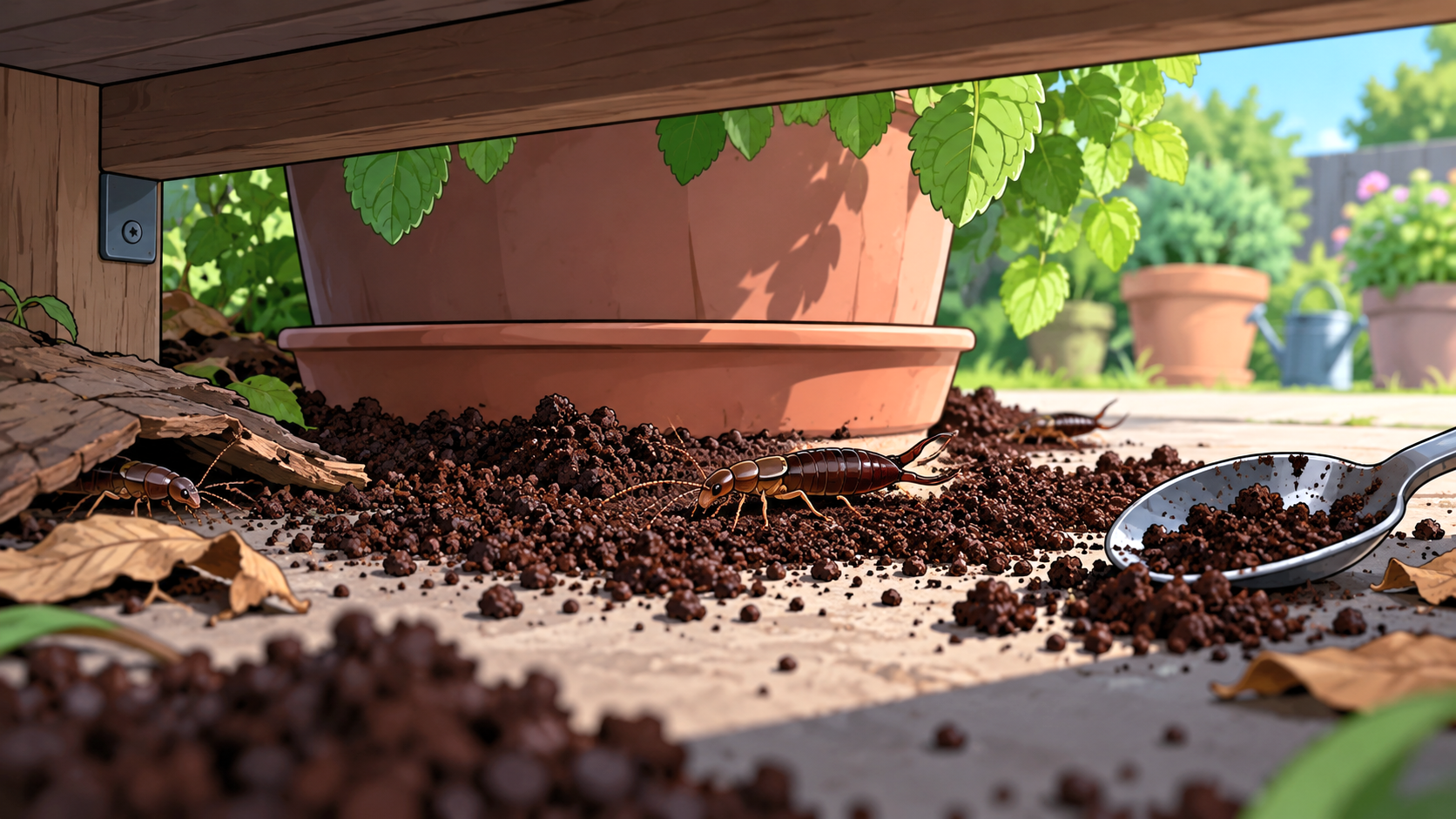
Coffee grounds have an unusually convincing reputation as a garden pest remedy. They smell strong, contain caffeine, and are easy to scatter around plants. Since caffeine can affect some insects, it is tempting to connect those facts and assume a ring of used grounds will kill an earwig that crosses it. That conclusion goes further than the evidence allows.
Coffee grounds should not be relied on to kill earwigs. Research has found insecticidal effects from coffee-derived materials against certain insects under specific experimental conditions, but those results do not establish ordinary spent coffee grounds as an earwig killer. For earwig control, we would use a method actually supported for earwigs instead.
Caffeine Does Not Make Coffee Grounds an Earwig Insecticide
Caffeine is probably the strongest reason the coffee-ground idea sounds scientifically plausible. It is biologically active, and researchers have investigated its effects on insects. The problem comes when results from one insect and one form of exposure are treated as though they apply automatically to earwigs in a garden.
For example, spent coffee grounds and caffeine have produced toxic effects in Aedes aegypti mosquito larvae under laboratory conditions. Another study found substantial mortality when mosquito larvae were exposed to specific concentrations of wet spent coffee grounds. Those are interesting findings, but mosquito larvae developing in water are biologically and environmentally very different from an adult earwig walking through soil or mulch.
Other research makes the importance of formulation even clearer. In experiments involving fruit flies and coffee berry borers, simple aqueous caffeine solutions showed no insecticidal activity, while specially prepared caffeine oleate emulsions did. In other words, knowing that caffeine can affect insects does not tell us what a handful of used coffee grounds will do to an earwig.
We think this is the key point homeowners should take from the research. An ingredient having insecticidal potential somewhere in entomology is not enough to turn the household material containing it into a dependable pest treatment.
Scattering Coffee Grounds Is a Completely Different Exposure
There is another problem with translating laboratory research into a garden remedy. Studies that investigate coffee-derived insecticidal effects control factors such as concentration, preparation and exposure. A homeowner sprinkling yesterday’s grounds around a dahlia has none of that standardization.
Even spent coffee grounds are not simply caffeine granules. Research has identified multiple chemical constituents in them, including phenolic compounds and flavonoids. Some experiments go further and produce extracts from the grounds before testing them. One study that reported insecticidal activity against several crop pests used a methanolic extract of spent coffee grounds, not ordinary damp grounds tipped out of a coffee maker.
That difference is easy to lose once the research gets reduced to a claim that “coffee kills bugs.” A laboratory extract, an aqueous caffeine solution, wet spent grounds submerged with mosquito larvae and dry grounds scattered over garden soil are four different treatments. Evidence for one cannot be assigned to all the others.
For ordinary gardening, the more relevant guidance is much less exciting. A review of coffee-ground use in gardens found no published evidence that coffee grounds repel or kill garden pests. That gives us no reason to promote them as an earwig killer.
Coffee Grounds Can Change the Place Earwigs Are Living
The irony is that scattering coffee grounds around a plant is not necessarily a neutral experiment. You are adding organic material to the exact environment where earwigs spend much of their time.
Earwigs are nocturnal and commonly shelter during the day in dark, protected places. Garden management for troublesome populations therefore focuses partly on reducing unnecessary hiding places and managing conditions around vulnerable plants. That is more directly connected to earwig biology than adding another layer of material and hoping its chemistry kills them.
Coffee grounds can also affect the physical properties of soil when used heavily. Thick layers may reduce water infiltration and form a water-repellent layer. They are not simply an invisible pesticide that disappears after application.
We would be especially reluctant to pile grounds around seedlings. Coffee grounds have been associated with reduced germination and plant growth in experiments, and seedlings are already among the plants that can be vulnerable to earwig feeding damage. Trying to solve one garden problem should not introduce an unnecessary variable around the plant you are trying to protect.
Coffee Grounds Also Do Not Tell You Whether Earwigs Need Killing
Before treating anything, check whether the earwigs are actually responsible for the damage. Earwigs eat both plant and animal material. Depending on the situation, they can feed on plants while also consuming other small organisms and decaying material. That is why simply finding one underneath a pot or beside a damaged leaf is weak evidence by itself.
Nighttime inspection is much more useful. Earwigs become active after dark, so checking vulnerable plants with a flashlight can connect the insect to fresh feeding damage. Our guide to whether earwigs are good or bad for a garden explains why their presence alone is not a reason to eliminate them.
This is particularly useful with damaged flowers and leaves because other garden pests can leave superficially similar holes. For example, earwig damage on dahlias is better judged by combining the damage pattern with nighttime confirmation than by assuming the insect hiding nearby caused it.
Once you know earwigs are responsible, you can stop experimenting with materials that have no established earwig-control role and target the actual activity instead.
Use Earwig Behavior Against Them Instead
A coffee-ground barrier asks an unproven chemical effect to do the work. Earwig traps take advantage of behavior we already know they exhibit.
Earwigs seek protected daytime refuges, which makes simple shelter traps useful for concentrating them in a place where they can be collected. Rolled newspaper, corrugated cardboard and similar refuge traps can be positioned near plants with confirmed activity. Oil traps provide another established approach. Detailed guidance on trapping earwigs recommends checking traps regularly and continuing while damaging numbers remain.
This approach also gives you information. If a trap beside a damaged plant repeatedly collects earwigs, you have learned something about where activity is concentrated. A layer of coffee grounds does not provide the same feedback because you cannot tell whether an earwig avoided it, crossed it, sheltered elsewhere or was unaffected.
For larger garden problems, reducing unnecessary hiding places and excess moisture around the affected area can complement trapping. Our garden earwig control guide covers that broader strategy. The goal is not to sterilize the entire garden. It is to reduce unacceptable damage where it is actually occurring.
Indoors, coffee grounds make even less sense as a control method. European earwigs do not reproduce indoors, and individual invaders can usually be swept or vacuumed up. Repeated appearances are better handled by finding and sealing entry routes, which is why preventing earwigs from entering the house addresses the cause rather than placing coffee around rooms.
Other Questions About Coffee Grounds and Earwigs
Can I compost used coffee grounds instead?
Yes, composting is a more conventional use for spent coffee grounds than treating them as an insecticide. However, adding coffee grounds to compost should not be expected to turn the pile into an earwig-control treatment. Earwigs may use protected outdoor environments without that meaning the compost itself needs pesticide treatment.
Will fresh unbrewed coffee work better than used grounds?
A higher caffeine content does not establish an effective earwig treatment. Fresh coffee and spent coffee grounds also differ as materials, so results involving one cannot simply be transferred to the other. We would not sacrifice fresh coffee to an experiment when established DIY earwig traps are available.
Can coffee grounds be mixed with another ingredient to make an earwig killer?
We would not build a homemade pesticide recipe around coffee grounds. Combining an unestablished treatment with another household substance makes the result harder to predict rather than turning it into a tested earwig-control method. When pesticide treatment is necessary, use a product labeled for the pest and intended treatment site.
What if I only want to repel earwigs rather than kill them?
That is a separate question because repellency and mortality are different outcomes. Coffee grounds should not automatically be assumed to do either. We cover the narrower claim in our guide to whether coffee grounds repel earwigs.