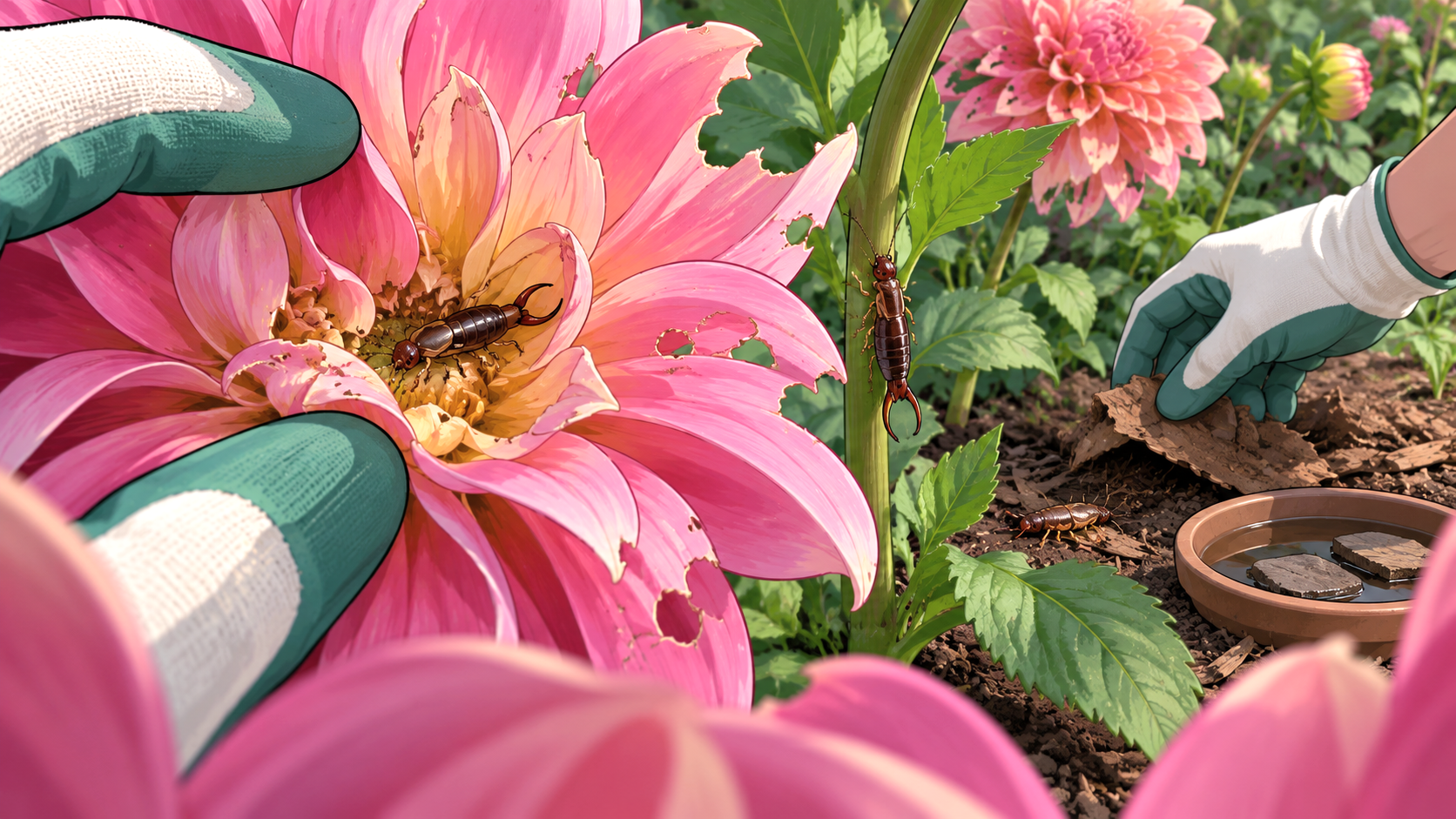
A dahlia can look perfect one evening and strangely ragged a few mornings later. Petals have holes, leaf edges look chewed, and the insect responsible is nowhere in sight. Earwigs are one possible culprit, and dahlias happen to be among the ornamental flowers they readily feed on.
Earwig damage on dahlias usually appears as irregular holes and chewed edges in the leaves, buds, or flower petals. Heavy feeding can leave blooms looking tattered. Because earwigs feed mainly at night and hide during the day, the best way to confirm them is to inspect the damaged dahlias after dark with a flashlight.
What Earwig Damage on Dahlias Looks Like
Earwigs have chewing mouthparts, so their damage looks like missing plant tissue rather than discoloration or spotting. On dahlia leaves, they can produce small, irregular holes or ragged areas where tissue has been eaten. Flowers can suffer the same kind of chewing, leaving damaged petals and blooms with a tattered appearance.
Dahlias are specifically listed among the flowers susceptible to irregular holes caused by earwig feeding. The injury can involve more than the foliage. European earwigs feed on buds, flowers, leaves and other tender plant tissues, which means a dahlia can show damage before a flower opens as well as after it blooms.
The pattern is usually messy rather than geometrically neat. You may find uneven holes through a leaf blade, portions missing from its edge, or petals that look as though something took small bites from them. When earwig numbers become high, the damage can become extensive enough to spoil much of the ornamental value of a flowering plant.
That last point matters particularly with dahlias. A few holes in an established plant’s leaves may be tolerable, while repeated feeding on the flowers defeats much of the reason for growing the plant in the first place.
Check the Dahlias at Night Before Blaming Earwigs
Chewed petals do not identify the culprit by themselves. Slugs and several other garden pests can leave damage that overlaps with earwig feeding.
Earwig damage is particularly easy to confuse with slug damage because both can produce irregular holes. One useful difference is that slugs can leave a characteristic slime trail, while earwigs do not. However, the strongest evidence is seeing the insect actually feeding.
Earwigs are active primarily at night and retreat into protected places during daylight. Consequently, examining a damaged dahlia in the middle of the day can produce a frustrating result. The damage is obvious, but the plant appears empty.
Return after dark and inspect the leaves, flower heads, buds and stems with a flashlight. Night inspection is specifically recommended for confirming earwigs on damaged flowers. Finding earwigs actively feeding on the same areas where fresh damage is appearing gives you much stronger evidence than finding one elsewhere in the garden.
We would make this confirmation before trying to control anything. Earwigs are omnivores and can also prey on aphids, caterpillars, mites and other small pests. An earwig merely hiding near a dahlia is not enough to prove that it caused the holes.
Look Inside the Dahlia Flowers Too
The flower itself can provide earwigs with more than food. Its tight spaces can also give them a protected place to hide.
Earwigs prefer dark, confined locations during daylight, and they can shelter inside flowers. That means you may not see one sitting openly on a leaf even when several are using the plant. Gently checking among the petals and around protected plant structures can reveal insects that are otherwise easy to miss.
The same behavior explains why damage can appear to continue without an obvious pest nearby. Earwigs can remain concealed during the day, emerge to feed at night, and return to cover before you inspect the plant the following morning.
Still, avoid treating every earwig found inside a bloom as proof of feeding. The useful combination is fresh chewing damage plus earwigs present on the affected dahlias during their nighttime activity period. That is a much better basis for deciding whether control is warranted.
Why Dahlias Can Take So Much Earwig Damage
Dahlias are not incidental additions to the earwig menu. They repeatedly appear among ornamental plants susceptible to earwig feeding.
European earwigs consume living plant material as part of a much broader omnivorous diet. They can chew leaves, stems, flowers, fruits and roots, while also scavenging decaying organic matter and hunting other small animals. Dahlias, marigolds and zinnias are among the annual flowers specifically identified as commonly injured.
Tender plant tissue is particularly vulnerable when earwig populations become abundant. Their feeding can leave flowers and leaves visibly ragged, and large populations can seriously injure flowering plants.
This does not mean every earwig near a dahlia needs to die. Their mixed diet is exactly why earwig control in a garden should be based on actual damage rather than their presence alone. The broader question of their helpful and harmful roles is covered in our guide to whether earwigs are good or bad for the garden.
Start by Making the Dahlia Bed Less Comfortable for Earwigs
Once nighttime inspection confirms earwig feeding, look around the base of the dahlias before reaching for a pesticide.
Earwigs spend daylight in dark, tight and moist places. Dense ground debris, objects resting against the soil and similar protected hiding places can give them convenient daytime shelter close to the flowers they visit at night. Highly irrigated and mulched areas can also support greater earwig abundance.
Removing unnecessary hiding places can therefore make the immediate area less accommodating. Reducing nesting and shelter sites is part of integrated earwig management, particularly when populations are causing unacceptable plant damage.
That does not mean stripping every bit of organic material from a healthy garden or allowing dahlias to become water-stressed. The better approach is targeted. Remove unnecessary boards, piles of plant debris and other protected cover near affected plants, and avoid creating persistently damp hiding places simply because the area is watered more than necessary.
This is also where the distinction between attraction and diet becomes useful. The dahlias provide food, while nearby moisture and shelter can make the same small area suitable for daytime hiding. Our guide to what attracts earwigs explains that combination in more detail.
Trap Earwigs Close to the Damaged Dahlias
Trapping is particularly well suited to a flower bed because it can concentrate control around the plants actually being damaged.
Rolled or corrugated cardboard can serve as daytime shelter traps. Earwigs enter these protected spaces after their nighttime activity, allowing the traps to be checked and the insects removed. Rolled or crumpled newspaper can be used in a similar way. These methods exploit the earwig’s natural desire to find a tight daytime refuge rather than relying on an attractant alone.
Oil traps offer another option. Containers baited with strong-smelling oils can attract and kill earwigs, and oil-based traps are an established garden management method. Positioning traps in the affected bed makes more sense than scattering them throughout areas where earwigs are causing no noticeable damage.
The goal is not necessarily to eliminate every earwig from the property. We prefer the narrower target here: reduce the population around the dahlias enough that new flower and foliage damage becomes acceptable. The site has a separate DIY earwig trap guide for the construction and use of traps.
Protect the Dahlias Based on Damage, Not Earwig Numbers Alone
Earwigs complicate garden pest control because killing every one you encounter can remove insects that also consume other garden pests and decaying material.
Low populations can often be tolerated. Management becomes worthwhile when feeding reaches a level you consider unacceptable, especially when earwigs repeatedly damage buds and flowers. This damage-based approach is also part of integrated management guidance for European earwigs.
After removing nearby shelter and using traps, continue checking the dahlias at night. New growth and flowers will tell you whether the pressure is falling. A trap full of earwigs is interesting, but the condition of the dahlias is the better measure of whether your intervention is accomplishing its purpose.
For a larger garden-wide problem, the next step belongs in our broader guide to getting rid of earwigs in the garden. Keeping this dahlia-specific problem focused prevents a few damaged flowers from turning into unnecessary treatment across the entire yard.
Other Questions About Earwigs and Dahlias
Will dahlias recover from earwig damage?
Established dahlias can tolerate some feeding, particularly when damage is limited to portions of the foliage. However, damaged petals and leaves do not repair the missing tissue. The practical goal is to protect subsequent growth and flowers from continued feeding.
Do earwigs eat dahlia tubers?
The characteristic earwig problem documented on dahlias is feeding on aboveground plant tissue such as leaves and flowers. Damage to a dahlia tuber should not automatically be attributed to earwigs simply because earwigs are present elsewhere in the bed.
Can earwigs hide in cut dahlias?
Yes. Earwigs seek tight, protected hiding places and can shelter within flowers. Inspecting blooms before bringing freshly cut dahlias indoors can prevent a hidden earwig from coming inside with the bouquet.
Are young dahlias more vulnerable to earwigs?
Tender young plants can suffer more consequential damage than large established plants because they have much less tissue to lose. Earwigs can seriously injure seedlings when populations are high, so recently established dahlias deserve closer monitoring when earwig activity is heavy.
Do earwigs damage every variety of dahlia?
Earwig feeding is associated with dahlias as a group rather than one named cultivar. Local earwig abundance, available shelter and other food sources can affect how much feeding a particular plant experiences, so neighboring dahlias do not necessarily suffer identical damage.
2 thoughts on “Earwig Damage on Dahlias: What It Looks Like and What to Do”