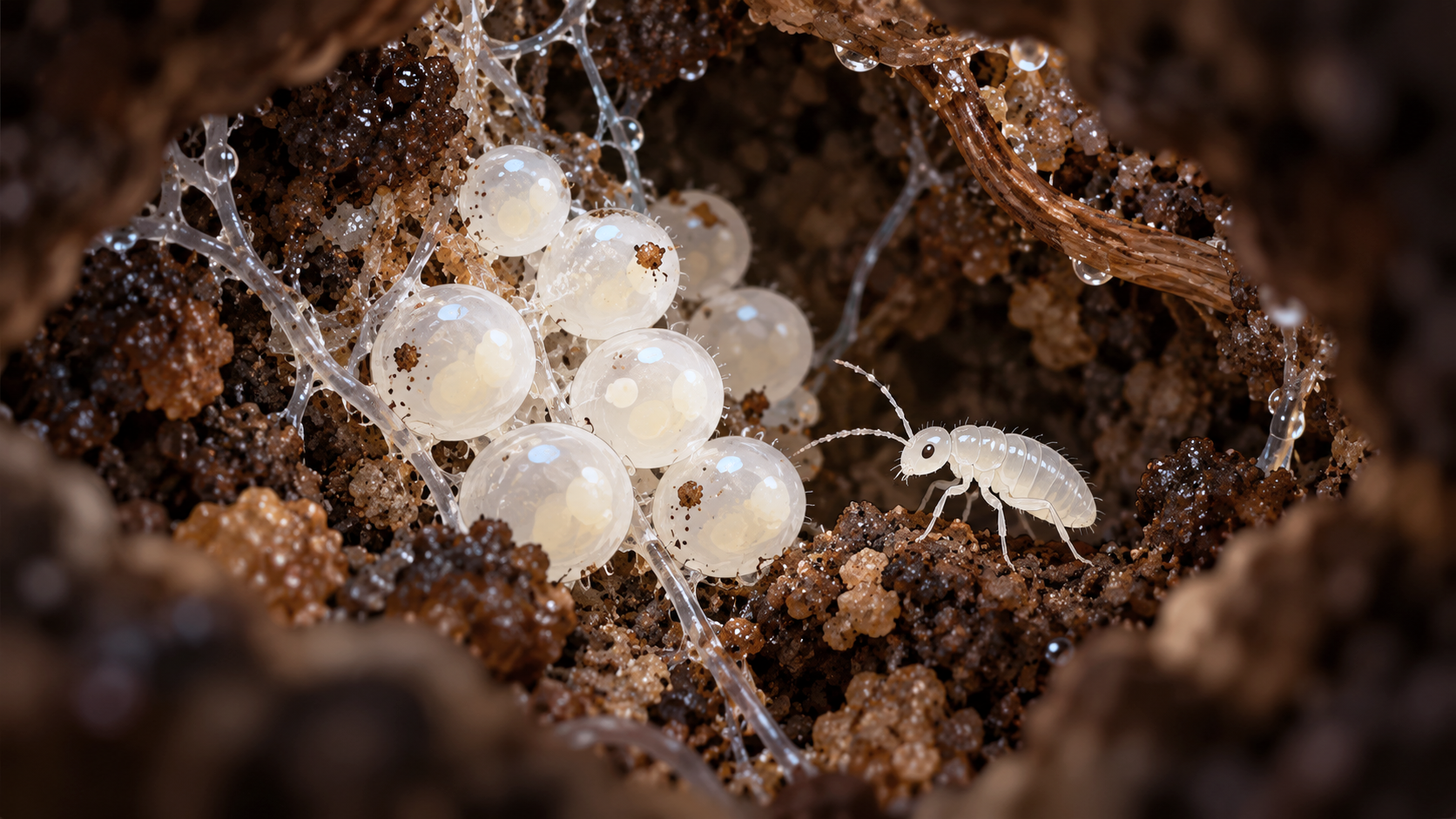
Springtail eggs are easy to overlook even when you know where to search. They are far smaller than the already tiny adults, and their usual location in damp soil makes accidental discovery unlikely. Springtail eggs are tiny and spherical. Depending on the species, females may lay them individually or together in small clusters. They are commonly deposited in moist soil, particularly where organic matter is abundant. At about 0.2 mm across in some springtails, the eggs can be extremely difficult to distinguish without magnification.
Springtail Eggs Are Tiny and Round
The most useful identifying feature is their shape. Springtails lay tiny spherical eggs, rather than the elongated or obviously segmented forms associated with some other small arthropods.
Size makes identification considerably harder. A springtail egg can be around 0.2 mm in diameter, although springtails include many species and egg dimensions should not be treated as identical across the entire group. At that scale, an individual egg is only a tiny speck to the unaided eye.
For comparison, the springtails commonly encountered around homes are often about 1 to 2 mm long. That makes their eggs only a fraction of the size of an adult. Our guide to how big springtails are puts those dimensions into perspective.
Color is less useful as a universal identification feature because egg appearance varies among springtails. In greenhouse-associated species described in one extension guide, females produce smooth, spherical, cream-colored eggs. Shape, size, location, and the presence of springtails nearby therefore make a stronger identification case than color alone.
Springtail Eggs Can Appear Singly or in Clusters
Finding several round specks together does not necessarily mean you have found an egg sac. Springtail females can lay eggs singly or in clusters, depending on the species.
Some species place their eggs together in small groups, while others deposit individual eggs separately. In certain springtails, the female may also cover batches after laying them.
That variation means there is no single arrangement that identifies springtail eggs by itself. A scattered egg and a small cluster can both fit springtail reproduction. Likewise, you should not expect a conspicuous enclosed egg case comparable with the ootheca produced by cockroaches.
This is one reason identifying the adults nearby is useful. Knowing what springtails look like gives you much stronger evidence than trying to identify a microscopic egg from shape alone.
Where You Are Most Likely to Find Springtail Eggs
Location provides one of the best clues. Springtails generally place their eggs in moist environments, and moist soil rich in organic matter can provide particularly suitable conditions.
That matches the habitat used by springtails themselves. They commonly occupy soil, leaf litter, organic mulch, decaying wood, and other moist environments where suitable moisture and organic material are available.
Houseplants are therefore one of the more plausible indoor places to encounter their eggs. Springtails readily inhabit damp potting soil, particularly when the growing medium stays wet. Our guide to springtails in potted plants covers that situation separately.
Springtail Eggs Are Hard to Identify With the Naked Eye
The biggest mistake would be treating every tiny white or cream-colored sphere in soil as a springtail egg. Their appearance is not distinctive enough for that conclusion.
An egg around 0.2 mm across offers very little useful detail to the unaided eye. Even adult springtails can be difficult to inspect closely, and a hand lens can help when identifying springtails.
Instead of relying on an isolated speck, look at the surrounding evidence. Tiny round eggs in persistently moist soil become more meaningful when adult or juvenile springtails are also present. Adults are particularly revealing because many species jump when disturbed, giving you an identification clue that stationary eggs cannot provide.
This approach also helps prevent confusion with other tiny organisms found around houseplants. Fungus gnats, mites, thrips, and other small arthropods can share the same general environment. Our guide to bugs that look like springtails is the better starting point when the moving animals themselves have not yet been identified.
What Happens After a Springtail Egg Hatches?
Springtails do not emerge from their eggs as larvae that look completely different from the adults. Instead, springtail eggs hatch into juveniles that resemble miniature adults, although they are smaller and not yet reproductively mature.
Under suitable conditions, the eggs of some springtails can hatch in about 10 days, but development time depends on temperature and should not be treated as identical for every species. The young then molt repeatedly as they develop.
That transition is covered in more detail in our springtail life cycle guide. For egg identification, the important point is that newly emerged springtails look like much smaller versions of the animals you may already see moving through the soil.
Finding Springtail Eggs Usually Points to a Suitable Habitat
Spotting an adult springtail indoors and finding eggs are not equivalent clues. A lone adult may simply have wandered inside. Eggs indicate that the immediate environment was suitable enough for a female to deposit them there.
Moisture deserves particular attention because springtails depend heavily on humid conditions. Reducing persistent moisture can make indoor areas much less suitable for springtails, while continued dampness can allow populations to remain.
If you suspect eggs in a houseplant, damp basement material, or another humid location, first confirm that springtails are actually present. Then look at why the area remains wet. Our guide to what attracts springtails explains the conditions that can support them around a home.
Other Questions About Springtail Eggs
Can you see springtail eggs without a microscope?
Some springtail eggs may be visible as extremely small specks, but seeing them is different from identifying them confidently. Eggs around 0.2 mm across offer very little useful detail to the unaided eye, so magnification and the surrounding evidence can make identification much more reliable.
Do springtails carry their eggs?
Springtail eggs are deposited into the environment rather than carried around on the adult’s body. Depending on the species, females may lay them individually or in batches.
Can springtail eggs be found in houseplant soil?
Yes. Springtails can live and reproduce in damp potting media, so houseplant soil can provide suitable conditions for eggs. Repeatedly overwatering the growing medium also favors the moist conditions springtails prefer.
Are springtail eggs the same size in every species?
No. Springtails comprise many species with substantial differences in adult size and biology, so one egg measurement should not be applied to the entire group. The commonly cited 0.2 mm measurement is useful for understanding how tiny springtail eggs can be, not as a universal identification rule.
Do springtail eggs jump?
No. The jumping ability belongs to mobile springtails and depends on a forked appendage called the furcula. Eggs are stationary. Once the egg hatches and the juvenile develops, the characteristic springtail body form becomes recognizable.
One thought on “What Do Springtail Eggs Look Like?”