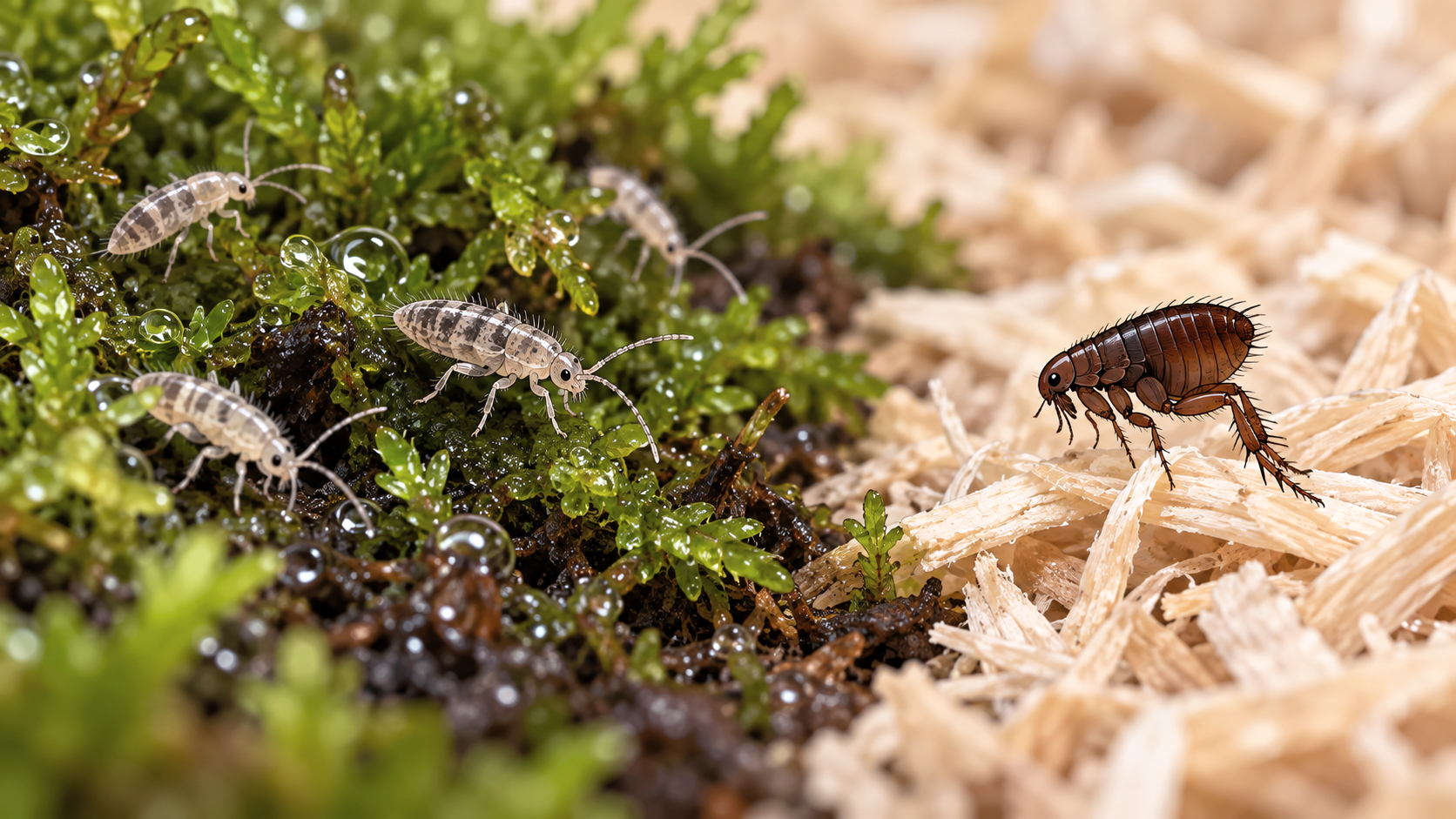
Springtails and fleas can look surprisingly similar when all you see is a tiny dark speck suddenly jumping away. That shared behavior causes much of the confusion, but the two are very different once you know what to check. Springtails are soft-bodied, moisture-loving arthropods that commonly gather around damp soil, bathrooms, basements, and houseplants. Fleas are hard-bodied, blood-feeding insects associated with mammals and birds. The quickest distinction is context: a jumper around persistent moisture points toward springtails, while one associated with pets, animal resting areas, or bites points toward fleas.
Springtails vs. Fleas at a Glance
| Feature | Springtails | Fleas |
|---|---|---|
| Typical household size | Often about 1–2 mm | Usually under 1/8 inch |
| Body | Soft, elongated or rounded | Hard, flattened from side to side |
| Wings | None | None |
| Jump | Yes, in most species | Yes |
| Main jumping structure | Furcula beneath abdomen | Enlarged hind legs |
| Common indoor clue | Moisture | Pets or other animal hosts |
| Bite people | No | Yes |
| Common around houseplants | Yes | Not a typical association |
| Blood feeder | No | Yes |
The table shows why jumping alone is not enough. Both can leap, both are wingless, and their size ranges can overlap. Body shape and where you found the animal are much more useful.
Springtails and Fleas Have Different Body Shapes
Body shape is one of the strongest physical differences once you can get a close look. Springtails are soft-bodied and occur in several forms. Many species have an elongated body with visible antennae, while globular springtails have a compact, rounded appearance. Most springtails that enter homes are about 1 to 2 millimeters long.
Fleas have a much more specialized body. Adult fleas are flattened from side to side, which helps them move through an animal’s hair or fur. Their bodies are also hard and have large hind legs adapted for jumping.
That side-to-side compression is more useful than color. A dark springtail and a dark flea can both look like black specks without magnification. However, a flea viewed closely has the narrow, vertically deep profile associated with moving between hairs, while a typical elongated springtail looks softer and less compressed.
Our guide to what springtails look like covers the different springtail body forms in more detail.
Both Jump, but They Do It Differently
Watching a tiny bug launch itself across a floor may be what creates the confusion in the first place. However, springtails and fleas do not use the same anatomy to jump.
Most springtails have a forked appendage called a furcula folded beneath the abdomen. When released, the furcula strikes against the surface and propels the springtail. This can make a group of disturbed springtails appear to pop in different directions.
Fleas rely on their legs instead. Their enlarged hind legs provide the jumping power that lets adults move onto animal hosts. Neither animal needs wings to get airborne.
There is one important exception on the springtail side. Some soil-dwelling species have a reduced or absent furcula and cannot make the familiar jump. So jumping can support a springtail identification, but failure to jump does not eliminate every springtail. Our guide to how springtails jump explains that mechanism separately.
Where You Found Them May Solve the Mystery Faster
A specimen’s surroundings can be more revealing than trying to judge a one-millimeter body with your naked eye.
Springtails need moist environments. Indoors, they commonly appear around plumbing leaks, damp basements, bathrooms, kitchens, and overwatered houseplant soil. Outdoors, they occur in soil, leaf litter, mulch, compost, and decaying organic material.
Fleas have a different ecological connection. The cat flea, Ctenocephalides felis, is the most common flea infesting cats and dogs, and it can also feed on humans and other animals. Flea eggs can fall from a host into bedding, carpeting, floor cracks, and other places where the animal spends time.
This gives us a useful identification rule. Hundreds of tiny jumpers appearing on wet potting mix immediately after watering fit springtails extremely well. Repeated jumping insects around a pet’s sleeping area deserve serious consideration as fleas instead.
For a broader look at the first situation, see our guide to springtails in potted plants.
Fleas Bite, Springtails Do Not
This difference matters more than the superficial resemblance between the animals. Springtails do not bite or sting people or animals. They primarily live around moisture and organic material rather than seeking a blood meal.
Adult fleas are blood feeders. They possess piercing-sucking mouthparts and feed on animal hosts, including cats, dogs, rodents, birds, and other mammals. Fleas can also bite people.
Because of that difference, a jumping creature should not automatically get blamed for unexplained skin irritation just because springtails are present nearby. Finding springtails in a damp bathroom and having skin marks at the same time does not establish that the springtails caused them. Our article on whether springtails bite humans deals with that question directly.
Likewise, bites alone do not identify fleas. Identifying the actual pest and checking the surrounding environment provides stronger evidence than trying to identify a tiny arthropod solely from a skin reaction.
Crushing Them Reveals Another Difference
A less obvious clue is what happens when you physically press the specimen.
Springtails have soft bodies and are relatively easy to crush. Fleas have a hard exterior and are noticeably more difficult to crush between your fingers. That distinction is useful because the animals may otherwise be too small to compare comfortably without magnification.
We would not use this as the first identification method, though. A hand lens or a clear close-up photograph gives you much more information without destroying the specimen. Look for the flea’s side-flattened body and enlarged hind legs, or the springtail’s antennae and characteristic body form.
If the animal is too small to identify confidently, preserving it on clear tape or in a small sealed container can also make later examination easier.
A House Full of Springtails Points to a Different Problem Than Fleas
Correct identification matters because the reason each animal is indoors is different.
Large numbers of springtails are strongly associated with moisture. Persistent indoor populations therefore justify checking for damp soil, condensation, plumbing leaks, drainage problems, wet building materials, or other sources of excess moisture. Our guide to what attracts springtails explores those conditions in detail.
A flea problem shifts the investigation toward animals and the places they rest. Adult fleas spend much of their time associated with hosts, while immature stages can develop away from the animal in its environment. That is why simply comparing two jumping adults is only the beginning of the diagnosis.
This is the practical difference we think matters most. Misidentifying springtails as fleas can send you searching pets and carpets while the actual clue is excess moisture. Mistaking fleas for springtails can make a real animal-associated pest problem look like nothing more than a damp-room nuisance.
What to Check When You Find a Tiny Jumping Bug
Start with where you found it. A sink, bathtub, damp basement wall, wet windowsill, or flowerpot strongly supports springtails, especially when many tiny individuals appear together. Pet bedding, carpets where an animal regularly rests, and the animal itself make fleas more plausible.
Then inspect the body under magnification. A hard insect compressed from side to side with prominent hind legs fits a flea. A soft-bodied animal with springtail characteristics fits Collembola. If several specimens are available, compare more than one rather than relying on an unusually shaped or damaged individual.
Once springtails are the stronger match, the next useful step is figuring out whether you have occasional visitors or a persistent moisture problem. Our guide to the signs of a springtail infestation can help with that distinction.
Other Questions About Springtails and Fleas
Can springtails live on dogs or cats like fleas?
No. Springtails are not animal parasites and do not establish themselves in a pet’s coat as fleas do. Finding springtails near a pet does not turn them into a flea-like parasite.
Can fleas live in a house without a dog or cat?
Yes. Fleas can be associated with other animal hosts, including rodents and wildlife. A home without a dog or cat therefore cannot rule out fleas solely on that basis.
Are all tiny bugs jumping in a flowerpot springtails?
No. Jumping is useful evidence, but it is not an identification by itself. Examine the animal’s body and consider the surrounding conditions before deciding. Our broader guide to bugs that look like springtails covers additional possibilities.
Can springtails and fleas be in the same home?
Yes. Their presence is not mutually exclusive because they occupy homes for different reasons. A moisture problem can support springtails while an animal-associated flea population exists elsewhere in the same building.
Are springtails actually a type of flea?
No. The nickname “snow flea” can make this confusing, but snow fleas are springtails, not true fleas. Springtails belong to Collembola, while true fleas are insects in the order Siphonaptera.
One thought on “Springtails vs. Fleas: How to Tell the Difference”