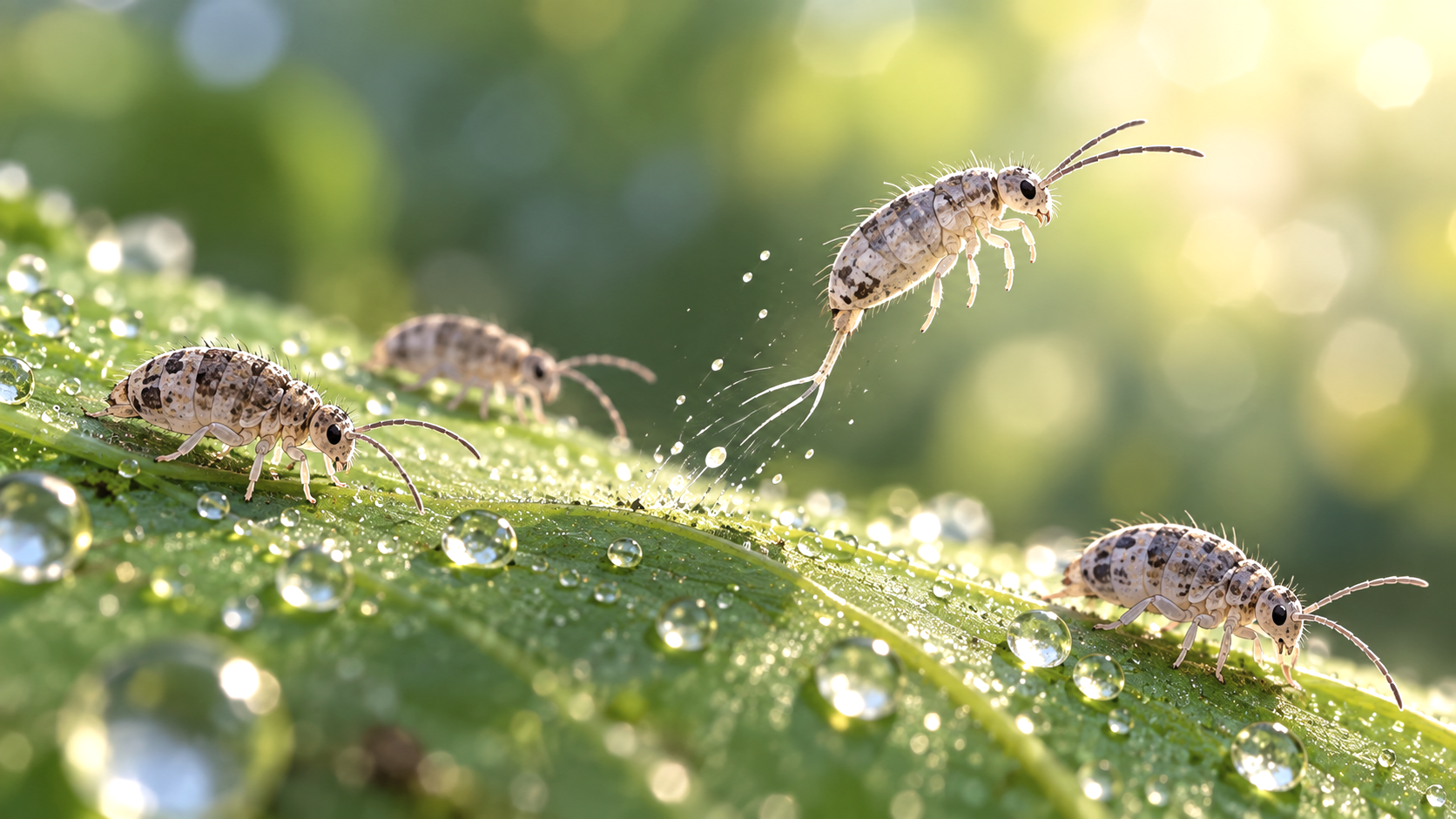
A tiny speck on a bathroom floor can disappear the instant you try to touch it. It may look as though it flew away, but springtails have a much stranger way of escaping. Springtails can jump. They launch themselves with a forked appendage called a furcula, which normally folds underneath the abdomen. When released, the furcula snaps against the surface and propels the springtail into the air. Springtails can also crawl, but they have no wings and cannot fly.
Springtails Jump With a Furcula
The springtail’s famous jump starts underneath its abdomen. Most springtails have a forked appendage called a furcula, which folds forward beneath the body when it is not being used.
A small clasp-like structure called the tenaculum holds the furcula in position. When the springtail releases it, the furcula snaps downward and propels the body into the air. That sudden launch is the movement that gave springtails their common name.
Because the furcula sits underneath such a tiny animal, you probably will not see it while watching a springtail on your floor. A hand lens or close macro photograph is much more useful for seeing the structure itself. From normal viewing distance, what you notice is the result: one moment the springtail is there, and the next it has jumped somewhere else.
This mechanism also explains why the movement can look so abrupt. The springtail does not need a running start before leaving the surface.
How Far Can Springtails Jump?
For an animal that can be barely more than a moving speck, the jump is substantial. Household springtails are commonly only 1 to 2 millimeters long, yet the furcula can propel a springtail many times its own body length.
Some household guides describe springtails as capable of jumping several inches. The exact distance you see will not be identical for every springtail or every jump.
That relative scale is what makes the movement look so dramatic. An animal that is already difficult to follow with your eyes can suddenly leave the tiny area you were watching.
This also makes jumping distance a poor way to estimate how big a springtail actually is. Its launch can cover far more space than its body size would suggest.
Springtails Do Not Jump With Their Legs
This is the easiest part of springtail movement to misunderstand. Watching one launch without magnification gives you almost no chance to see what happened underneath it.
Springtails have six legs, but their characteristic jump comes from the furcula rather than a powerful pair of jumping legs. The fork-like structure releases from beneath the abdomen and pushes against the surface, sending the animal away.
That separates the springtail’s launch mechanism from the way a flea jumps. A flea uses its hind legs to propel itself, while a springtail relies on its abdominal springing organ.
The difference is useful when identifying an unknown jumping speck. Jumping alone does not prove that you found a springtail, because other tiny arthropods jump too. Our springtails versus fleas comparison covers the physical differences that can settle the identification.
A Springtail’s Jump Is More Like a Launch Than a Controlled Hop
Calling the movement a “jump” can make it sound more controlled than it is. A springtail uses the furcula to propel itself rapidly away from the surface rather than making a precise leg-powered leap toward a carefully chosen landing point.
The mechanism is especially useful when the animal is disturbed. Springtails can snap the furcula downward when disturbed, producing the sudden movement people notice when they touch the soil, move debris, or approach the animal.
This is why a springtail may seem to vanish instead of following an obvious arc through the air. Its body is so small and the movement happens so quickly that following the entire launch with your eyes can be difficult.
That behavior can actually help with identification. A tiny speck that abruptly flings itself away after being disturbed fits springtail behavior better than one that simply walks away.
Springtails Crawl When They Are Not Jumping
Springtails do not bounce continuously from place to place. They also use their six legs for ordinary movement.
In fact, springtails crawl slowly when moving normally. Jumping provides another form of locomotion, particularly when they are disturbed.
You may therefore see completely different movement from the same population. Springtails around damp concrete can appear to crawl, while touching or disturbing them causes several individuals to spring away. Springtails in soil may similarly move across the surface before suddenly launching when the soil or nearby material is disturbed.
This is useful when checking signs of a springtail infestation. A mass of tiny crawling specks does not stop being consistent with springtails simply because none happens to jump while you are watching.
Springtails Cannot Fly
A springtail’s jump happens so quickly that it can easily be mistaken for flight. However, springtails are wingless.
They do not have wings and cannot fly. Once a springtail has launched itself, it does not continue flying around the room under its own power.
That gives you a useful observation to make. A tiny animal that suddenly springs away from your finger could be a springtail. One that takes off and remains airborne under powered flight is something else.
Fungus gnats are one possible source of confusion around damp houseplant soil because their adults can fly. Our guide to springtails versus fungus gnats covers that distinction in more detail, while whether springtails can fly deals specifically with the flight question.
Why Springtails Jump When You Disturb Them
The springtail’s launch provides a rapid way to get away from a disturbance. The furcula can propel the animal through the air far more abruptly than simply crawling away.
You can see why that matters when you consider their scale. Springtails are extremely small and commonly live among soil, leaf litter, organic debris, and other complicated surfaces. A quick launch can move the animal away from its immediate position in an instant.
The reaction is easy to trigger while trying to inspect one. Springtails commonly appear to jump or fling themselves when disturbed, which is why poking at an unknown speck can provide a useful behavioral clue.
Still, we would not identify a springtail from that test alone. Jumping should be combined with the animal’s size and physical characteristics. The full set of visual clues is covered in our guide to what springtails look like.
Why Some Springtails May Not Jump When You Watch Them
Finding an animal that looks like a springtail but refuses to jump does not automatically rule out the identification. Jumping is one form of springtail movement, not their only way of getting around.
They can simply crawl across a surface. Also, the furcula itself is not equally obvious when looking at every springtail without magnification. What you see during a casual inspection is often the animal walking normally rather than performing its characteristic escape response.
For identification, movement works best as positive evidence rather than an absolute test. Seeing the animal suddenly spring away strongly supports a springtail identification when its other features match. Failing to see one jump during a brief observation tells you much less.
That distinction prevents a common mistake: repeatedly disturbing an unknown tiny arthropod and assuming it cannot be a springtail because it did not immediately launch.
Use the Jump as an Identification Clue, Not the Whole Identification
Springtail movement is distinctive enough to narrow down what you are looking at, especially when tiny specks suddenly scatter from damp soil or a wet surface. However, several unrelated arthropods can jump.
Start with the movement, then check the body. Springtails are tiny, wingless, six-legged arthropods with antennae, while body shape varies from elongated to rounded forms. Their colors also vary considerably, so neither jumping nor color should carry the identification alone.
Location can add another clue. Springtails thrive in moist environments, which helps explain why people often notice their movement around damp soil, bathrooms, sinks, concrete, and other moisture-prone areas.
When the animal remains too small to examine properly, a close photograph or hand lens is more useful than trying to make it jump repeatedly. That lets you combine movement with actual anatomy instead of relying on one dramatic behavior.
Other Questions About How Springtails Move
Can springtails jump on water?
Springtails can occur on the surface of water, and some species are commonly seen gathered there. Their small size and springing ability can make movement across these surfaces particularly noticeable.
Do baby springtails jump?
Immature springtails resemble smaller versions of adults, but the prominence and function of the furcula can vary among springtail groups and developmental stages. Movement alone should not be used to determine whether an individual is an adult or immature springtail.
Can springtails climb walls?
Springtails can crawl across surfaces and are frequently found moving around structures when moisture conditions suit them. Seeing tiny arthropods above floor level therefore does not rule out springtails.
Why do several springtails jump at once?
A shared disturbance can trigger multiple nearby springtails to launch in quick succession. In a dense group, that can make the surface appear to flicker or scatter as several tiny animals move almost simultaneously.
Can a springtail jump onto a person?
A springtail can launch in a direction that happens to bring it onto clothing or skin. The jump is a movement response, not evidence that the springtail is targeting a person.
13 thoughts on “Can Springtails Jump? How They Actually Move”