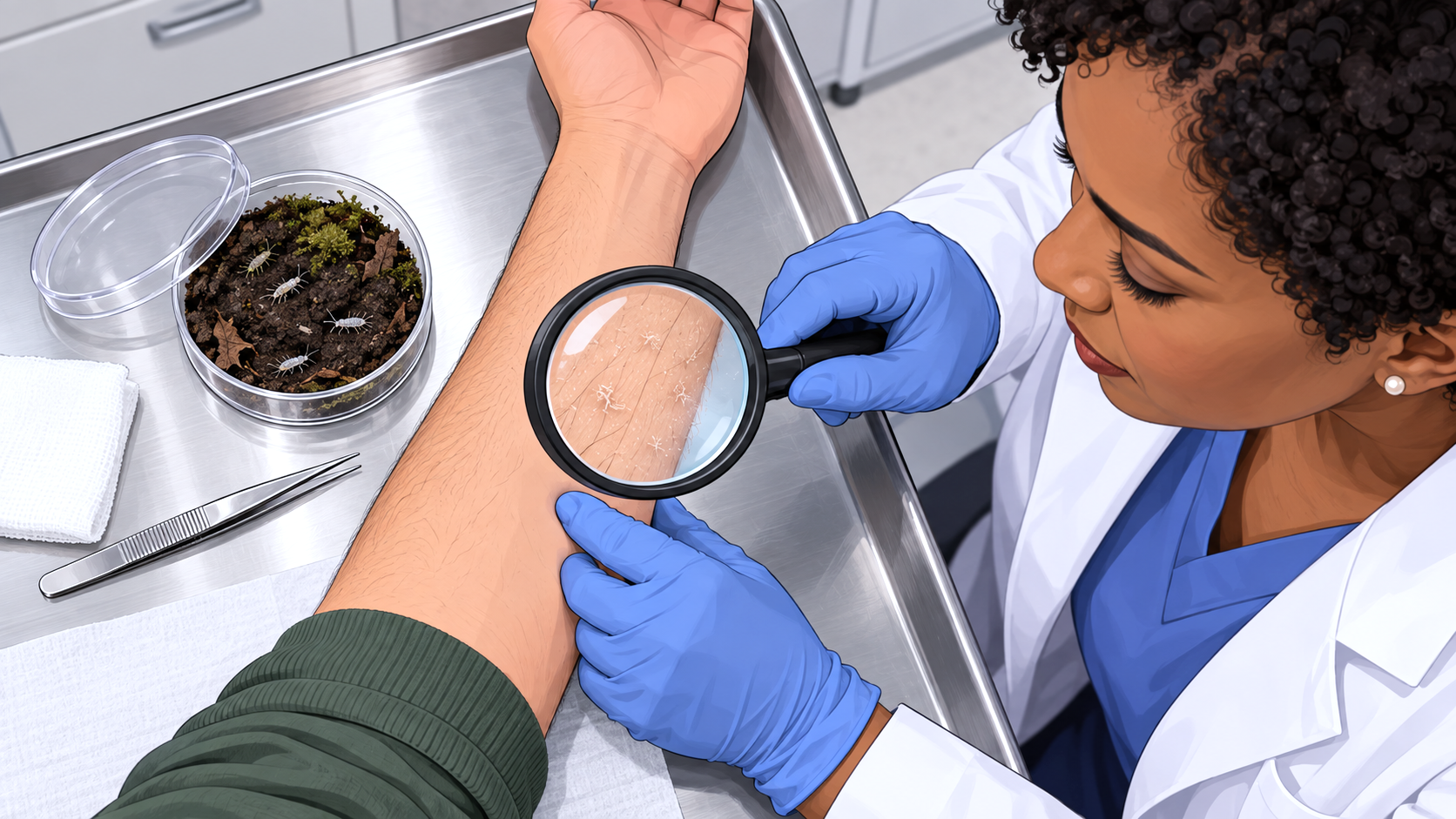
Search for springtails and humans long enough and you will eventually encounter alarming claims about these tiny arthropods living in skin, hair, wounds, or even inside the body. That makes “springtail infestation in humans” sound like a recognized parasitic condition. It is not. Springtails do not live on humans as parasites and do not establish human infestations. They cannot bite or sting people, and their normal habitats are moist soil, leaf litter, decaying organic matter, and similarly damp environments. Claims that springtails routinely infest human skin are not supported by reliable entomological or medical evidence.
The confusion deserves more explanation than simply calling springtails harmless. Some published reports have connected Collembola with human skin complaints, which is one reason the claim continues to circulate. The quality of that evidence matters.
Springtails Are Not Human Parasites
A parasite needs a biological relationship with its host. Fleas feed on blood. Head lice live among human hair and feed from the scalp. Scabies mites burrow into the skin. Springtails have no comparable relationship with people.
Springtails, collectively classified as Collembola, are soil-associated arthropods. Most live where moisture and organic material are readily available. The majority feed on fungi, algae, bacteria and decaying plant material, although diets vary among species. Their biology is built around those environments rather than a vertebrate host.
That distinction is important because simply finding an arthropod on a person does not make it a parasite. A springtail could land on skin or clothing after being disturbed, just as an ant or small fly could. It does not follow that the animal can remain there, reproduce there, or use the person as its habitat.
This is also why the term “human springtail infestation” is misleading when it implies an infestation of the body. Springtails can occur in enormous numbers in the environment around a person without colonizing that person’s skin.
Springtails Cannot Bite or Feed on Human Blood
A human-infesting arthropod normally needs some way to obtain what it needs from its host. Springtails do not have that relationship with us.
Springtails cannot bite and are considered harmless to humans. They also do not sting. Their feeding biology centers primarily on the microorganisms and organic materials found in moist environments, not blood or human tissue.
That makes them fundamentally different from several tiny arthropods people commonly worry about. A jumping speck can be mistaken for a flea, while an unexplained skin sensation may lead someone to suspect mites or another tiny pest. Appearance and symptoms alone can therefore send an identification in the wrong direction.
Our guide to whether springtails bite humans deals specifically with the bite question. When an actual specimen is available, what springtails look like and their characteristic jumping behavior are much more useful for identification than trying to identify them from a skin mark.
Why Do People Claim Springtails Live in Human Skin?
This is where the subject becomes more complicated. Reports connecting Collembola with human skin complaints do exist in the scientific literature. However, a report of springtails being associated with symptoms is not the same thing as demonstrating that springtails can parasitize humans.
One investigation examined two people whose dermatitis was suspected to involve springtails. Testing did not demonstrate the proposed allergic reactions to the springtails. The researchers concluded that other organisms or organic material in the same moist environment could instead have caused the dermatitis.
An especially influential claim came from research that purported to find Collembola in people who reported unexplained skin infestation. The evidence depended on digitally enhanced images rather than intact springtails recovered as parasites from human tissue. A later scientific critique found unacceptable manipulation in an image presented as evidence of a Collembola skin infestation.
That history explains part of the contradiction you may encounter online. The existence of a published claim does not establish springtails as human parasites, particularly when the evidence underlying that claim did not withstand later scrutiny.
Can Springtails Crawl on Your Skin?
Yes. This is entirely different from living on you.
A springtail can physically crawl across exposed skin if you encounter one. These arthropods can also jump when disturbed using the furcula beneath the body. Someone sitting near damp soil, handling a houseplant, gardening, or standing near a large outdoor population could therefore have incidental contact with one.
The springtail has not infested the person in that situation. It is simply an environmental arthropod temporarily on a surface that happens to be human skin.
This distinction becomes particularly useful during a household outbreak. Springtails sometimes appear indoors in substantial numbers, especially around moisture. They are commonly associated with high-moisture areas and organic debris, including bathrooms, basements and houseplant soil. Someone surrounded by hundreds of tiny springtails may understandably feel as though the insects are everywhere, but their abundance in the room does not change their biology into that of a human parasite.
Springtails Do Not Live in Human Hair
Hair does not turn humans into suitable springtail habitat either. Springtails do not have the host relationship that allows head lice to remain on a person’s scalp and reproduce.
A springtail could accidentally end up in someone’s hair after outdoor activity or contact with an infested environment. That possibility should not be confused with establishing a population there. The same distinction applies to clothing. Temporary contact is possible, while parasitic colonization is not.
When tiny animals repeatedly appear around a person, it is more useful to identify where they are actually coming from. Springtails need moisture and are commonly associated with soil, leaf litter, decaying material and damp areas. Our guide to what attracts springtails covers the environmental conditions behind indoor populations.
Finding the source also helps separate a genuine household springtail problem from an assumed problem on the body.
Skin Symptoms Do Not Prove Springtails Are Responsible
Itching, crawling sensations, bumps and skin irritation are real symptoms, but they cannot identify the cause by themselves. This is one of the most important distinctions in the entire springtail-human question.
A person can have a genuine skin problem while being wrong about what caused it. The reverse is also possible: a real arthropod infestation can occur, but the responsible organism may be lice, mites, fleas, bed bugs, or something else rather than springtails. Skin symptoms therefore require medical evaluation when they persist or become severe, not identification based solely on an internet image.
The same caution applies when springtails are actually present in the home. Their presence establishes that springtails are in the environment. It does not establish that they caused an accompanying rash, lesion, itch, or crawling sensation.
Research specifically investigating suspected springtail dermatitis has failed to establish the proposed reaction in tested patients. Meanwhile, household guidance consistently describes springtails as non-biting and harmless to people. Those are much stronger grounds for interpreting a suspected case than the simple coincidence of skin symptoms and springtails appearing in the same building.
Where “Delusional Infestation” Fits Into This Discussion
The subject needs careful wording because unexplained crawling sensations and skin symptoms should never be dismissed simply because springtails are an unlikely cause.
Delusional infestation is a recognized medical condition in which a person has a fixed belief that the body or skin is infested despite the absence of objective evidence supporting an infestation. It can involve reports of insects, worms, fibers, or other materials. The diagnosis is about the unsupported belief in infestation, not about springtails specifically.
In one large clinical study of people diagnosed with delusional skin infestation, researchers examined biopsies and samples that patients brought with them. None of the 80 skin biopsies demonstrated an infestation. Some patient-provided samples contained insects, but almost all of those insects were noninfesting species.
That does not mean every unexplained skin sensation is psychological. Medical conditions, genuine arthropod infestations and other causes have to be evaluated appropriately. Jumping immediately from “springtails cannot infest people” to “the symptoms are imaginary” would be just as careless as assuming springtails caused them.
A Real Springtail Problem Can Still Exist in the Home
There is another reason this topic gets muddled. Someone can be completely correct that springtails are invading the house while being incorrect that those springtails are living on their body.
Indoor springtails commonly point toward an environmental moisture issue. Bathrooms, kitchens, basements and areas around plumbing can provide the damp conditions they need. Houseplant soil is another frequent source. During certain weather conditions, large outdoor populations can also move toward and into buildings.
So, a photograph or collected specimen confirmed as a springtail should not simply be ignored. It tells you what arthropod is present and gives you somewhere useful to direct your attention. Check damp areas and investigate the source rather than treating your skin.
Our guides to signs of a springtail infestation and how springtails get into a house can help separate an environmental infestation from the very different claim that a person is infested.
What to Do If You Think Springtails Are on Your Body
Start with identification rather than treatment. When you can see an actual arthropod, capture an intact specimen without crushing it. A clear specimen gives an entomologist, pest professional, or other qualified identifier something objective to examine. Our guide to bugs that look like springtails can also help with the initial comparison.
Avoid applying household pesticides to your skin. Products intended for floors, foundations, plants, or other surfaces are not automatically appropriate for human use. Likewise, repeatedly treating the home without identifying an environmental springtail source can leave the moisture problem untouched.
Persistent itching, lesions, rashes, or crawling sensations belong with a healthcare professional, regardless of whether springtails have been found nearby. Bring an intact specimen or clear photograph if you have one. That approach takes both possibilities seriously: a real skin problem deserves medical attention, while a real springtail population deserves correct identification and environmental control.
Other Questions About Springtails and the Human Body
Can springtails live inside the human body?
Springtails are not human endoparasites. Their normal life cycle takes place in environmental habitats rather than inside a human host. A claim that a springtail population is reproducing internally should not be treated as an ordinary springtail infestation.
Can springtails lay eggs on people?
Human skin is not the normal reproductive habitat of springtails. Their eggs and immature stages develop in suitable environmental habitats, especially moist ones. You can see what their eggs actually look like in our guide to springtail eggs.
Can springtails get into an open wound?
An outdoor arthropod can accidentally contact exposed skin or a wound, but that is not the same as parasitic infestation. A wound that contains foreign material, shows signs of infection, or is not healing properly needs medical assessment rather than DIY pest treatment.
Can springtails follow a person from one home to another?
Springtails are environmental pests rather than human hitchhiking parasites. When they appear in a building, moisture and suitable habitat are the important factors to investigate. Their presence should not be interpreted as evidence that a particular person is carrying an infestation.
Can you test a home for springtails?
Visible specimens can be collected for identification when you are unsure what the tiny arthropods are. Once springtails are confirmed, concentrate on where they repeatedly appear and the moisture conditions in that location. That gives you more useful information than trying to diagnose an infestation from skin sensations alone.