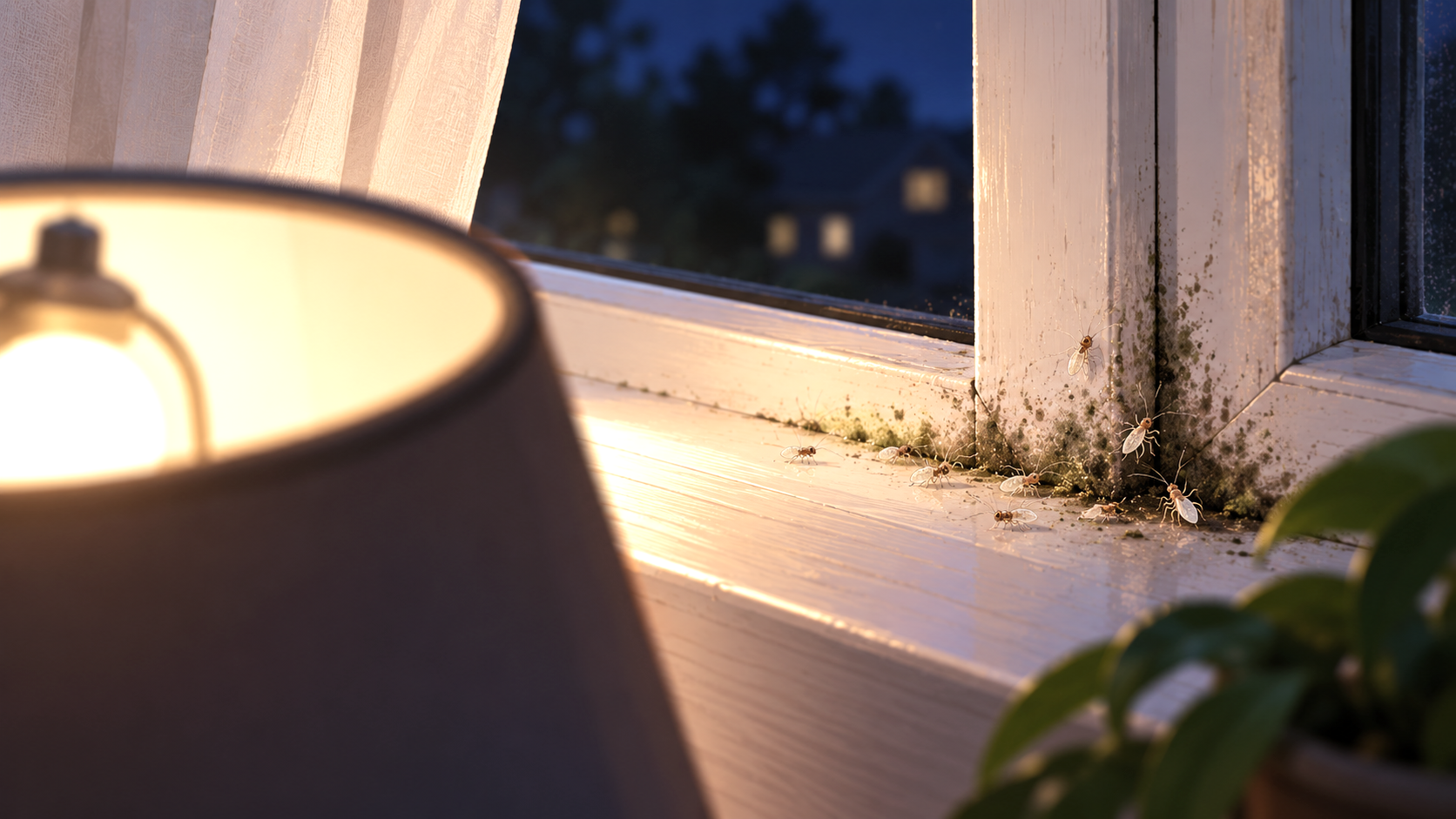
Are booklice attracted to light? The response varies among species and can differ between males and females. Some tested booklice moved toward ultraviolet, green, or white light, while another species showed no attraction to the wavelengths tested. Light is therefore neither a universal booklouse lure nor a reliable identification test. Seeing several tiny insects on a bright windowsill can make the answer appear obvious. Yet the window adds moisture, temperature, airflow, and visibility to the scene. Light is only one possible influence, and often it is not the most useful onea.
Booklice Do Not Share One Light Response
Laboratory research tested three stored-product species against six light-emitting diode wavelengths. Male and female Liposcelis entomophila showed no attraction to any wavelength tested. Female Liposcelis paeta responded to ultraviolet light at 351 and 400 nanometers and to green light at 527 nanometers, while males did not respond. Both sexes of Liposcelis brunnea responded to all six wavelengths. The species-by-species results rule out a single answer for all booklice.
The white-light trial was equally specific. Females of L. paeta and L. brunnea preferred white light over an unlit control, but L. entomophila females did not. The complete experimental summary also identifies 351-nanometer ultraviolet light as the most broadly attractive wavelength in that study, not as a universal lure.
These were controlled tests involving stored-product pests. They do not prove that every household species will approach a lamp, nor that ordinary room lighting reproduces the experimental response. The common name covers multiple insects, which is why booklice classification matters when behavior is discussed.
A Bright Windowsill Can Mislead You
Windows are complicated microhabitats. Condensation may dampen wood, paint, drywall, wallpaper, dust, or nearby cardboard. Microscopic fungi can grow on those materials, giving booklice food. Indoor populations are strongly associated with humid areas and fungal growth, so moisture may explain the cluster even when every insect sits in daylight.
The surface also improves visibility. A moving insect that vanishes against patterned flooring becomes obvious against white trim. Air currents can carry tiny arthropods toward the window, and cracks around the frame can connect the sill with a damp wall void. None of those routes requires attraction to light.
Outdoor psocids add another source of confusion. Some possess wings and may arrive from vegetation, bark, or leaf litter. Household booklice are usually wingless, but psocids as a group include winged and wingless forms. A specimen near glass should be identified before the window is blamed for an indoor infestation.
Light Traps Are Not a Household Solution
The light-response research was designed to improve monitoring of stored-product psocids. It showed that a wavelength capable of attracting one species may fail with another. Sex also changed the response in L. paeta. A desk lamp or ultraviolet device cannot be assumed to collect the booklice present in a home.
Even successful attraction would not remove the conditions sustaining the population. Booklice feed on fungi, algae, and organic debris rather than light. Turning lamps off leaves condensation, leaks, damp wall coverings, and mold untouched. Leaving a lamp on may collect a few insects without reaching eggs or concealed nymphs.
Moisture control has a firmer basis. Household populations decline when the damp environment and fungal food are removed. Correcting humidity and water problems addresses the cause, while manipulating light addresses an inconsistent behavior. Our booklice humidity guide explains how the two are connected indoors.
Inspect What Surrounds the Light
Check the frame, sill, wall edge, curtain, and nearby plant pots for moisture. Watch whether condensation forms at a particular time, and measure relative humidity instead of judging the room by feel. Also inspect stored paper and food close to the window. Booklice can be introduced with damp or infested materials rather than drawn across the room by brightness.
Photograph or capture one specimen for magnified identification. Its head, antennae, wings, and body shape provide stronger evidence than where it stopped. Once booklice are confirmed, the practical response is to dry the habitat and remove mold-affected material.
Other Questions About Booklice and Light
Does ultraviolet light attract all booklice?
No. Tested species responded differently, and one showed no attraction to any wavelength in the experiment. Ultraviolet attraction cannot be assigned to every booklouse.
Why do booklice appear more visible during the day?
Daylight increases contrast on pale walls, paper, and sills. Because booklice are only about 1 to 2 millimeters long, a brighter background can reveal insects that were present but overlooked.
Will closing blinds stop booklice from gathering at a window?
Blinds do not remove humidity or fungal growth. They may also conceal recurring condensation, so the frame still needs inspection.
Are booklice afraid of sudden light?
There is no single documented response that applies to every species. An insect running when a lamp switches on may be reacting to disturbance rather than avoiding light.
Does finding booklice near a lamp mean they are nocturnal?
No. Attraction to a light source and activity at night are separate behaviors. The evidence behind whether booklice are nocturnal is also species-specific.
One thought on “Are Booklice Attracted to Light?”